



 Chat with AI
Exam 48: Gas Exchange

Exam 1: Studying Life246 Questions
Exam 2: Small Molecules and the Chemistry of Life246 Questions
Exam 3: Proteins, Carbohydrates, and Lipids246 Questions
Exam 4: Nucleic Acids and the Origin of Life246 Questions
Exam 5: Cells: the Working Units of Life248 Questions
Exam 6: Cell Membranes246 Questions
Exam 7: Cell Communication and Multicellularity246 Questions
Exam 8: Energy, Enzymes, and Metabolism246 Questions
Exam 9: Pathways That Harvest Chemical Energy246 Questions
Exam 10: Photosynthesis: Energy From Sunlight242 Questions
Exam 11: The Cell Cycle and Cell Division260 Questions
Exam 12: Inheritance, Genes, and Chromosomes250 Questions
Exam 13: Dna and Its Role in Heredity257 Questions
Exam 14: From Dna to Protein: Gene Expression252 Questions
Exam 15: Gene Mutation and Molecular Medicine251 Questions
Exam 16: Regulation of Gene Expression245 Questions
Exam 17: Genomes249 Questions
Exam 18: Recombinant Dna and Biotechnology243 Questions
Exam 20: Mechanisms of Evolution243 Questions
Exam 21: Reconstructing and Using Phylogenies246 Questions
Exam 22: Speciation247 Questions
Exam 23: Evolution of Genes and Genomes252 Questions
Exam 24: The History of Life on Earth246 Questions
Exam 25: Bacteria, Archaea, and Viruses262 Questions
Exam 26: The Origin and Diversification of Eukaryotes252 Questions
Exam 27: Plants Without Seeds: From Water to Land251 Questions
Exam 28: The Evolution of Seed Plants259 Questions
Exam 29: The Evolution and Diversity of Fungi261 Questions
Exam 30: Animal Origins and the Evolution of Body Plans248 Questions
Exam 31: Protostome Animals244 Questions
Exam 32: Deuterostome Animals246 Questions
Exam 33: The Plant Body243 Questions
Exam 34: Transport in Plants248 Questions
Exam 35: Plant Nutrition247 Questions
Exam 36: Regulation of Plant Growth246 Questions
Exam 37: Reproduction in Flowering Plants247 Questions
Exam 38: Plant Responses to Environmental Challenges246 Questions
Exam 39: Physiology, Homeostasis, and Temperature Regulation258 Questions
Exam 40: Animal Hormones249 Questions
Exam 41: Immunology: Animal Defense Systems265 Questions
Exam 42: Animal Reproduction261 Questions
Exam 43: Animal Development261 Questions
Exam 44: Neurons, Glia, and Nervous Systems250 Questions
Exam 45: Sensory Systems249 Questions
Exam 46: The Mammalian Nervous System: Structure and Higher Functions254 Questions
Exam 47: Musculoskeletal Systems259 Questions
Exam 48: Gas Exchange247 Questions
Exam 49: Circulatory Systems252 Questions
Exam 50: Nutrition, Digestion, and Absorption259 Questions
Exam 51: Salt and Water Balance and Nitrogen Excretion251 Questions
Exam 52: Animal Behavior249 Questions
Exam 53: The Physical Environment and Biogeography of Life248 Questions
Exam 54: Populations259 Questions
Exam 55: Species Interactions254 Questions
Exam 56: Communities247 Questions
Exam 57: Ecosystems238 Questions
Exam 58: A Changing Biosphere222 Questions
Select questions type


Which process regularly exposes a respiratory membrane to maximum O2 and minimum CO2?
(Multiple Choice)
4.9/5  (80)
(80) Refer to the graph showing ventilation rates in a human. 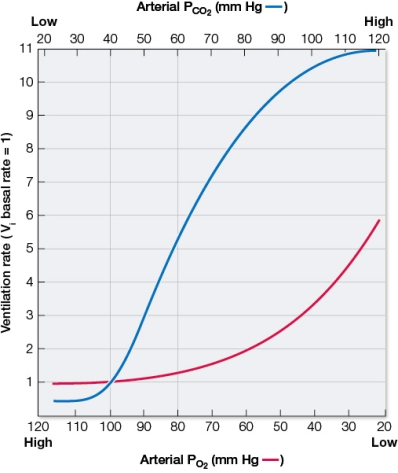 Based on the graph, an increase in arterial partial pressure of CO2 increases a person's ventilation rate more than a(n) _______ in arterial partial pressure of O2.
 (Short Answer)
4.9/5 (77)
(77) Refer to the graph showing a spirometer tracing. 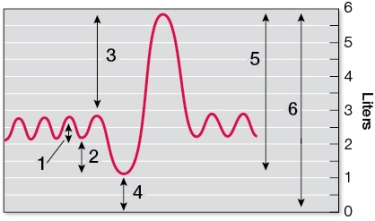 Suppose that you have been resting on the couch while watching a 30-minute TV show; you test your airflow with a spirometer and record the tracing shown in the graph.From this, you see that while you are breathing normally without added effort, you are moving approximately _______ of air into your lungs when you breathe in (inhale) and approximately _______ of air out of your lungs when you breathe out (exhale).
 (Multiple Choice)
4.8/5 (71)
(71) The solubility of oxygen in water _______ as the temperature of water _______.
(Multiple Choice)
4.8/5 (89)
(89) The shape of the O2-binding/dissociation curve of hemoglobin is _______.
(Short Answer)
4.8/5 (69)
(69) When humans take short trips to places of high altitude, their hemoglobin
(Multiple Choice)
4.7/5 (73)
(73) The level of _______ in the blood controls the breathing rate of humans via changes in pH.
(Multiple Choice)
4.8/5 (77)
(77) Which part of the blood is most efficient at carrying oxygen?
(Multiple Choice)
4.9/5 (87)
(87) Which is a reason that diffusion of CO2 from an animal is less problematic than diffusion of O2 into an animal?
(Multiple Choice)
4.8/5 (87)
(87) Which statement about the binding of oxygen by hemoglobin is true?
(Multiple Choice)
4.8/5 (82)
(82) Antarctic icefish lack both red blood cells and hemoglobin.Scientists are worried that as global climate change warms the Southern (Antarctic) Ocean, these fish will not survive.Why is it likely that Antarctic icefish will not survive in warmer water?
(Essay)
4.8/5 (81)
(81) In analyzing a drop of blood from a capillary leaving a muscle in a person, a researcher finds that most of the CO2 is in the form of _______ carried in the plasma.
(Short Answer)
4.8/5 (85)
(85) The barometric pressure at sea level is 760 mm Hg.Because of the relatively high altitude of Antonito, Colorado, the town has a normal barometric pressure of about 600 mm Hg.The partial pressure of O2 in Antonito's air is therefore approximately _______ mm Hg.
(Multiple Choice)
4.8/5 (77)
(77) When you are lying on the couch, resting, the blood going from your heart to your lungs is approximately _______ % saturated with oxygen.When you are running fast on a treadmill, _______.
(Multiple Choice)
4.9/5 (63)
(63) While a runner rests before a race, the hemoglobin in the blood returning to her heart is 75% saturated with oxygen.While she is running, this percentage
(Multiple Choice)
4.9/5 (73)
(73) Refer to the figure. 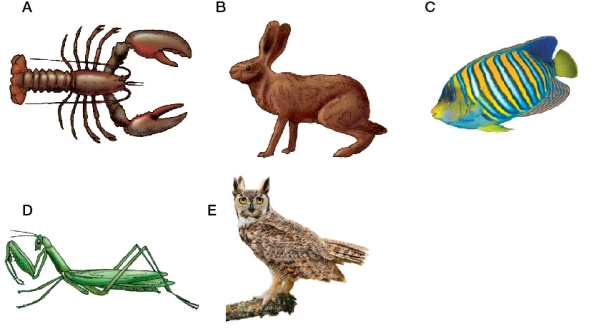 Which organism is least likely to have an oxygen-carrying molecule, such as hemoglobin or hemocyanin, in its blood or hemolymph?
 (Multiple Choice)
4.9/5 (79)
(79) When you breathe in as much as possible, adding the inspirational reserve volume to your lungs, your lungs are filling with air in part because
(Multiple Choice)
4.9/5 (72)
(72) 
Filters
- Essay(0)
- Multiple Choice(0)
- Short Answer(0)
- True False(0)
- Matching(0)