



 Chat with AI
Exam 48: Gas Exchange

Exam 1: Studying Life246 Questions
Exam 2: Small Molecules and the Chemistry of Life246 Questions
Exam 3: Proteins, Carbohydrates, and Lipids246 Questions
Exam 4: Nucleic Acids and the Origin of Life246 Questions
Exam 5: Cells: the Working Units of Life248 Questions
Exam 6: Cell Membranes246 Questions
Exam 7: Cell Communication and Multicellularity246 Questions
Exam 8: Energy, Enzymes, and Metabolism246 Questions
Exam 9: Pathways That Harvest Chemical Energy246 Questions
Exam 10: Photosynthesis: Energy From Sunlight242 Questions
Exam 11: The Cell Cycle and Cell Division260 Questions
Exam 12: Inheritance, Genes, and Chromosomes250 Questions
Exam 13: Dna and Its Role in Heredity257 Questions
Exam 14: From Dna to Protein: Gene Expression252 Questions
Exam 15: Gene Mutation and Molecular Medicine251 Questions
Exam 16: Regulation of Gene Expression245 Questions
Exam 17: Genomes249 Questions
Exam 18: Recombinant Dna and Biotechnology243 Questions
Exam 20: Mechanisms of Evolution243 Questions
Exam 21: Reconstructing and Using Phylogenies246 Questions
Exam 22: Speciation247 Questions
Exam 23: Evolution of Genes and Genomes252 Questions
Exam 24: The History of Life on Earth246 Questions
Exam 25: Bacteria, Archaea, and Viruses262 Questions
Exam 26: The Origin and Diversification of Eukaryotes252 Questions
Exam 27: Plants Without Seeds: From Water to Land251 Questions
Exam 28: The Evolution of Seed Plants259 Questions
Exam 29: The Evolution and Diversity of Fungi261 Questions
Exam 30: Animal Origins and the Evolution of Body Plans248 Questions
Exam 31: Protostome Animals244 Questions
Exam 32: Deuterostome Animals246 Questions
Exam 33: The Plant Body243 Questions
Exam 34: Transport in Plants248 Questions
Exam 35: Plant Nutrition247 Questions
Exam 36: Regulation of Plant Growth246 Questions
Exam 37: Reproduction in Flowering Plants247 Questions
Exam 38: Plant Responses to Environmental Challenges246 Questions
Exam 39: Physiology, Homeostasis, and Temperature Regulation258 Questions
Exam 40: Animal Hormones249 Questions
Exam 41: Immunology: Animal Defense Systems265 Questions
Exam 42: Animal Reproduction261 Questions
Exam 43: Animal Development261 Questions
Exam 44: Neurons, Glia, and Nervous Systems250 Questions
Exam 45: Sensory Systems249 Questions
Exam 46: The Mammalian Nervous System: Structure and Higher Functions254 Questions
Exam 47: Musculoskeletal Systems259 Questions
Exam 48: Gas Exchange247 Questions
Exam 49: Circulatory Systems252 Questions
Exam 50: Nutrition, Digestion, and Absorption259 Questions
Exam 51: Salt and Water Balance and Nitrogen Excretion251 Questions
Exam 52: Animal Behavior249 Questions
Exam 53: The Physical Environment and Biogeography of Life248 Questions
Exam 54: Populations259 Questions
Exam 55: Species Interactions254 Questions
Exam 56: Communities247 Questions
Exam 57: Ecosystems238 Questions
Exam 58: A Changing Biosphere222 Questions
Select questions type


A small amount of CO2 in the bloodstream stimulates a _______ increase in breathing rate.
(Short Answer)
5.0/5  (82)
(82) In using a flowmeter to measure the volume of air in your lungs you determine that your vital capacity is 5 liters, your expiratory reserve is 1 liter, and your inspiratory reserve is 2.5 liters.This means that your total lung capacity is
(Multiple Choice)
4.9/5 (74)
(74) Air flows into the lungs of mammals during inhalation because the
(Multiple Choice)
4.9/5 (92)
(92) A woman gives birth to a baby that is five weeks premature.The baby has trouble breathing on its own so the physicians put the baby on a respirator.The most likely reason for the baby's breathing problems is
(Multiple Choice)
5.0/5 (86)
(86) Due to the activity of carbonic anhydrase, within the lung there is a concentration gradient of _______ that is higher in the _______ than in the _______.
(Multiple Choice)
4.7/5 (72)
(72) All gases diffuse faster at ______ temperatures, and faster in _______ than in _______.
(Multiple Choice)
4.9/5 (93)
(93) There are no active transport mechanisms for respiratory gases.Therefore, the only means by which respiratory gases are exchanged is _______.
(Short Answer)
4.8/5 (86)
(86) A large drop in arterial O2 has a _______ effect on breathing rate.
(Short Answer)
4.8/5 (79)
(79) Which statement about respiration in birds and mammals is true?
(Multiple Choice)
4.9/5 (76)
(76) In the equation below, which quantity represents the volume of your normal breath? Total lung capacity = residual volume + expiratory reserve volume + inspiratory reserve volume + tidal volume
(Multiple Choice)
4.9/5 (82)
(82) Refer to the figure showing the respiratory system in birds. 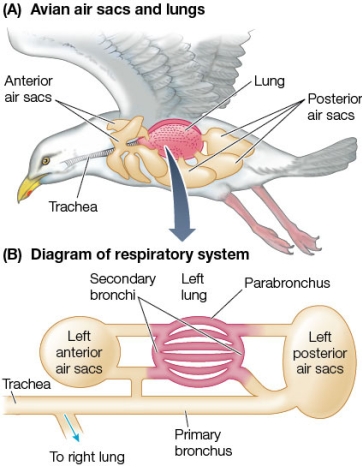 In the respiratory cycle of birds, air flows
 (Multiple Choice)
4.9/5 (84)
(84) Breathing rhythm is generated in the _______ and is influenced by variation in levels of _______ in the blood.
(Multiple Choice)
4.8/5 (81)
(81) Emergency medical technicians (EMTs) suspect that a victim of a serious accident has suffered an injury to the brainstem because his breathing has continued but is irregular.Specifically, the injury is likely to
(Multiple Choice)
4.9/5 (75)
(75) Refer to the figure showing a countercurrent exchanger from a fish gill. 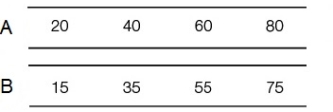 The values in the figure represent percent saturation of O2.Based on the information provided, which statement is true?
 (Multiple Choice)
4.9/5 (78)
(78) Which represents the correct order of structures through which air travels to reach the cells of insects?
(Multiple Choice)
4.7/5 (78)
(78) Small insects may take a bubble of air underwater when they dive.The bubble can serve as an air tank for some time because
(Multiple Choice)
4.8/5 (75)
(75) 
Filters
- Essay(0)
- Multiple Choice(0)
- Short Answer(0)
- True False(0)
- Matching(0)