



 Chat with AI
Exam 48: Gas Exchange

Exam 1: Studying Life246 Questions
Exam 2: Small Molecules and the Chemistry of Life246 Questions
Exam 3: Proteins, Carbohydrates, and Lipids246 Questions
Exam 4: Nucleic Acids and the Origin of Life246 Questions
Exam 5: Cells: the Working Units of Life248 Questions
Exam 6: Cell Membranes246 Questions
Exam 7: Cell Communication and Multicellularity246 Questions
Exam 8: Energy, Enzymes, and Metabolism246 Questions
Exam 9: Pathways That Harvest Chemical Energy246 Questions
Exam 10: Photosynthesis: Energy From Sunlight242 Questions
Exam 11: The Cell Cycle and Cell Division260 Questions
Exam 12: Inheritance, Genes, and Chromosomes250 Questions
Exam 13: Dna and Its Role in Heredity257 Questions
Exam 14: From Dna to Protein: Gene Expression252 Questions
Exam 15: Gene Mutation and Molecular Medicine251 Questions
Exam 16: Regulation of Gene Expression245 Questions
Exam 17: Genomes249 Questions
Exam 18: Recombinant Dna and Biotechnology243 Questions
Exam 20: Mechanisms of Evolution243 Questions
Exam 21: Reconstructing and Using Phylogenies246 Questions
Exam 22: Speciation247 Questions
Exam 23: Evolution of Genes and Genomes252 Questions
Exam 24: The History of Life on Earth246 Questions
Exam 25: Bacteria, Archaea, and Viruses262 Questions
Exam 26: The Origin and Diversification of Eukaryotes252 Questions
Exam 27: Plants Without Seeds: From Water to Land251 Questions
Exam 28: The Evolution of Seed Plants259 Questions
Exam 29: The Evolution and Diversity of Fungi261 Questions
Exam 30: Animal Origins and the Evolution of Body Plans248 Questions
Exam 31: Protostome Animals244 Questions
Exam 32: Deuterostome Animals246 Questions
Exam 33: The Plant Body243 Questions
Exam 34: Transport in Plants248 Questions
Exam 35: Plant Nutrition247 Questions
Exam 36: Regulation of Plant Growth246 Questions
Exam 37: Reproduction in Flowering Plants247 Questions
Exam 38: Plant Responses to Environmental Challenges246 Questions
Exam 39: Physiology, Homeostasis, and Temperature Regulation258 Questions
Exam 40: Animal Hormones249 Questions
Exam 41: Immunology: Animal Defense Systems265 Questions
Exam 42: Animal Reproduction261 Questions
Exam 43: Animal Development261 Questions
Exam 44: Neurons, Glia, and Nervous Systems250 Questions
Exam 45: Sensory Systems249 Questions
Exam 46: The Mammalian Nervous System: Structure and Higher Functions254 Questions
Exam 47: Musculoskeletal Systems259 Questions
Exam 48: Gas Exchange247 Questions
Exam 49: Circulatory Systems252 Questions
Exam 50: Nutrition, Digestion, and Absorption259 Questions
Exam 51: Salt and Water Balance and Nitrogen Excretion251 Questions
Exam 52: Animal Behavior249 Questions
Exam 53: The Physical Environment and Biogeography of Life248 Questions
Exam 54: Populations259 Questions
Exam 55: Species Interactions254 Questions
Exam 56: Communities247 Questions
Exam 57: Ecosystems238 Questions
Exam 58: A Changing Biosphere222 Questions
Select questions type


Refer to the graph. 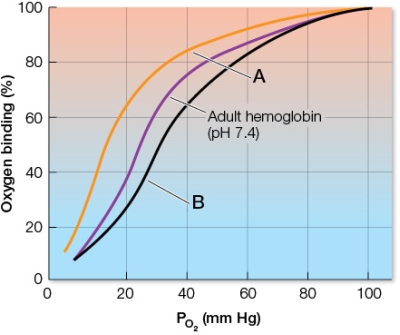 When you are exercising hard, you are producing more CO2 in your muscles than you are when resting.This causes a shift in the oxygen-binding/dissociation curve of your hemoglobin, with the new curve looking like the curve labeled _______ in the graph.
 (Short Answer)
4.8/5  (79)
(79) Air is about 78% nitrogen, and atmospheric pressure is about 760 mm Hg at sea level.The partial pressure of nitrogen at sea level is about _______ mm Hg.
(Short Answer)
4.7/5 (89)
(89) _______ is a condition in which respiratory problems result from inflammation that destroys the alveoli and leads to large, but few, alveoli.It is caused primarily by smoking and is a leading cause of death in the United States.
(Short Answer)
4.9/5 (80)
(80) Which statement about gill ventilation in fishes is false?
(Multiple Choice)
4.9/5 (79)
(79) Electrophysiological recordings are made to determine the activity of respiratory motor neurons from a patient's medulla.The recordings show that the respiratory motor neurons from the dorsal medulla are functioning normally, but those from the ventral medulla have lower than normal activity.Which is the patient's most likely symptom?
(Multiple Choice)
4.8/5 (85)
(85) One reason rapid gas exchange can be accomplished more easily in air than in water is that
(Multiple Choice)
4.8/5 (70)
(70) If you climb a mountain to an altitude where the PO2 is half of what it is at sea level, it is likely that
(Multiple Choice)
4.9/5 (75)
(75) By converting CO2 to H2CO3, carbonic anhydrase _______the PCO2 in endothelial cells, red blood cells, and plasma, thereby _______ diffusion of CO2 from tissue cells to these locations.
(Multiple Choice)
4.7/5 (80)
(80) Which statement about the human respiratory system is true?
(Multiple Choice)
4.8/5 (58)
(58) Which statement about positive cooperativity of hemoglobin is true?
(Multiple Choice)
4.7/5 (76)
(76) Sensors for detecting PO2 levels are found on two major arteries: the _______ and the carotid arteries.
(Short Answer)
4.9/5 (83)
(83) Chemosensitive cells in the carotid bodies and aortic bodies are sensitive to the _______.When this falls, signals are sent to the medulla and cause a(n) _______ ventilation rate.This represents a _______ feedback control of breathing.
(Multiple Choice)
4.9/5 (94)
(94) Respiratory gases are exchanged between the body fluids of an animal and its environment by
(Multiple Choice)
4.8/5 (73)
(73) In humans, the process of exhalation is brought about in large part by
(Multiple Choice)
4.9/5 (83)
(83) The presence of CO2 in blood will lower blood pH because CO2 combines with _______ to form _______.The rate of the reaction is increased by _______.
(Multiple Choice)
4.8/5 (92)
(92) The lungs of _______ are the most efficient lungs of vertebrates.
(Short Answer)
4.9/5 (91)
(91) In humans, the lower (posterior) side of the thoracic cavity is defined by the
(Multiple Choice)
4.8/5 (70)
(70) Oxygen can be exchanged more easily in air than in water in part because
(Multiple Choice)
4.9/5 (80)
(80) 
Filters
- Essay(0)
- Multiple Choice(0)
- Short Answer(0)
- True False(0)
- Matching(0)