



 Chat with AI
Exam 48: Gas Exchange

Exam 1: Studying Life246 Questions
Exam 2: Small Molecules and the Chemistry of Life246 Questions
Exam 3: Proteins, Carbohydrates, and Lipids246 Questions
Exam 4: Nucleic Acids and the Origin of Life246 Questions
Exam 5: Cells: the Working Units of Life248 Questions
Exam 6: Cell Membranes246 Questions
Exam 7: Cell Communication and Multicellularity246 Questions
Exam 8: Energy, Enzymes, and Metabolism246 Questions
Exam 9: Pathways That Harvest Chemical Energy246 Questions
Exam 10: Photosynthesis: Energy From Sunlight242 Questions
Exam 11: The Cell Cycle and Cell Division260 Questions
Exam 12: Inheritance, Genes, and Chromosomes250 Questions
Exam 13: Dna and Its Role in Heredity257 Questions
Exam 14: From Dna to Protein: Gene Expression252 Questions
Exam 15: Gene Mutation and Molecular Medicine251 Questions
Exam 16: Regulation of Gene Expression245 Questions
Exam 17: Genomes249 Questions
Exam 18: Recombinant Dna and Biotechnology243 Questions
Exam 20: Mechanisms of Evolution243 Questions
Exam 21: Reconstructing and Using Phylogenies246 Questions
Exam 22: Speciation247 Questions
Exam 23: Evolution of Genes and Genomes252 Questions
Exam 24: The History of Life on Earth246 Questions
Exam 25: Bacteria, Archaea, and Viruses262 Questions
Exam 26: The Origin and Diversification of Eukaryotes252 Questions
Exam 27: Plants Without Seeds: From Water to Land251 Questions
Exam 28: The Evolution of Seed Plants259 Questions
Exam 29: The Evolution and Diversity of Fungi261 Questions
Exam 30: Animal Origins and the Evolution of Body Plans248 Questions
Exam 31: Protostome Animals244 Questions
Exam 32: Deuterostome Animals246 Questions
Exam 33: The Plant Body243 Questions
Exam 34: Transport in Plants248 Questions
Exam 35: Plant Nutrition247 Questions
Exam 36: Regulation of Plant Growth246 Questions
Exam 37: Reproduction in Flowering Plants247 Questions
Exam 38: Plant Responses to Environmental Challenges246 Questions
Exam 39: Physiology, Homeostasis, and Temperature Regulation258 Questions
Exam 40: Animal Hormones249 Questions
Exam 41: Immunology: Animal Defense Systems265 Questions
Exam 42: Animal Reproduction261 Questions
Exam 43: Animal Development261 Questions
Exam 44: Neurons, Glia, and Nervous Systems250 Questions
Exam 45: Sensory Systems249 Questions
Exam 46: The Mammalian Nervous System: Structure and Higher Functions254 Questions
Exam 47: Musculoskeletal Systems259 Questions
Exam 48: Gas Exchange247 Questions
Exam 49: Circulatory Systems252 Questions
Exam 50: Nutrition, Digestion, and Absorption259 Questions
Exam 51: Salt and Water Balance and Nitrogen Excretion251 Questions
Exam 52: Animal Behavior249 Questions
Exam 53: The Physical Environment and Biogeography of Life248 Questions
Exam 54: Populations259 Questions
Exam 55: Species Interactions254 Questions
Exam 56: Communities247 Questions
Exam 57: Ecosystems238 Questions
Exam 58: A Changing Biosphere222 Questions
Select questions type


The Bohr effect is the phenomenon whereby decreases in _______ cause hemoglobin to _______ O2.
(Multiple Choice)
4.9/5  (69)
(69) Which statement about the transport of respiratory gases by the blood in humans is true?
(Multiple Choice)
4.9/5 (86)
(86) Which feature characterizes 2,3-bisphosphoglyceric acid (BPG)?
(Multiple Choice)
4.8/5 (77)
(77) Refer to the figure showing three aquatic species. 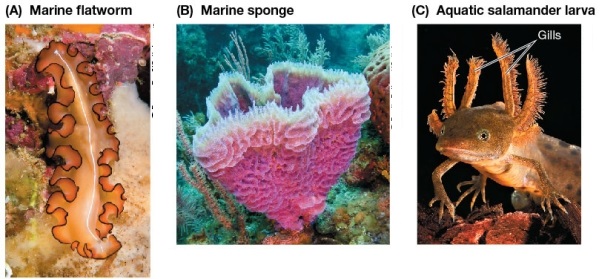 Which organism(s) is/are adapted for maximizing respiratory gas exchange by having a small path length (the variable L in Fick's law) for diffusion of respiratory gases?
 (Multiple Choice)
4.7/5 (83)
(83) Refer to the figure.  Where would you most likely find this pattern of blood and water flow?
 (Multiple Choice)
4.8/5 (81)
(81) Breathing rhythm is generated in the _______ and modified by neurons either in or above the _______.
(Multiple Choice)
4.8/5 (64)
(64) While climbing to a Mount Everest base camp you find that you have less energy to climb the higher you go.The most likely reason for this is that
(Multiple Choice)
4.8/5 (89)
(89) If the O2-binding/dissociation curves were plotted for the following types of hemoglobin at the pH levels indicated, which curve would be to the right of all the others?
(Multiple Choice)
4.8/5 (69)
(69) Which is a characteristic of the residual volume of human lungs?
(Multiple Choice)
4.9/5 (72)
(72) The rate at which a gas diffuses between two locations _______ between those locations.
(Multiple Choice)
4.8/5 (77)
(77) Which of the following represents the correct air pathway during inhalation in humans?
(Multiple Choice)
4.9/5 (87)
(87) Refer to the figure. 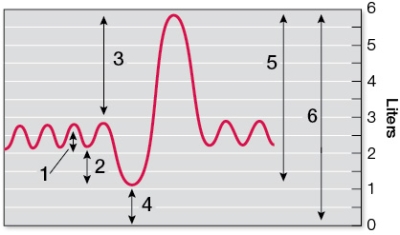 The figure shows a tracing of ventilation volumes that would be typical of your own breathing when at rest.If you started running, which arrow(s) would increase in length, as the peaks changed size in the tracing?
 (Short Answer)
4.8/5 (85)
(85) Refer to the figure. 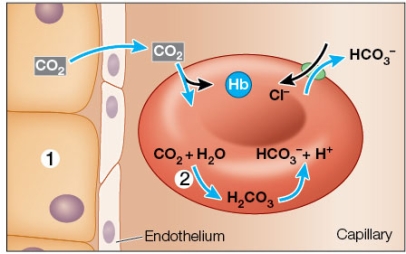 This capillary could be in a(n) _______.This is apparent because _______.
 (Multiple Choice)
4.7/5 (91)
(91) When your diaphragm relaxes and your thoracic cavity contracts, you are _______, and the pressure in your alveoli is _______ the atmospheric pressure.
(Multiple Choice)
4.8/5 (71)
(71) Why would you be more likely to find birds than mammals at high altitudes?
(Essay)
4.8/5 (88)
(88) The delicate gills of fishes are protected by _______ and supported by _______.
(Multiple Choice)
5.0/5 (83)
(83) 
Filters
- Essay(0)
- Multiple Choice(0)
- Short Answer(0)
- True False(0)
- Matching(0)