



 Chat with AI
Exam 47: Musculoskeletal Systems

Exam 1: Studying Life246 Questions
Exam 2: Small Molecules and the Chemistry of Life246 Questions
Exam 3: Proteins, Carbohydrates, and Lipids246 Questions
Exam 4: Nucleic Acids and the Origin of Life246 Questions
Exam 5: Cells: the Working Units of Life248 Questions
Exam 6: Cell Membranes246 Questions
Exam 7: Cell Communication and Multicellularity246 Questions
Exam 8: Energy, Enzymes, and Metabolism246 Questions
Exam 9: Pathways That Harvest Chemical Energy246 Questions
Exam 10: Photosynthesis: Energy From Sunlight242 Questions
Exam 11: The Cell Cycle and Cell Division260 Questions
Exam 12: Inheritance, Genes, and Chromosomes250 Questions
Exam 13: Dna and Its Role in Heredity257 Questions
Exam 14: From Dna to Protein: Gene Expression252 Questions
Exam 15: Gene Mutation and Molecular Medicine251 Questions
Exam 16: Regulation of Gene Expression245 Questions
Exam 17: Genomes249 Questions
Exam 18: Recombinant Dna and Biotechnology243 Questions
Exam 20: Mechanisms of Evolution243 Questions
Exam 21: Reconstructing and Using Phylogenies246 Questions
Exam 22: Speciation247 Questions
Exam 23: Evolution of Genes and Genomes252 Questions
Exam 24: The History of Life on Earth246 Questions
Exam 25: Bacteria, Archaea, and Viruses262 Questions
Exam 26: The Origin and Diversification of Eukaryotes252 Questions
Exam 27: Plants Without Seeds: From Water to Land251 Questions
Exam 28: The Evolution of Seed Plants259 Questions
Exam 29: The Evolution and Diversity of Fungi261 Questions
Exam 30: Animal Origins and the Evolution of Body Plans248 Questions
Exam 31: Protostome Animals244 Questions
Exam 32: Deuterostome Animals246 Questions
Exam 33: The Plant Body243 Questions
Exam 34: Transport in Plants248 Questions
Exam 35: Plant Nutrition247 Questions
Exam 36: Regulation of Plant Growth246 Questions
Exam 37: Reproduction in Flowering Plants247 Questions
Exam 38: Plant Responses to Environmental Challenges246 Questions
Exam 39: Physiology, Homeostasis, and Temperature Regulation258 Questions
Exam 40: Animal Hormones249 Questions
Exam 41: Immunology: Animal Defense Systems265 Questions
Exam 42: Animal Reproduction261 Questions
Exam 43: Animal Development261 Questions
Exam 44: Neurons, Glia, and Nervous Systems250 Questions
Exam 45: Sensory Systems249 Questions
Exam 46: The Mammalian Nervous System: Structure and Higher Functions254 Questions
Exam 47: Musculoskeletal Systems259 Questions
Exam 48: Gas Exchange247 Questions
Exam 49: Circulatory Systems252 Questions
Exam 50: Nutrition, Digestion, and Absorption259 Questions
Exam 51: Salt and Water Balance and Nitrogen Excretion251 Questions
Exam 52: Animal Behavior249 Questions
Exam 53: The Physical Environment and Biogeography of Life248 Questions
Exam 54: Populations259 Questions
Exam 55: Species Interactions254 Questions
Exam 56: Communities247 Questions
Exam 57: Ecosystems238 Questions
Exam 58: A Changing Biosphere222 Questions
Select questions type


When an action potential arrives at the neuromuscular junction, acetylcholine is released into the synaptic cleft and binds to receptors in the postsynaptic membrane.Which of the following represents the correct order of the next series of events?

Free
(Multiple Choice)
4.9/5  (77)
(77) Correct Answer: Verified
B
Which statement about insect muscles is true?
Free
(Multiple Choice)
4.7/5 (67)
(67) Correct Answer:Verified
VerifiedD
In humans, the _______ skeleton includes the skull, vertebral column, and ribs.
Free
(Short Answer)
4.7/5 (59)
(59) Correct Answer:Verified
Verifiedaxial
Refer to figure showing the knee joint and the bones and muscles of the human leg. 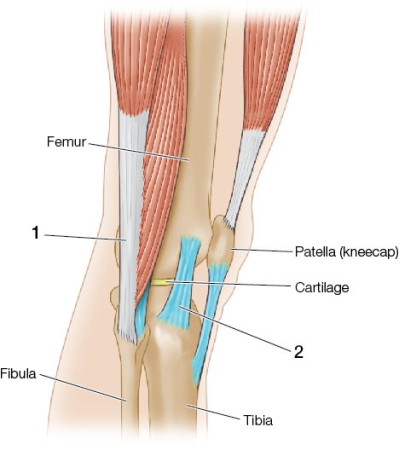 The structure labeled 1 is _______; the structure labeled 2 is _______.
 (Multiple Choice)
4.7/5 (80)
(80) Refer to the figure. 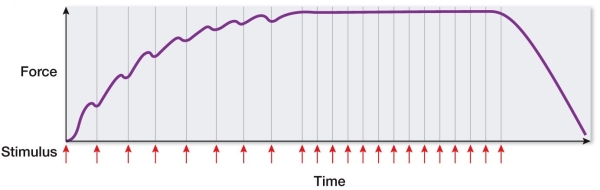 What is a state of tetanus? Indicate on the figure the points at which the muscle is in a state of tetanus?
 (Essay)
4.8/5 (78)
(78) Wild turkeys have breast muscles that are capable of explosively fast flight, but only for short distances.These muscles most likely
(Multiple Choice)
4.8/5 (87)
(87) Refer to the figure of growing bone. 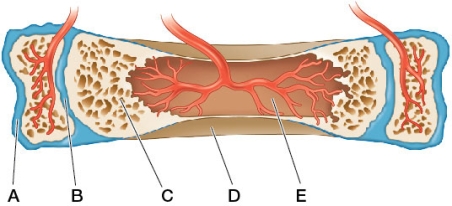 Which statement the bone shown is true?
 (Multiple Choice)
5.0/5 (85)
(85) What is the correct order of events in the pathway leading up to the release of calcium from the sarcoplasmic reticulum of a skeletal muscle cell?
(Multiple Choice)
4.9/5 (78)
(78) Bone is continuously remodeled by _______ that resorb bone and release calcium into the extracellular fluid, and _______ that lay down new bone.
(Multiple Choice)
4.8/5 (78)
(78) Which type of diet would produce the highest rate of glycogen replenishment in muscles?
(Multiple Choice)
4.8/5 (79)
(79) Refer to the figure showing the components of a sarcomere. 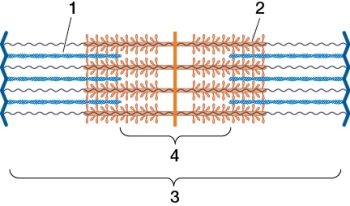 Which statement about the structures shown in the figure is true?
 (Multiple Choice)
4.9/5 (87)
(87) Which statement about the endoskeletons of vertebrates is true?
(Multiple Choice)
5.0/5 (88)
(88) Which statement about the process of muscle contraction is true?
(Multiple Choice)
4.8/5 (72)
(72) Which statement about the interaction between actin and myosin molecules is true?
(Multiple Choice)
4.7/5 (72)
(72) What type of bone forms without a cartilage "model" or structure resembling the future mature bone?
(Multiple Choice)
4.9/5 (79)
(79) When comparing bones and joints to lever systems, the _______ is represented by the fulcrum.
(Multiple Choice)
5.0/5 (71)
(71) In a class 1 lever, the fulcrum is between the load and force arms.A class 1 lever is used when
(Multiple Choice)
4.9/5 (62)
(62) Which statement about the structure of skeletal muscle is true?
(Multiple Choice)
4.9/5 (93)
(93) 
Filters
- Essay(0)
- Multiple Choice(0)
- Short Answer(0)
- True False(0)
- Matching(0)