



 Chat with AI
Exam 47: Musculoskeletal Systems

Exam 1: Studying Life246 Questions
Exam 2: Small Molecules and the Chemistry of Life246 Questions
Exam 3: Proteins, Carbohydrates, and Lipids246 Questions
Exam 4: Nucleic Acids and the Origin of Life246 Questions
Exam 5: Cells: the Working Units of Life248 Questions
Exam 6: Cell Membranes246 Questions
Exam 7: Cell Communication and Multicellularity246 Questions
Exam 8: Energy, Enzymes, and Metabolism246 Questions
Exam 9: Pathways That Harvest Chemical Energy246 Questions
Exam 10: Photosynthesis: Energy From Sunlight242 Questions
Exam 11: The Cell Cycle and Cell Division260 Questions
Exam 12: Inheritance, Genes, and Chromosomes250 Questions
Exam 13: Dna and Its Role in Heredity257 Questions
Exam 14: From Dna to Protein: Gene Expression252 Questions
Exam 15: Gene Mutation and Molecular Medicine251 Questions
Exam 16: Regulation of Gene Expression245 Questions
Exam 17: Genomes249 Questions
Exam 18: Recombinant Dna and Biotechnology243 Questions
Exam 20: Mechanisms of Evolution243 Questions
Exam 21: Reconstructing and Using Phylogenies246 Questions
Exam 22: Speciation247 Questions
Exam 23: Evolution of Genes and Genomes252 Questions
Exam 24: The History of Life on Earth246 Questions
Exam 25: Bacteria, Archaea, and Viruses262 Questions
Exam 26: The Origin and Diversification of Eukaryotes252 Questions
Exam 27: Plants Without Seeds: From Water to Land251 Questions
Exam 28: The Evolution of Seed Plants259 Questions
Exam 29: The Evolution and Diversity of Fungi261 Questions
Exam 30: Animal Origins and the Evolution of Body Plans248 Questions
Exam 31: Protostome Animals244 Questions
Exam 32: Deuterostome Animals246 Questions
Exam 33: The Plant Body243 Questions
Exam 34: Transport in Plants248 Questions
Exam 35: Plant Nutrition247 Questions
Exam 36: Regulation of Plant Growth246 Questions
Exam 37: Reproduction in Flowering Plants247 Questions
Exam 38: Plant Responses to Environmental Challenges246 Questions
Exam 39: Physiology, Homeostasis, and Temperature Regulation258 Questions
Exam 40: Animal Hormones249 Questions
Exam 41: Immunology: Animal Defense Systems265 Questions
Exam 42: Animal Reproduction261 Questions
Exam 43: Animal Development261 Questions
Exam 44: Neurons, Glia, and Nervous Systems250 Questions
Exam 45: Sensory Systems249 Questions
Exam 46: The Mammalian Nervous System: Structure and Higher Functions254 Questions
Exam 47: Musculoskeletal Systems259 Questions
Exam 48: Gas Exchange247 Questions
Exam 49: Circulatory Systems252 Questions
Exam 50: Nutrition, Digestion, and Absorption259 Questions
Exam 51: Salt and Water Balance and Nitrogen Excretion251 Questions
Exam 52: Animal Behavior249 Questions
Exam 53: The Physical Environment and Biogeography of Life248 Questions
Exam 54: Populations259 Questions
Exam 55: Species Interactions254 Questions
Exam 56: Communities247 Questions
Exam 57: Ecosystems238 Questions
Exam 58: A Changing Biosphere222 Questions
Select questions type


Refer to the figure showing molecules found in sarcomeres. 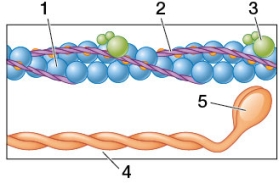 Which statement about the structures shown in the figure is true?
 (Multiple Choice)
4.9/5  (90)
(90) The strength or weakness of a skeletal muscle contraction depends on
(Multiple Choice)
4.9/5 (72)
(72) Refer to the figure showing the components of a sarcomere. 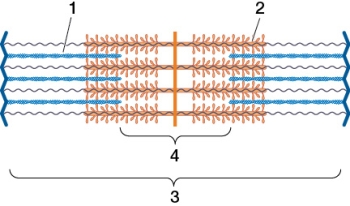 Which statement about the structures shown in the figure is true?
 (Multiple Choice)
4.9/5 (83)
(83) Refer to the graph showing the capacity of three systems that provide ATP for muscle contraction. 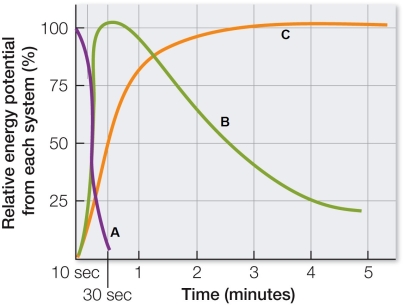 Based on the graph, which statement is true?
 (Multiple Choice)
4.9/5 (86)
(86) Satellite cells are characterized in part by their ability to
(Multiple Choice)
4.9/5 (76)
(76) The total energy supply in all the muscles of the human body (in the form of ATP and creatine phosphate) is about 10 kilocalories.When a human is sitting at rest, how long does it take the body to metabolize this amount of energy?
(Multiple Choice)
4.9/5 (77)
(77) A patient with a family history of osteoporosis is advised by her physician to engage in weight-bearing exercise.What is osteoporosis, and how might such exercise help to prevent it?
(Essay)
4.9/5 (65)
(65) Fast-twitch skeletal muscle fibers, called white muscle, are characterized by
(Multiple Choice)
4.8/5 (80)
(80) Because the heartbeat is generated by the heart muscle itself, it is said to be _______.
(Short Answer)
4.9/5 (87)
(87) The skeletal muscles in the legs of competitive cross-country skiers and long-distance runners are likely to have
(Multiple Choice)
4.8/5 (76)
(76) Curare is a plant poison from South America that is applied to the tips of arrows.Curare acts by preventing acetylcholine from binding to its receptors.Mammals hit by these darts die by asphyxiation.How does the poison cause the victim to stop breathing?
(Essay)
5.0/5 (74)
(74) Choose the correct sequence in which skeletal muscle cells rely on the listed sources of ATP.
(Multiple Choice)
4.9/5 (79)
(79) If you are training for a marathon by running long distances on a frequent basis, the _______ capacity of intermediate fibers in your leg muscles will increase.
(Short Answer)
4.9/5 (77)
(77) The two types of cells responsible for the remodeling of bone structure are the _______.
(Short Answer)
4.9/5 (81)
(81) Refer to the figure showing a sarcomere when it is relaxed. 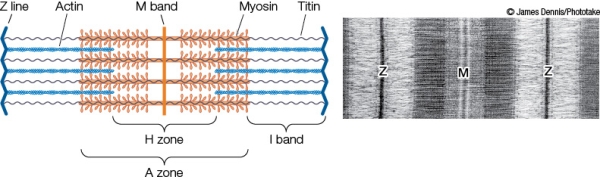 When the muscle contracts, _______ will become more narrow in the sarcomere.
 (Multiple Choice)
4.9/5 (88)
(88) Which muscle type(s) has/have the least regular arrangements of actin and myosin?
(Multiple Choice)
4.9/5 (73)
(73) 
Filters
- Essay(0)
- Multiple Choice(0)
- Short Answer(0)
- True False(0)
- Matching(0)