



 Chat with AI
Exam 47: Musculoskeletal Systems

Exam 1: Studying Life246 Questions
Exam 2: Small Molecules and the Chemistry of Life246 Questions
Exam 3: Proteins, Carbohydrates, and Lipids246 Questions
Exam 4: Nucleic Acids and the Origin of Life246 Questions
Exam 5: Cells: the Working Units of Life248 Questions
Exam 6: Cell Membranes246 Questions
Exam 7: Cell Communication and Multicellularity246 Questions
Exam 8: Energy, Enzymes, and Metabolism246 Questions
Exam 9: Pathways That Harvest Chemical Energy246 Questions
Exam 10: Photosynthesis: Energy From Sunlight242 Questions
Exam 11: The Cell Cycle and Cell Division260 Questions
Exam 12: Inheritance, Genes, and Chromosomes250 Questions
Exam 13: Dna and Its Role in Heredity257 Questions
Exam 14: From Dna to Protein: Gene Expression252 Questions
Exam 15: Gene Mutation and Molecular Medicine251 Questions
Exam 16: Regulation of Gene Expression245 Questions
Exam 17: Genomes249 Questions
Exam 18: Recombinant Dna and Biotechnology243 Questions
Exam 20: Mechanisms of Evolution243 Questions
Exam 21: Reconstructing and Using Phylogenies246 Questions
Exam 22: Speciation247 Questions
Exam 23: Evolution of Genes and Genomes252 Questions
Exam 24: The History of Life on Earth246 Questions
Exam 25: Bacteria, Archaea, and Viruses262 Questions
Exam 26: The Origin and Diversification of Eukaryotes252 Questions
Exam 27: Plants Without Seeds: From Water to Land251 Questions
Exam 28: The Evolution of Seed Plants259 Questions
Exam 29: The Evolution and Diversity of Fungi261 Questions
Exam 30: Animal Origins and the Evolution of Body Plans248 Questions
Exam 31: Protostome Animals244 Questions
Exam 32: Deuterostome Animals246 Questions
Exam 33: The Plant Body243 Questions
Exam 34: Transport in Plants248 Questions
Exam 35: Plant Nutrition247 Questions
Exam 36: Regulation of Plant Growth246 Questions
Exam 37: Reproduction in Flowering Plants247 Questions
Exam 38: Plant Responses to Environmental Challenges246 Questions
Exam 39: Physiology, Homeostasis, and Temperature Regulation258 Questions
Exam 40: Animal Hormones249 Questions
Exam 41: Immunology: Animal Defense Systems265 Questions
Exam 42: Animal Reproduction261 Questions
Exam 43: Animal Development261 Questions
Exam 44: Neurons, Glia, and Nervous Systems250 Questions
Exam 45: Sensory Systems249 Questions
Exam 46: The Mammalian Nervous System: Structure and Higher Functions254 Questions
Exam 47: Musculoskeletal Systems259 Questions
Exam 48: Gas Exchange247 Questions
Exam 49: Circulatory Systems252 Questions
Exam 50: Nutrition, Digestion, and Absorption259 Questions
Exam 51: Salt and Water Balance and Nitrogen Excretion251 Questions
Exam 52: Animal Behavior249 Questions
Exam 53: The Physical Environment and Biogeography of Life248 Questions
Exam 54: Populations259 Questions
Exam 55: Species Interactions254 Questions
Exam 56: Communities247 Questions
Exam 57: Ecosystems238 Questions
Exam 58: A Changing Biosphere222 Questions
Select questions type


A sport such as weight lifting, which is very demanding and leads quickly to fatigue, is reliant on _______ fibers.
(Short Answer)
4.9/5  (78)
(78) Which of the following is not one of the systems that supplies muscles with the ATP needed for contraction?
(Multiple Choice)
4.9/5 (81)
(81) The primary determinant regarding the proportion of fast- and slow-twitch fibers in a person's skeletal muscle is
(Multiple Choice)
4.9/5 (80)
(80) Refer to the figure. 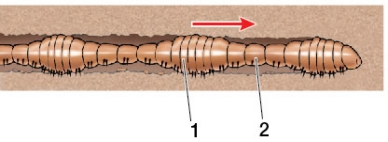 The animal shown is able to move using the circular and longitudinal musculature within each segment.In the segment labeled 1, _______, and in the segment labeled 2, _______.
 (Multiple Choice)
4.9/5 (65)
(65) When a clown at a birthday party squeezes a long balloon to twist it into a poodle or a hat, the volume of air inside the balloon stretches the balloon and extends its length and stays constant.This example is analogous to the action of muscles on the
(Multiple Choice)
4.9/5 (76)
(76) When animals die, the lack of ATP causes muscles to stiffen in rigor mortis because
(Multiple Choice)
4.9/5 (82)
(82) A pair of closely related bird species includes one that migrates long distances over the course of months and another that has evolved near-flightlessness on its island home.What might you expect to find when comparing the breast muscles (used for flight) of these species?
(Multiple Choice)
4.7/5 (67)
(67) Refer to the figure showing an earthworm. 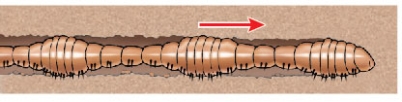 The earthworm is able to move using its _______ skeleton and body musculature.
 (Short Answer)
4.8/5 (73)
(73) In examining a fruit fly in flight, a researcher was able to determine that the stroke frequency of the wings is 221 strokes per second.Comparing this with flight in a zebra finch, the researcher found the stroke frequency of the wings in a zebra finch was _______ than that of the fruit fly.
(Short Answer)
5.0/5 (80)
(80) _______ is the continuous activation of the contractile "machinery."
(Short Answer)
4.7/5 (78)
(78) Which feature characterizes a muscle that is fully stretched?
(Multiple Choice)
4.9/5 (88)
(88) Refer to the figure. 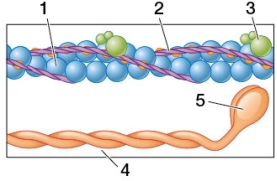 If the purple structure labeled 2 was not present, what would be the most likely position for the structure labeled 5?
 (Multiple Choice)
4.7/5 (72)
(72) Workers who built the U.S.Transcontinental Railroad exerted a tremendous amount of effort, creating tunnels through the Sierra Nevada Mountains by breaking down the stone bit by bit.This step-by-step deconstruction process was analogous to the work performed in the body by
(Multiple Choice)
4.9/5 (86)
(86) Muscles at joints are often arranged in antagonistic pairs of extensors and _______.
(Short Answer)
4.9/5 (71)
(71) 
Filters
- Essay(0)
- Multiple Choice(0)
- Short Answer(0)
- True False(0)
- Matching(0)