



 Chat with AI
Exam 47: Musculoskeletal Systems

Exam 1: Studying Life246 Questions
Exam 2: Small Molecules and the Chemistry of Life246 Questions
Exam 3: Proteins, Carbohydrates, and Lipids246 Questions
Exam 4: Nucleic Acids and the Origin of Life246 Questions
Exam 5: Cells: the Working Units of Life248 Questions
Exam 6: Cell Membranes246 Questions
Exam 7: Cell Communication and Multicellularity246 Questions
Exam 8: Energy, Enzymes, and Metabolism246 Questions
Exam 9: Pathways That Harvest Chemical Energy246 Questions
Exam 10: Photosynthesis: Energy From Sunlight242 Questions
Exam 11: The Cell Cycle and Cell Division260 Questions
Exam 12: Inheritance, Genes, and Chromosomes250 Questions
Exam 13: Dna and Its Role in Heredity257 Questions
Exam 14: From Dna to Protein: Gene Expression252 Questions
Exam 15: Gene Mutation and Molecular Medicine251 Questions
Exam 16: Regulation of Gene Expression245 Questions
Exam 17: Genomes249 Questions
Exam 18: Recombinant Dna and Biotechnology243 Questions
Exam 20: Mechanisms of Evolution243 Questions
Exam 21: Reconstructing and Using Phylogenies246 Questions
Exam 22: Speciation247 Questions
Exam 23: Evolution of Genes and Genomes252 Questions
Exam 24: The History of Life on Earth246 Questions
Exam 25: Bacteria, Archaea, and Viruses262 Questions
Exam 26: The Origin and Diversification of Eukaryotes252 Questions
Exam 27: Plants Without Seeds: From Water to Land251 Questions
Exam 28: The Evolution of Seed Plants259 Questions
Exam 29: The Evolution and Diversity of Fungi261 Questions
Exam 30: Animal Origins and the Evolution of Body Plans248 Questions
Exam 31: Protostome Animals244 Questions
Exam 32: Deuterostome Animals246 Questions
Exam 33: The Plant Body243 Questions
Exam 34: Transport in Plants248 Questions
Exam 35: Plant Nutrition247 Questions
Exam 36: Regulation of Plant Growth246 Questions
Exam 37: Reproduction in Flowering Plants247 Questions
Exam 38: Plant Responses to Environmental Challenges246 Questions
Exam 39: Physiology, Homeostasis, and Temperature Regulation258 Questions
Exam 40: Animal Hormones249 Questions
Exam 41: Immunology: Animal Defense Systems265 Questions
Exam 42: Animal Reproduction261 Questions
Exam 43: Animal Development261 Questions
Exam 44: Neurons, Glia, and Nervous Systems250 Questions
Exam 45: Sensory Systems249 Questions
Exam 46: The Mammalian Nervous System: Structure and Higher Functions254 Questions
Exam 47: Musculoskeletal Systems259 Questions
Exam 48: Gas Exchange247 Questions
Exam 49: Circulatory Systems252 Questions
Exam 50: Nutrition, Digestion, and Absorption259 Questions
Exam 51: Salt and Water Balance and Nitrogen Excretion251 Questions
Exam 52: Animal Behavior249 Questions
Exam 53: The Physical Environment and Biogeography of Life248 Questions
Exam 54: Populations259 Questions
Exam 55: Species Interactions254 Questions
Exam 56: Communities247 Questions
Exam 57: Ecosystems238 Questions
Exam 58: A Changing Biosphere222 Questions
Select questions type


While lifting weights at the gym, you pause to use your fingertip to adjust the volume on your iPod.Which statement about the muscle contractions involved in adjusting the volume is true?
(Multiple Choice)
4.8/5  (85)
(85) Refer to the graph showing world record times for running events of different durations.Each colored band in the graph (labeled 1-3) corresponds to the time courses of the three energy systems that supply fuel to the muscles. 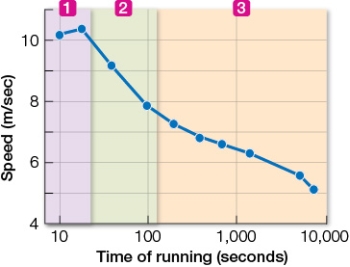 During which time period(s) are mitochondria the main source of ATP for the runner's muscles?
 (Multiple Choice)
4.8/5 (86)
(86) Refer to the figure showing the growth of a long bone. 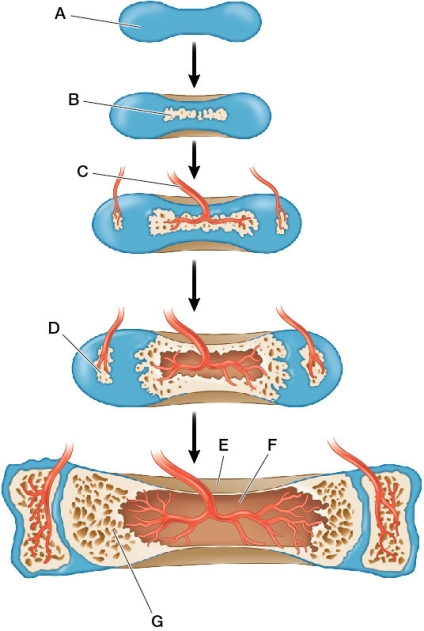 How does the type of bone at E differ from that shown at G in terms of weight, and what structural differences are responsible this weight difference?
 (Essay)
5.0/5 (96)
(96) _______ chemically binds with calcium, and this complex activates myosin kinase in smooth muscle cells.
(Multiple Choice)
4.9/5 (90)
(90) The type of skeleton a lobster has is a(n) _______.In order to grow larger, the lobster must molt.
(Short Answer)
4.8/5 (78)
(78) How does the action of Ca2+ in smooth muscle contraction differ from its action in skeletal muscle?
(Essay)
4.9/5 (90)
(90) Refer to the figure. 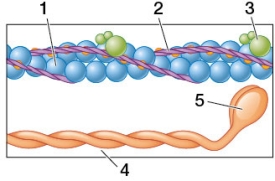 If the structures in the figure are exposed to calcium ions, to which structure will the ions bind?
 (Multiple Choice)
4.9/5 (79)
(79) A simple _______ skeleton consists of a fluid-filled cavity controlled by muscle movement.
(Short Answer)
4.8/5 (71)
(71) If the slow-twitch muscle fiber of a world-class marathon runner, a weight lifter, and a 100-meter dash Olympian were compared, which would represent the correct order, from highest to lowest, of the percentage of slow-twitch muscle in their bodies?
(Multiple Choice)
4.9/5 (77)
(77) If we compare a vertebrate jaw and knee joints as lever systems,
(Multiple Choice)
4.9/5 (72)
(72) When the circular muscles of a segment in an earthworm contract, that compartment _______, and when the longitudinal muscles of a segment contract, that compartment _______.
(Multiple Choice)
4.8/5 (101)
(101) An adolescent breaks a leg bone close to the ankle joint.After the break heals, that leg may not grow as long as the other one.Why?
(Essay)
5.0/5 (84)
(84) An advantage of an endoskeleton over an exoskeleton is that an endoskeleton
(Multiple Choice)
4.9/5 (69)
(69) Which feature characterizes slow-twitch skeletal muscle fibers?
(Multiple Choice)
4.7/5 (81)
(81) Cartilage tissue consists of cells embedded in an extracellular matrix containing _______ fibers that give it strength and resiliency.
(Short Answer)
4.8/5 (68)
(68) 
Filters
- Essay(0)
- Multiple Choice(0)
- Short Answer(0)
- True False(0)
- Matching(0)