



 Chat with AI
Exam 47: Musculoskeletal Systems

Exam 1: Studying Life246 Questions
Exam 2: Small Molecules and the Chemistry of Life246 Questions
Exam 3: Proteins, Carbohydrates, and Lipids246 Questions
Exam 4: Nucleic Acids and the Origin of Life246 Questions
Exam 5: Cells: the Working Units of Life248 Questions
Exam 6: Cell Membranes246 Questions
Exam 7: Cell Communication and Multicellularity246 Questions
Exam 8: Energy, Enzymes, and Metabolism246 Questions
Exam 9: Pathways That Harvest Chemical Energy246 Questions
Exam 10: Photosynthesis: Energy From Sunlight242 Questions
Exam 11: The Cell Cycle and Cell Division260 Questions
Exam 12: Inheritance, Genes, and Chromosomes250 Questions
Exam 13: Dna and Its Role in Heredity257 Questions
Exam 14: From Dna to Protein: Gene Expression252 Questions
Exam 15: Gene Mutation and Molecular Medicine251 Questions
Exam 16: Regulation of Gene Expression245 Questions
Exam 17: Genomes249 Questions
Exam 18: Recombinant Dna and Biotechnology243 Questions
Exam 20: Mechanisms of Evolution243 Questions
Exam 21: Reconstructing and Using Phylogenies246 Questions
Exam 22: Speciation247 Questions
Exam 23: Evolution of Genes and Genomes252 Questions
Exam 24: The History of Life on Earth246 Questions
Exam 25: Bacteria, Archaea, and Viruses262 Questions
Exam 26: The Origin and Diversification of Eukaryotes252 Questions
Exam 27: Plants Without Seeds: From Water to Land251 Questions
Exam 28: The Evolution of Seed Plants259 Questions
Exam 29: The Evolution and Diversity of Fungi261 Questions
Exam 30: Animal Origins and the Evolution of Body Plans248 Questions
Exam 31: Protostome Animals244 Questions
Exam 32: Deuterostome Animals246 Questions
Exam 33: The Plant Body243 Questions
Exam 34: Transport in Plants248 Questions
Exam 35: Plant Nutrition247 Questions
Exam 36: Regulation of Plant Growth246 Questions
Exam 37: Reproduction in Flowering Plants247 Questions
Exam 38: Plant Responses to Environmental Challenges246 Questions
Exam 39: Physiology, Homeostasis, and Temperature Regulation258 Questions
Exam 40: Animal Hormones249 Questions
Exam 41: Immunology: Animal Defense Systems265 Questions
Exam 42: Animal Reproduction261 Questions
Exam 43: Animal Development261 Questions
Exam 44: Neurons, Glia, and Nervous Systems250 Questions
Exam 45: Sensory Systems249 Questions
Exam 46: The Mammalian Nervous System: Structure and Higher Functions254 Questions
Exam 47: Musculoskeletal Systems259 Questions
Exam 48: Gas Exchange247 Questions
Exam 49: Circulatory Systems252 Questions
Exam 50: Nutrition, Digestion, and Absorption259 Questions
Exam 51: Salt and Water Balance and Nitrogen Excretion251 Questions
Exam 52: Animal Behavior249 Questions
Exam 53: The Physical Environment and Biogeography of Life248 Questions
Exam 54: Populations259 Questions
Exam 55: Species Interactions254 Questions
Exam 56: Communities247 Questions
Exam 57: Ecosystems238 Questions
Exam 58: A Changing Biosphere222 Questions
Select questions type


Refer to the figure showing various stages of a contraction cycle in a sarcomere. 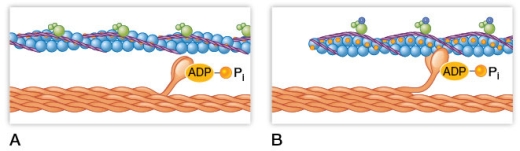 What has happened between panels A and B that has allowed myosin to attach to actin?
 (Essay)
4.9/5  (83)
(83) Performing a chin-up is usually particularly difficult at the very end of the exercise because
(Multiple Choice)
4.7/5 (82)
(82) Refer to figure showing the knee joint and the bones and muscles of the human leg. 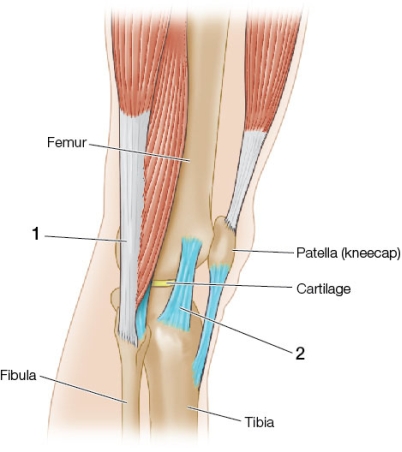 Structure 1 is a _______ and attaching ______.Structure 2 is a _______ and attaching _______.
 (Multiple Choice)
4.8/5 (77)
(77) You come across several invertebrate organisms crawling through the sand.You notice that they have a soft body wall, and when you dissect one, you see that it has no rigid structures inside the body.This organism most likely
(Multiple Choice)
4.9/5 (76)
(76) Prior to running a marathon, you decide to try carbo-loading in order to increase the amount of _______ stored in your muscles.
(Short Answer)
4.8/5 (89)
(89) Insect flight muscles can contract as fast as _______ times per second, which is _______ hummingbird flight muscles.
(Multiple Choice)
4.8/5 (70)
(70) Which of the following is a major difference between strength training and aerobic exercise?
(Multiple Choice)
4.8/5 (71)
(71) Which feature characterizes the glycolytic system for supplying ATP to muscle cells?
(Multiple Choice)
4.8/5 (92)
(92) Hydrostatic skeletons are found in annelids, such as earthworms, and in cnidarians, such as hydras.Would a hydrostatic skeleton support locomotion in a large terrestrial animal? Why or why not?
(Essay)
4.9/5 (76)
(76) Fast-twitch fibers are also called _______ muscle because they contain few mitochondria and little or no myoglobin.
(Short Answer)
5.0/5 (99)
(99) Refer to the graph showing the capacity of three systems that provide ATP for muscle contraction. 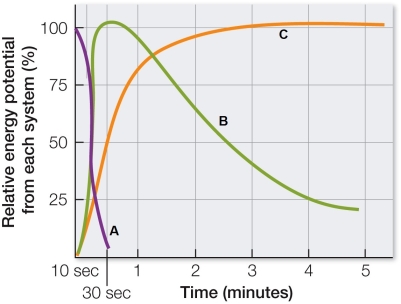 A short-distance world-record champion running a 400-meter race in 43 seconds relies mostly on
 (Multiple Choice)
4.8/5 (81)
(81) Refer to the figure relating sarcomere length to the force a muscle can generate. 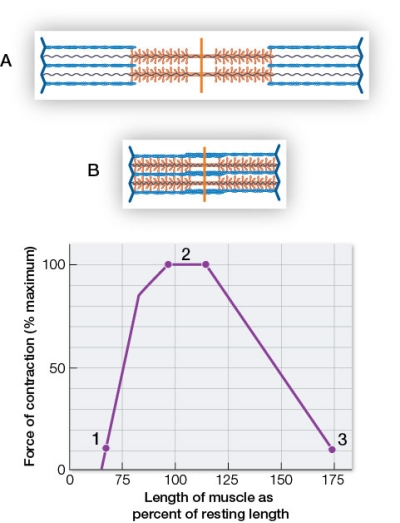 At the beginning of a pull-up, the sarcomeres in your biceps are best represented by _______.As you get within an inch of the bar, the same sarcomeres are best represented by _______.
 (Multiple Choice)
4.9/5 (71)
(71) Which pairing between body region and type of joint is correct?
(Multiple Choice)
4.9/5 (83)
(83) 
Filters
- Essay(0)
- Multiple Choice(0)
- Short Answer(0)
- True False(0)
- Matching(0)