



 Chat with AI
Exam 47: Musculoskeletal Systems

Exam 1: Studying Life246 Questions
Exam 2: Small Molecules and the Chemistry of Life246 Questions
Exam 3: Proteins, Carbohydrates, and Lipids246 Questions
Exam 4: Nucleic Acids and the Origin of Life246 Questions
Exam 5: Cells: the Working Units of Life248 Questions
Exam 6: Cell Membranes246 Questions
Exam 7: Cell Communication and Multicellularity246 Questions
Exam 8: Energy, Enzymes, and Metabolism246 Questions
Exam 9: Pathways That Harvest Chemical Energy246 Questions
Exam 10: Photosynthesis: Energy From Sunlight242 Questions
Exam 11: The Cell Cycle and Cell Division260 Questions
Exam 12: Inheritance, Genes, and Chromosomes250 Questions
Exam 13: Dna and Its Role in Heredity257 Questions
Exam 14: From Dna to Protein: Gene Expression252 Questions
Exam 15: Gene Mutation and Molecular Medicine251 Questions
Exam 16: Regulation of Gene Expression245 Questions
Exam 17: Genomes249 Questions
Exam 18: Recombinant Dna and Biotechnology243 Questions
Exam 20: Mechanisms of Evolution243 Questions
Exam 21: Reconstructing and Using Phylogenies246 Questions
Exam 22: Speciation247 Questions
Exam 23: Evolution of Genes and Genomes252 Questions
Exam 24: The History of Life on Earth246 Questions
Exam 25: Bacteria, Archaea, and Viruses262 Questions
Exam 26: The Origin and Diversification of Eukaryotes252 Questions
Exam 27: Plants Without Seeds: From Water to Land251 Questions
Exam 28: The Evolution of Seed Plants259 Questions
Exam 29: The Evolution and Diversity of Fungi261 Questions
Exam 30: Animal Origins and the Evolution of Body Plans248 Questions
Exam 31: Protostome Animals244 Questions
Exam 32: Deuterostome Animals246 Questions
Exam 33: The Plant Body243 Questions
Exam 34: Transport in Plants248 Questions
Exam 35: Plant Nutrition247 Questions
Exam 36: Regulation of Plant Growth246 Questions
Exam 37: Reproduction in Flowering Plants247 Questions
Exam 38: Plant Responses to Environmental Challenges246 Questions
Exam 39: Physiology, Homeostasis, and Temperature Regulation258 Questions
Exam 40: Animal Hormones249 Questions
Exam 41: Immunology: Animal Defense Systems265 Questions
Exam 42: Animal Reproduction261 Questions
Exam 43: Animal Development261 Questions
Exam 44: Neurons, Glia, and Nervous Systems250 Questions
Exam 45: Sensory Systems249 Questions
Exam 46: The Mammalian Nervous System: Structure and Higher Functions254 Questions
Exam 47: Musculoskeletal Systems259 Questions
Exam 48: Gas Exchange247 Questions
Exam 49: Circulatory Systems252 Questions
Exam 50: Nutrition, Digestion, and Absorption259 Questions
Exam 51: Salt and Water Balance and Nitrogen Excretion251 Questions
Exam 52: Animal Behavior249 Questions
Exam 53: The Physical Environment and Biogeography of Life248 Questions
Exam 54: Populations259 Questions
Exam 55: Species Interactions254 Questions
Exam 56: Communities247 Questions
Exam 57: Ecosystems238 Questions
Exam 58: A Changing Biosphere222 Questions
Select questions type


Which statement about muscle contractile proteins is true?
(Multiple Choice)
4.9/5  (79)
(79) Other than preformed ATP, a storage compound in muscles called _______ is part of the immediate system for obtaining ATP.
(Short Answer)
4.9/5 (85)
(85) Smooth muscle differs from both cardiac and skeletal muscle in that
(Multiple Choice)
4.8/5 (80)
(80) Refer to the figure showing sarcomeres of various lengths. 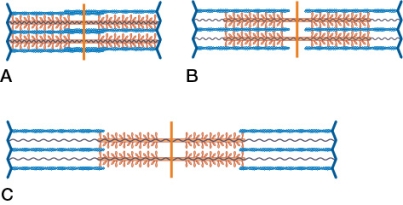 Which sarcomere(s) is/are poised to generate the greatest amount of force? Which sarcomere(s) is/are poised to generate the least amount of force? Explain your answer.
 (Essay)
4.8/5 (76)
(76) Which statement about skeletal muscle contraction is true?
(Multiple Choice)
4.8/5 (94)
(94) ATP is supplied to your muscles through several systems.As you exercise, where does the ATP you use come from, in order from most accessible to most slowly produced?
(Multiple Choice)
4.9/5 (84)
(84) Refer to the figure showing the fiber types in the leg muscles of two runners.Arrows represent the duration (length of arrow) and speed of running (thickness of arrow). 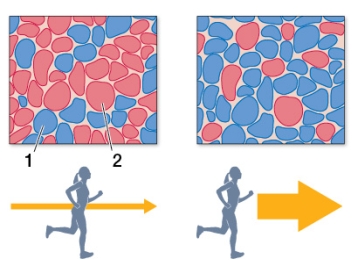 Based on the figure we can surmise that the fibers labeled 1 _______ than the fibers labeled 2.
 (Multiple Choice)
4.7/5 (73)
(73) Refer to figure of the knee joint and the bones and muscles of the human leg. 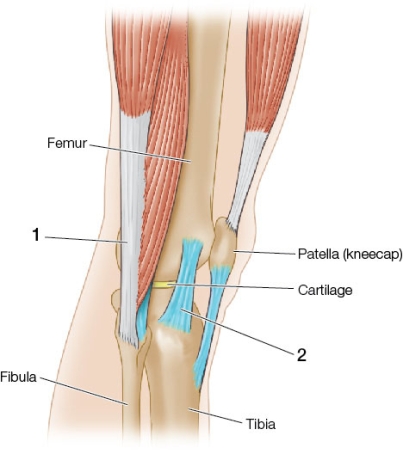 The ligament, labeled _______ in this figure, must be able to stretch when the knee flexes.
 (Short Answer)
4.8/5 (69)
(69) Some athletes hoping to improve their performance take creatine as a dietary supplement.There are some reports that creatine supplements boost performance in activities that require short bursts of energy, such as sprinting, but not in those that require endurance.Why might this be the case?
(Essay)
4.8/5 (83)
(83) Vertebrate skeletal muscles are categorized as excitable cells because
(Multiple Choice)
4.9/5 (83)
(83) Which feature is an advantage of endoskeletons over exoskeletons?
(Multiple Choice)
4.9/5 (75)
(75) Which statement about growing long bones of the legs and arms in the human skeleton is true?
(Multiple Choice)
4.8/5 (76)
(76) If a spontaneous mutation arose in the gene for a ryanodine receptor within a nucleus of a skeletal muscle cell, that cell would most likely (still be able/be unable) _______ to contract.
(Short Answer)
5.0/5 (71)
(71) 
Filters
- Essay(0)
- Multiple Choice(0)
- Short Answer(0)
- True False(0)
- Matching(0)