



 Chat with AI
Exam 47: Musculoskeletal Systems

Exam 1: Studying Life246 Questions
Exam 2: Small Molecules and the Chemistry of Life246 Questions
Exam 3: Proteins, Carbohydrates, and Lipids246 Questions
Exam 4: Nucleic Acids and the Origin of Life246 Questions
Exam 5: Cells: the Working Units of Life248 Questions
Exam 6: Cell Membranes246 Questions
Exam 7: Cell Communication and Multicellularity246 Questions
Exam 8: Energy, Enzymes, and Metabolism246 Questions
Exam 9: Pathways That Harvest Chemical Energy246 Questions
Exam 10: Photosynthesis: Energy From Sunlight242 Questions
Exam 11: The Cell Cycle and Cell Division260 Questions
Exam 12: Inheritance, Genes, and Chromosomes250 Questions
Exam 13: Dna and Its Role in Heredity257 Questions
Exam 14: From Dna to Protein: Gene Expression252 Questions
Exam 15: Gene Mutation and Molecular Medicine251 Questions
Exam 16: Regulation of Gene Expression245 Questions
Exam 17: Genomes249 Questions
Exam 18: Recombinant Dna and Biotechnology243 Questions
Exam 20: Mechanisms of Evolution243 Questions
Exam 21: Reconstructing and Using Phylogenies246 Questions
Exam 22: Speciation247 Questions
Exam 23: Evolution of Genes and Genomes252 Questions
Exam 24: The History of Life on Earth246 Questions
Exam 25: Bacteria, Archaea, and Viruses262 Questions
Exam 26: The Origin and Diversification of Eukaryotes252 Questions
Exam 27: Plants Without Seeds: From Water to Land251 Questions
Exam 28: The Evolution of Seed Plants259 Questions
Exam 29: The Evolution and Diversity of Fungi261 Questions
Exam 30: Animal Origins and the Evolution of Body Plans248 Questions
Exam 31: Protostome Animals244 Questions
Exam 32: Deuterostome Animals246 Questions
Exam 33: The Plant Body243 Questions
Exam 34: Transport in Plants248 Questions
Exam 35: Plant Nutrition247 Questions
Exam 36: Regulation of Plant Growth246 Questions
Exam 37: Reproduction in Flowering Plants247 Questions
Exam 38: Plant Responses to Environmental Challenges246 Questions
Exam 39: Physiology, Homeostasis, and Temperature Regulation258 Questions
Exam 40: Animal Hormones249 Questions
Exam 41: Immunology: Animal Defense Systems265 Questions
Exam 42: Animal Reproduction261 Questions
Exam 43: Animal Development261 Questions
Exam 44: Neurons, Glia, and Nervous Systems250 Questions
Exam 45: Sensory Systems249 Questions
Exam 46: The Mammalian Nervous System: Structure and Higher Functions254 Questions
Exam 47: Musculoskeletal Systems259 Questions
Exam 48: Gas Exchange247 Questions
Exam 49: Circulatory Systems252 Questions
Exam 50: Nutrition, Digestion, and Absorption259 Questions
Exam 51: Salt and Water Balance and Nitrogen Excretion251 Questions
Exam 52: Animal Behavior249 Questions
Exam 53: The Physical Environment and Biogeography of Life248 Questions
Exam 54: Populations259 Questions
Exam 55: Species Interactions254 Questions
Exam 56: Communities247 Questions
Exam 57: Ecosystems238 Questions
Exam 58: A Changing Biosphere222 Questions
Select questions type


A muscle reaches its maximum force of contraction when it is at _______ percent of its resting length.
(Multiple Choice)
4.9/5  (85)
(85) Refer to the figure showing sarcomeres of various lengths. 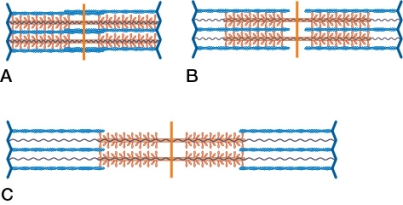 Which panel (A-C) best illustrates the state of the sarcomeres in your biceps muscle fibers during these phases of a pull-up: hanging full length from a pull-up bar; applying the maximum amount of force as you pull yourself up towards the bar; pulling yourself up the last few inches to reach the bar.
 (Short Answer)
4.7/5 (79)
(79) The _______ is a highly specialized network of intracellular membranes that enables striated muscle cells to sequester and release calcium for muscle contraction.
(Short Answer)
4.8/5 (88)
(88) Refer to the figure showing the leg muscles of two athletes. 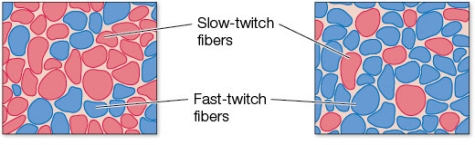 Investigators studying the leg muscles of Usain Bolt, the Olympian recognized as the fastest sprinter in the world for his performance in the 100-meter dash, would likely find _______ muscle fibers, as shown in the panel on the _______.
 (Multiple Choice)
4.9/5 (79)
(79) Cartilage bone, found in the _______, forms first as a _______ "model," which is later replaced by _______.
(Multiple Choice)
4.8/5 (69)
(69) Which is a feature of cardiac muscle that helps the heart withstand high pressures without tearing?
(Multiple Choice)
4.7/5 (82)
(82) The type of joint that allows your head to rotate is a(n) _______ joint.
(Multiple Choice)
5.0/5 (79)
(79) Salmon returning to spawn in their native stream undertake a journey that requires extreme endurance.An examination of the muscles used to perform this activity would reveal
(Multiple Choice)
4.8/5 (87)
(87) Refer to the figure of sarcomeres. 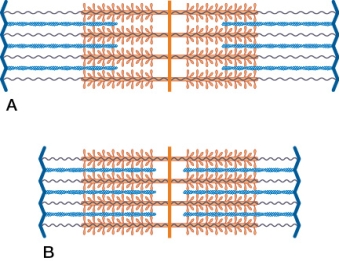 When you bend your elbow to touch your cheek, the sarcomeres in your biceps muscle look most like the sarcomere in panel _______.
 (Short Answer)
4.9/5 (71)
(71) Which feature distinguishes a smooth muscle cell from a skeletal muscle cell?
(Multiple Choice)
4.8/5 (76)
(76) Refer to the figure that shows world-record times for running events of different durations.Each colored band in the graph (labeled 1-3) corresponds to the time courses of the three energy systems that supply fuel to the muscles. 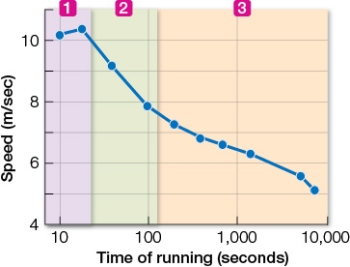 Band 2 corresponds to when _______ kicks in.
 (Short Answer)
4.9/5 (75)
(75) Which of the following is a benefit of the tough exoskeleton of arthropods that might help explain their tremendous evolutionary success?
(Multiple Choice)
4.8/5 (78)
(78) What gives the long bones of our arms and legs their strength, and allows them to resist both compressional and bending forces?
(Multiple Choice)
4.9/5 (78)
(78) Shot-putters competing in track and field events rely on short, intense bursts of energy.An examination of the muscles used in this sport would reveal
(Multiple Choice)
4.8/5 (84)
(84) 
Filters
- Essay(0)
- Multiple Choice(0)
- Short Answer(0)
- True False(0)
- Matching(0)