



 Chat with AI
Exam 31: Protostome Animals

Exam 1: Studying Life246 Questions
Exam 2: Small Molecules and the Chemistry of Life246 Questions
Exam 3: Proteins, Carbohydrates, and Lipids246 Questions
Exam 4: Nucleic Acids and the Origin of Life246 Questions
Exam 5: Cells: the Working Units of Life248 Questions
Exam 6: Cell Membranes246 Questions
Exam 7: Cell Communication and Multicellularity246 Questions
Exam 8: Energy, Enzymes, and Metabolism246 Questions
Exam 9: Pathways That Harvest Chemical Energy246 Questions
Exam 10: Photosynthesis: Energy From Sunlight242 Questions
Exam 11: The Cell Cycle and Cell Division260 Questions
Exam 12: Inheritance, Genes, and Chromosomes250 Questions
Exam 13: Dna and Its Role in Heredity257 Questions
Exam 14: From Dna to Protein: Gene Expression252 Questions
Exam 15: Gene Mutation and Molecular Medicine251 Questions
Exam 16: Regulation of Gene Expression245 Questions
Exam 17: Genomes249 Questions
Exam 18: Recombinant Dna and Biotechnology243 Questions
Exam 20: Mechanisms of Evolution243 Questions
Exam 21: Reconstructing and Using Phylogenies246 Questions
Exam 22: Speciation247 Questions
Exam 23: Evolution of Genes and Genomes252 Questions
Exam 24: The History of Life on Earth246 Questions
Exam 25: Bacteria, Archaea, and Viruses262 Questions
Exam 26: The Origin and Diversification of Eukaryotes252 Questions
Exam 27: Plants Without Seeds: From Water to Land251 Questions
Exam 28: The Evolution of Seed Plants259 Questions
Exam 29: The Evolution and Diversity of Fungi261 Questions
Exam 30: Animal Origins and the Evolution of Body Plans248 Questions
Exam 31: Protostome Animals244 Questions
Exam 32: Deuterostome Animals246 Questions
Exam 33: The Plant Body243 Questions
Exam 34: Transport in Plants248 Questions
Exam 35: Plant Nutrition247 Questions
Exam 36: Regulation of Plant Growth246 Questions
Exam 37: Reproduction in Flowering Plants247 Questions
Exam 38: Plant Responses to Environmental Challenges246 Questions
Exam 39: Physiology, Homeostasis, and Temperature Regulation258 Questions
Exam 40: Animal Hormones249 Questions
Exam 41: Immunology: Animal Defense Systems265 Questions
Exam 42: Animal Reproduction261 Questions
Exam 43: Animal Development261 Questions
Exam 44: Neurons, Glia, and Nervous Systems250 Questions
Exam 45: Sensory Systems249 Questions
Exam 46: The Mammalian Nervous System: Structure and Higher Functions254 Questions
Exam 47: Musculoskeletal Systems259 Questions
Exam 48: Gas Exchange247 Questions
Exam 49: Circulatory Systems252 Questions
Exam 50: Nutrition, Digestion, and Absorption259 Questions
Exam 51: Salt and Water Balance and Nitrogen Excretion251 Questions
Exam 52: Animal Behavior249 Questions
Exam 53: The Physical Environment and Biogeography of Life248 Questions
Exam 54: Populations259 Questions
Exam 55: Species Interactions254 Questions
Exam 56: Communities247 Questions
Exam 57: Ecosystems238 Questions
Exam 58: A Changing Biosphere222 Questions
Select questions type


A disadvantage to protostomes having an anterior brain is that

Free
(Multiple Choice)
4.7/5  (84)
(84) Correct Answer: Verified
E
If a specimen found in coarse marine sediments of the continental shelf measures 0.5 millimeters and has six cuticular plates, it is most likely a(n) _______.
Free
(Short Answer)
4.7/5 (69)
(69) Correct Answer:Verified
Verifiedloriciferan
Growth in ecdysozoans is accomplished by _______, a periodic shedding of the exoskeleton followed by the rapid hardening of a new and larger exoskeleton that has formed under the old one.
(Short Answer)
4.8/5 (81)
(81) Fossilized parts of trilobites, such as head and tail coverings shed during growth, are common fossils in many geological deposits from ancient seas.Keeping in mind that soft body parts are rarely fossilized, what does this indicate about trilobites?
(Multiple Choice)
4.9/5 (78)
(78) Which are vectors for plant and animal diseases, including mange in domestic animals and skin irritation in humans?
(Multiple Choice)
5.0/5 (79)
(79) Which of the following is not one of the major recognized groups of winged insects?
(Multiple Choice)
4.9/5 (84)
(84) Which group of protostomes accounts for more than half of all known species of living organisms?
(Multiple Choice)
5.0/5 (77)
(77) Caenorhabditis elegans is easy to cultivate, matures in 3 days, and has a fixed number of body cells.This explains why it
(Multiple Choice)
4.9/5 (75)
(75) Some lophotrochozoans have a circular or U-shaped ring of tentacles around the mouth called a(n) _______.
(Short Answer)
4.9/5 (69)
(69) The entomologist Terry Erwin estimated that there were 30 million species of insects based on studies he conducted of beetles that fell from 19 trees treated with insecticide.Later studies, however showed that his estimate was probably too high.Which statement about the Erwin study is false?
(Multiple Choice)
4.9/5 (78)
(78) The kinorhynchs and loriciferans are most closely related to
(Multiple Choice)
4.8/5 (81)
(81) The ancestral type of wings found among certain hexapods prevents these organisms from crawling into tight spaces.What is the ancestral condition for hexapod wings?
(Multiple Choice)
4.8/5 (93)
(93) Caenorhabditis elegans is a model organism in the laboratories of geneticists and developmental biologists.It matures in three days, has a fixed number of body cells, and is
(Multiple Choice)
4.9/5 (77)
(77) A terrestrial nematode found in upper layers of topsoil exchanges gases through
(Multiple Choice)
4.9/5 (78)
(78) The organisms shown in the figure are lophotrochozoans. 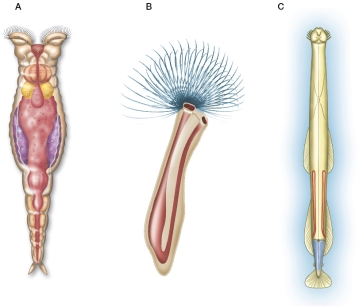 The lophophore is thought to have either evolved independently at least twice, or it is an ancestral feature and has been lost in many groups.Based on the figure, propose an argument as to which of these two statements is correct.
 (Essay)
4.9/5 (80)
(80) In free-living flatworms, which function does not occur by simple diffusion?
(Multiple Choice)
4.9/5 (68)
(68) 
Filters
- Essay(0)
- Multiple Choice(0)
- Short Answer(0)
- True False(0)
- Matching(0)