



 Chat with AI
Exam 31: Protostome Animals

Exam 1: Studying Life246 Questions
Exam 2: Small Molecules and the Chemistry of Life246 Questions
Exam 3: Proteins, Carbohydrates, and Lipids246 Questions
Exam 4: Nucleic Acids and the Origin of Life246 Questions
Exam 5: Cells: the Working Units of Life248 Questions
Exam 6: Cell Membranes246 Questions
Exam 7: Cell Communication and Multicellularity246 Questions
Exam 8: Energy, Enzymes, and Metabolism246 Questions
Exam 9: Pathways That Harvest Chemical Energy246 Questions
Exam 10: Photosynthesis: Energy From Sunlight242 Questions
Exam 11: The Cell Cycle and Cell Division260 Questions
Exam 12: Inheritance, Genes, and Chromosomes250 Questions
Exam 13: Dna and Its Role in Heredity257 Questions
Exam 14: From Dna to Protein: Gene Expression252 Questions
Exam 15: Gene Mutation and Molecular Medicine251 Questions
Exam 16: Regulation of Gene Expression245 Questions
Exam 17: Genomes249 Questions
Exam 18: Recombinant Dna and Biotechnology243 Questions
Exam 20: Mechanisms of Evolution243 Questions
Exam 21: Reconstructing and Using Phylogenies246 Questions
Exam 22: Speciation247 Questions
Exam 23: Evolution of Genes and Genomes252 Questions
Exam 24: The History of Life on Earth246 Questions
Exam 25: Bacteria, Archaea, and Viruses262 Questions
Exam 26: The Origin and Diversification of Eukaryotes252 Questions
Exam 27: Plants Without Seeds: From Water to Land251 Questions
Exam 28: The Evolution of Seed Plants259 Questions
Exam 29: The Evolution and Diversity of Fungi261 Questions
Exam 30: Animal Origins and the Evolution of Body Plans248 Questions
Exam 31: Protostome Animals244 Questions
Exam 32: Deuterostome Animals246 Questions
Exam 33: The Plant Body243 Questions
Exam 34: Transport in Plants248 Questions
Exam 35: Plant Nutrition247 Questions
Exam 36: Regulation of Plant Growth246 Questions
Exam 37: Reproduction in Flowering Plants247 Questions
Exam 38: Plant Responses to Environmental Challenges246 Questions
Exam 39: Physiology, Homeostasis, and Temperature Regulation258 Questions
Exam 40: Animal Hormones249 Questions
Exam 41: Immunology: Animal Defense Systems265 Questions
Exam 42: Animal Reproduction261 Questions
Exam 43: Animal Development261 Questions
Exam 44: Neurons, Glia, and Nervous Systems250 Questions
Exam 45: Sensory Systems249 Questions
Exam 46: The Mammalian Nervous System: Structure and Higher Functions254 Questions
Exam 47: Musculoskeletal Systems259 Questions
Exam 48: Gas Exchange247 Questions
Exam 49: Circulatory Systems252 Questions
Exam 50: Nutrition, Digestion, and Absorption259 Questions
Exam 51: Salt and Water Balance and Nitrogen Excretion251 Questions
Exam 52: Animal Behavior249 Questions
Exam 53: The Physical Environment and Biogeography of Life248 Questions
Exam 54: Populations259 Questions
Exam 55: Species Interactions254 Questions
Exam 56: Communities247 Questions
Exam 57: Ecosystems238 Questions
Exam 58: A Changing Biosphere222 Questions
Select questions type


Adult _______ cannot fold their wings against their bodies.
(Multiple Choice)
4.8/5  (78)
(78) A dragonfly pursuing a prey item into a small crevice would not be able to enter to capture the prey.Dragonflies would be considered _______ insects.
(Multiple Choice)
4.8/5 (89)
(89) Although lophotrochozoan species with spiral cleavage were once grouped together taxonomically as spiralians, gene sequence analysis does not support the spiralian taxon as monophyletic.What conclusion follows from this evidence?
(Multiple Choice)
4.9/5 (79)
(79) A researcher finds a hard, chitinous exoskeleton with eight appendages attached to the cephalothorax.This exoskeleton most likely came from a(n) _______.
(Short Answer)
4.8/5 (74)
(74) The possession of a relatively thin cuticle that is molted periodically as an animal grows to full size is a feature of
(Multiple Choice)
4.9/5 (84)
(84) What characteristics make priapulids, kinorhynchs, and loriciferans members of one clade, separate from the nematodes and horsehair worms? What do these characteristics imply about gas exchange in this clade and the habitats they occupy?
(Essay)
4.9/5 (93)
(93) You discover a new organism with the following characteristics: the body is wormlike and has a fluid-filled cavity, the long protrusible feeding organ looks like a proboscis, and a complete digestive tract is present.The organism is probably a(n)
(Multiple Choice)
4.8/5 (88)
(88) Refer to the figure. 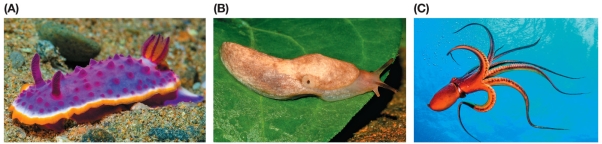 Which three types of organisms are shown? Which structures are common among these organisms? How has modification of these structures led to increased species diversity?
 (Essay)
4.8/5 (86)
(86) Which of the following is not a function of the molluscan foot?
(Multiple Choice)
4.8/5 (88)
(88) Many crustacean species have a fold of exoskeleton called a(n) _______ that extends dorsally and laterally from the head to cover and protect some body segments.
(Short Answer)
4.8/5 (86)
(86) Flatworms have no coelom.Gene sequencing shows that their closest relatives are the bryozoans (which are coelomate) and the rotifers (which are pseudocoelomate).Which of the following is a legitimate conclusion?
(Multiple Choice)
4.8/5 (79)
(79) Many familiar marine arthropods are crabs, lobsters, and shrimps, all of which are _______.
(Short Answer)
4.8/5 (92)
(92) 
Filters
- Essay(0)
- Multiple Choice(0)
- Short Answer(0)
- True False(0)
- Matching(0)