



 Chat with AI
Exam 6: Cell Membranes

Exam 1: Studying Life246 Questions
Exam 2: Small Molecules and the Chemistry of Life246 Questions
Exam 3: Proteins, Carbohydrates, and Lipids246 Questions
Exam 4: Nucleic Acids and the Origin of Life246 Questions
Exam 5: Cells: the Working Units of Life248 Questions
Exam 6: Cell Membranes246 Questions
Exam 7: Cell Communication and Multicellularity246 Questions
Exam 8: Energy, Enzymes, and Metabolism246 Questions
Exam 9: Pathways That Harvest Chemical Energy246 Questions
Exam 10: Photosynthesis: Energy From Sunlight242 Questions
Exam 11: The Cell Cycle and Cell Division260 Questions
Exam 12: Inheritance, Genes, and Chromosomes250 Questions
Exam 13: Dna and Its Role in Heredity257 Questions
Exam 14: From Dna to Protein: Gene Expression252 Questions
Exam 15: Gene Mutation and Molecular Medicine251 Questions
Exam 16: Regulation of Gene Expression245 Questions
Exam 17: Genomes249 Questions
Exam 18: Recombinant Dna and Biotechnology243 Questions
Exam 20: Mechanisms of Evolution243 Questions
Exam 21: Reconstructing and Using Phylogenies246 Questions
Exam 22: Speciation247 Questions
Exam 23: Evolution of Genes and Genomes252 Questions
Exam 24: The History of Life on Earth246 Questions
Exam 25: Bacteria, Archaea, and Viruses262 Questions
Exam 26: The Origin and Diversification of Eukaryotes252 Questions
Exam 27: Plants Without Seeds: From Water to Land251 Questions
Exam 28: The Evolution of Seed Plants259 Questions
Exam 29: The Evolution and Diversity of Fungi261 Questions
Exam 30: Animal Origins and the Evolution of Body Plans248 Questions
Exam 31: Protostome Animals244 Questions
Exam 32: Deuterostome Animals246 Questions
Exam 33: The Plant Body243 Questions
Exam 34: Transport in Plants248 Questions
Exam 35: Plant Nutrition247 Questions
Exam 36: Regulation of Plant Growth246 Questions
Exam 37: Reproduction in Flowering Plants247 Questions
Exam 38: Plant Responses to Environmental Challenges246 Questions
Exam 39: Physiology, Homeostasis, and Temperature Regulation258 Questions
Exam 40: Animal Hormones249 Questions
Exam 41: Immunology: Animal Defense Systems265 Questions
Exam 42: Animal Reproduction261 Questions
Exam 43: Animal Development261 Questions
Exam 44: Neurons, Glia, and Nervous Systems250 Questions
Exam 45: Sensory Systems249 Questions
Exam 46: The Mammalian Nervous System: Structure and Higher Functions254 Questions
Exam 47: Musculoskeletal Systems259 Questions
Exam 48: Gas Exchange247 Questions
Exam 49: Circulatory Systems252 Questions
Exam 50: Nutrition, Digestion, and Absorption259 Questions
Exam 51: Salt and Water Balance and Nitrogen Excretion251 Questions
Exam 52: Animal Behavior249 Questions
Exam 53: The Physical Environment and Biogeography of Life248 Questions
Exam 54: Populations259 Questions
Exam 55: Species Interactions254 Questions
Exam 56: Communities247 Questions
Exam 57: Ecosystems238 Questions
Exam 58: A Changing Biosphere222 Questions
Select questions type


Refer to the figures and table below. 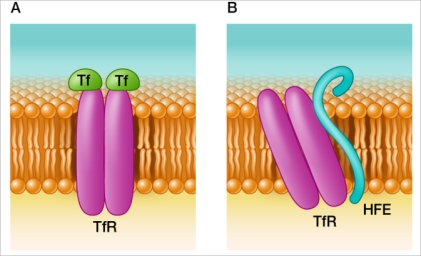
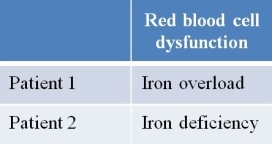 Human blood cell membranes import iron into the cell via receptor-mediated endocytosis.They do this using transferrin receptors to bind the iron-carrier protein transferrin, which carries two Fe3+ ions per protein molecule.Panel A of the figure above shows two transferrin molecules (Tf) bound to one receptor (TfR).Panel B shows the interaction between the regulatory protein HFE and the transferrin receptor, which results in inhibition of transferrin binding to the transferrin receptor.Genetic mutations in transferrin, transferrin receptor, or HFE can lead to red blood cell dysfunctions.How might mutations be involved in the two cases summarized in the table?
Free
(Multiple Choice)
4.8/5  (76)
(76) Correct Answer: Verified
E
The cell membrane contains carbohydrates, which can serve as recognition sites for other molecules.The carbohydrates may be bonded to
Free
(Multiple Choice)
4.8/5 (86)
(86) Correct Answer:Verified
VerifiedE
A protein that forms an ion channel in a membrane is most likely to be
Free
(Multiple Choice)
4.9/5 (76)
(76) Correct Answer:Verified
VerifiedB
In facilitated diffusion, the diffusion rate of a specific molecule across a membrane does not continue to increase as the molecule's concentration difference across the membrane increases beyond a certain point.The reason is that
(Multiple Choice)
4.7/5 (78)
(78) Refer to the figure below showing the molecular structure of dimethylmercury. 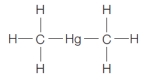 Exposure of human skin to a single drop of dimethylmercury can lead to death, as it passes easily through cell membranes because it is _______.
 (Short Answer)
4.8/5 (86)
(86) The membrane protein that transports glucose and sodium ions into intestinal epithelial cells simultaneously is an example of a(n) _______.
(Short Answer)
4.9/5 (91)
(91) Scientists have been able to engineer young laboratory mice to have a defective gene for a particular integrin protein only in epidermal skin cells.These mice develop into adults with severe hair loss and skin blistering.Which statement explains the connection between the mutation and the observed physical problems of the mice?
(Multiple Choice)
4.8/5 (78)
(78) Which is the name of a specialized cell junction that allows rapid spread of electric current via the flow of ions between animal cells?
(Multiple Choice)
4.9/5 (79)
(79) Integrin on the cell surface of a white blood cell binds reversibly with the extracellular matrix of blood vessel walls.This reversibility allows for
(Multiple Choice)
4.9/5 (80)
(80) Refer to the figure below showing concentrations of three ions inside and outside a cell, as well as the direction of transport of each ion facilitated by a membrane protein. 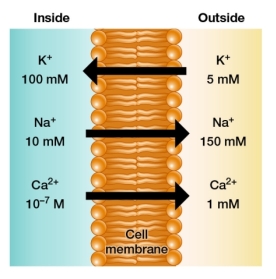 Which ions are moved by active transport and why?
 (Multiple Choice)
4.8/5 (82)
(82) Which statement correctly describes a trout that lives in fresh water?
(Multiple Choice)
4.8/5 (73)
(73) Which strategy is paired with an appropriate consequence that would enable a cell to maintain homeostasis when placed in a vessel of pure water?
(Multiple Choice)
4.7/5 (78)
(78) Refer to the table below. 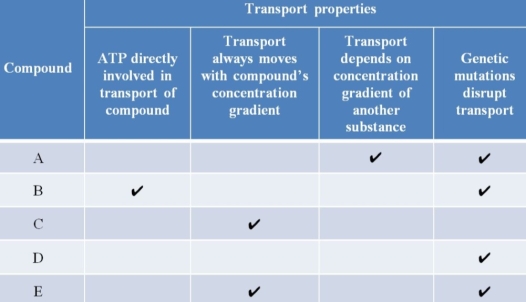 Five compounds labeled A through E are known to be transported into cells across the cell membrane.Some of the properties of each transport mechanism are summarized in the table.A check mark indicates that a compound's transport mechanism has the property described.Which compound might be transported via receptor-mediated endocytosis?
 (Multiple Choice)
5.0/5 (84)
(84) Refer to the figure below. 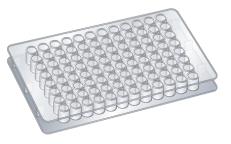 Biologists sometimes use plastic containers called microtiter plates to analyze biological interactions.The microtiter plate contains 96 wells of equal size, each of which holds 0.1-0.3 mL of liquid.When using the plate, a biologist covalently attaches (immobilizes) a different molecule to each well and then add cells suspended in a liquid.After an incubation period, cells that do not bind are washed away, and the whole plate is treated with a cell stain.The amount of stain observed in each well gives an indication of the number of cells binding to the immobilized molecule.Which molecules might the biologist attach to the wells prior to running an experiment to determine the specificity of recognition of a particular cell type for another cell type?
 (Multiple Choice)
4.8/5 (72)
(72) You are examining the membrane of a cell and notice many carbohydrates in the cell membrane.What role do these carbohydrates most likely play?
(Essay)
4.9/5 (77)
(77) Vertebrate animals have integral membrane proteins known as cadherins that all have similar structures and function in cell adhesion.Certain mutations in these proteins found in mice cause cells in mouse embryos to fall apart, leading to deaths of the embryos.Some of these mutations could affect the hydrophilic part of the protein molecule, disrupting its ability to recognize and _______to a region of another cadherin molecule.
(Short Answer)
4.9/5 (81)
(81) When cells arrange themselves into groups through cell recognition and specific types of binding, the connections between the cells are further strengthened by _______.
(Short Answer)
4.9/5 (71)
(71) The process by which the cell membrane engulfs large particles or even whole cells is called _______.
(Short Answer)
4.8/5 (82)
(82) Heart defects can cause severe problems in newborn infants.One type of defect occurs when an infant inherits a mutation in the gene encoding connexin, the protein that is the structural component of gap junctions between heart cells.Connexin mutants can cause arrhythmia, which is an abnormal heartbeat.In these cases, cardiac cells are unable to beat in unison because of the lack of a rapid spread of ________ among cells.
(Short Answer)
4.7/5 (80)
(80) 
Filters
- Essay(0)
- Multiple Choice(0)
- Short Answer(0)
- True False(0)
- Matching(0)