



 Chat with AI
Exam 6: Cell Membranes

Exam 1: Studying Life246 Questions
Exam 2: Small Molecules and the Chemistry of Life246 Questions
Exam 3: Proteins, Carbohydrates, and Lipids246 Questions
Exam 4: Nucleic Acids and the Origin of Life246 Questions
Exam 5: Cells: the Working Units of Life248 Questions
Exam 6: Cell Membranes246 Questions
Exam 7: Cell Communication and Multicellularity246 Questions
Exam 8: Energy, Enzymes, and Metabolism246 Questions
Exam 9: Pathways That Harvest Chemical Energy246 Questions
Exam 10: Photosynthesis: Energy From Sunlight242 Questions
Exam 11: The Cell Cycle and Cell Division260 Questions
Exam 12: Inheritance, Genes, and Chromosomes250 Questions
Exam 13: Dna and Its Role in Heredity257 Questions
Exam 14: From Dna to Protein: Gene Expression252 Questions
Exam 15: Gene Mutation and Molecular Medicine251 Questions
Exam 16: Regulation of Gene Expression245 Questions
Exam 17: Genomes249 Questions
Exam 18: Recombinant Dna and Biotechnology243 Questions
Exam 20: Mechanisms of Evolution243 Questions
Exam 21: Reconstructing and Using Phylogenies246 Questions
Exam 22: Speciation247 Questions
Exam 23: Evolution of Genes and Genomes252 Questions
Exam 24: The History of Life on Earth246 Questions
Exam 25: Bacteria, Archaea, and Viruses262 Questions
Exam 26: The Origin and Diversification of Eukaryotes252 Questions
Exam 27: Plants Without Seeds: From Water to Land251 Questions
Exam 28: The Evolution of Seed Plants259 Questions
Exam 29: The Evolution and Diversity of Fungi261 Questions
Exam 30: Animal Origins and the Evolution of Body Plans248 Questions
Exam 31: Protostome Animals244 Questions
Exam 32: Deuterostome Animals246 Questions
Exam 33: The Plant Body243 Questions
Exam 34: Transport in Plants248 Questions
Exam 35: Plant Nutrition247 Questions
Exam 36: Regulation of Plant Growth246 Questions
Exam 37: Reproduction in Flowering Plants247 Questions
Exam 38: Plant Responses to Environmental Challenges246 Questions
Exam 39: Physiology, Homeostasis, and Temperature Regulation258 Questions
Exam 40: Animal Hormones249 Questions
Exam 41: Immunology: Animal Defense Systems265 Questions
Exam 42: Animal Reproduction261 Questions
Exam 43: Animal Development261 Questions
Exam 44: Neurons, Glia, and Nervous Systems250 Questions
Exam 45: Sensory Systems249 Questions
Exam 46: The Mammalian Nervous System: Structure and Higher Functions254 Questions
Exam 47: Musculoskeletal Systems259 Questions
Exam 48: Gas Exchange247 Questions
Exam 49: Circulatory Systems252 Questions
Exam 50: Nutrition, Digestion, and Absorption259 Questions
Exam 51: Salt and Water Balance and Nitrogen Excretion251 Questions
Exam 52: Animal Behavior249 Questions
Exam 53: The Physical Environment and Biogeography of Life248 Questions
Exam 54: Populations259 Questions
Exam 55: Species Interactions254 Questions
Exam 56: Communities247 Questions
Exam 57: Ecosystems238 Questions
Exam 58: A Changing Biosphere222 Questions
Select questions type


Cells secrete materials to the exterior environment through the process of
(Multiple Choice)
4.8/5  (68)
(68) An important difference between phagocytosis and receptor-mediated endocytosis is that
(Multiple Choice)
5.0/5 (73)
(73) Plants depend on their cell walls to limit the amount of water entering their cells and maintain _______, which helps keep plants upright.
(Multiple Choice)
4.9/5 (77)
(77) In animals, the solute balance of the plasma surrounding blood cells must be carefully maintained so that the blood cells are not affected by changes in fluid or solute balance.If the plasma becomes hypotonic compared with the blood cells, what will be the effect?
(Multiple Choice)
4.9/5 (87)
(87) Receptor-mediated endocytosis is the mechanism for the import of
(Multiple Choice)
4.7/5 (91)
(91) For each molecule of ATP consumed during active transport of sodium and potassium, there is an import of _______ ion(s) and an export of _______ ion(s).
(Multiple Choice)
4.9/5 (81)
(81) Which analogy could best be used to describe the molecular structures interacting at the point of attachment between two animal cells physically bound to one another?
(Multiple Choice)
4.8/5 (77)
(77) Regardless of the specific type of molecule or particle being transported, endocytosis always involves
(Multiple Choice)
4.9/5 (78)
(78) If tight junctions were replaced by desmosomes in cells lining the bladder,
(Multiple Choice)
4.9/5 (81)
(81) Cells can move substances from their cytoplasms into the external environment via
(Multiple Choice)
4.8/5 (73)
(73) White blood cells can defend the body against invaders through
(Multiple Choice)
5.0/5 (58)
(58) A researcher studying a line of mouse skin cells has identified an oligosaccharide group attached to the cells' surfaces.What experiment should the researcher perform to test whether this oligosaccharide is important in cell-cell recognition?
(Multiple Choice)
4.7/5 (75)
(75) Refer to the figure below. 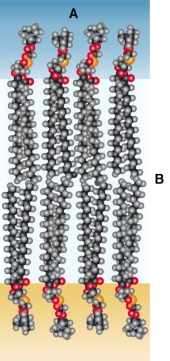 Which statement about the lipid bilayer shown in the figure is false?
 (Multiple Choice)
4.9/5 (91)
(91) Refer to the figure below showing the structure of a phospholipid molecule. 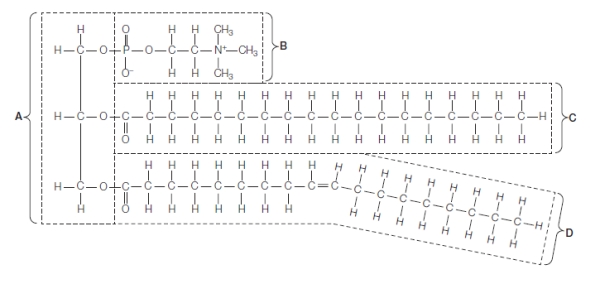 Which statement explains how this molecule is involved in the makeup of a cell membrane?
 (Multiple Choice)
4.7/5 (79)
(79) You are working in a lab that is studying cell recognition and cell attachment in a red sponge.You need to culture individual cells in a medium that promotes cell recognition and attachment of isolated cells.Which of the following would you add to the culture medium?
(Multiple Choice)
4.8/5 (86)
(86) Refer to the figure and table below. 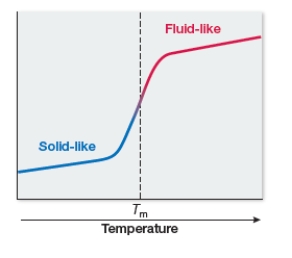
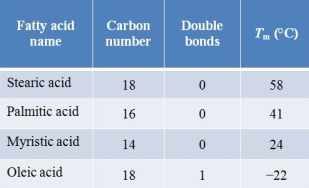 At low temperatures, cell membranes become quite immobile and solid-like.If the temperature is gradually increased, a membrane undergoes small changes until a large change in fluidity is observed.The midpoint temperature corresponding to this large change is called the melting temperature.The graph shows how a cell membrane's melting temperature (Tm) is measured.The table shows melting temperature data collected from membranes composed of phospholipids containing different fatty acids.Which statement is consistent with these data?
 (Multiple Choice)
4.7/5 (87)
(87) If a red blood cell with an internal salt concentration of about 0.85 percent is placed in a solution that is 4 percent salt,
(Multiple Choice)
4.8/5 (87)
(87) A marathon runner has just arrived in the emergency room with severe dehydration, and the physician must decide which type of solution to pump into his veins: pure water, 0.9 percent saline, or 1.5 percent saline.Blood cells are approximately 0.9 percent saline.Describe what is likely to happen to the blood cells when they are exposed to each solution.
(Essay)
4.9/5 (88)
(88) 
Filters
- Essay(0)
- Multiple Choice(0)
- Short Answer(0)
- True False(0)
- Matching(0)