



 Chat with AI
Exam 6: Cell Membranes

Exam 1: Studying Life246 Questions
Exam 2: Small Molecules and the Chemistry of Life246 Questions
Exam 3: Proteins, Carbohydrates, and Lipids246 Questions
Exam 4: Nucleic Acids and the Origin of Life246 Questions
Exam 5: Cells: the Working Units of Life248 Questions
Exam 6: Cell Membranes246 Questions
Exam 7: Cell Communication and Multicellularity246 Questions
Exam 8: Energy, Enzymes, and Metabolism246 Questions
Exam 9: Pathways That Harvest Chemical Energy246 Questions
Exam 10: Photosynthesis: Energy From Sunlight242 Questions
Exam 11: The Cell Cycle and Cell Division260 Questions
Exam 12: Inheritance, Genes, and Chromosomes250 Questions
Exam 13: Dna and Its Role in Heredity257 Questions
Exam 14: From Dna to Protein: Gene Expression252 Questions
Exam 15: Gene Mutation and Molecular Medicine251 Questions
Exam 16: Regulation of Gene Expression245 Questions
Exam 17: Genomes249 Questions
Exam 18: Recombinant Dna and Biotechnology243 Questions
Exam 20: Mechanisms of Evolution243 Questions
Exam 21: Reconstructing and Using Phylogenies246 Questions
Exam 22: Speciation247 Questions
Exam 23: Evolution of Genes and Genomes252 Questions
Exam 24: The History of Life on Earth246 Questions
Exam 25: Bacteria, Archaea, and Viruses262 Questions
Exam 26: The Origin and Diversification of Eukaryotes252 Questions
Exam 27: Plants Without Seeds: From Water to Land251 Questions
Exam 28: The Evolution of Seed Plants259 Questions
Exam 29: The Evolution and Diversity of Fungi261 Questions
Exam 30: Animal Origins and the Evolution of Body Plans248 Questions
Exam 31: Protostome Animals244 Questions
Exam 32: Deuterostome Animals246 Questions
Exam 33: The Plant Body243 Questions
Exam 34: Transport in Plants248 Questions
Exam 35: Plant Nutrition247 Questions
Exam 36: Regulation of Plant Growth246 Questions
Exam 37: Reproduction in Flowering Plants247 Questions
Exam 38: Plant Responses to Environmental Challenges246 Questions
Exam 39: Physiology, Homeostasis, and Temperature Regulation258 Questions
Exam 40: Animal Hormones249 Questions
Exam 41: Immunology: Animal Defense Systems265 Questions
Exam 42: Animal Reproduction261 Questions
Exam 43: Animal Development261 Questions
Exam 44: Neurons, Glia, and Nervous Systems250 Questions
Exam 45: Sensory Systems249 Questions
Exam 46: The Mammalian Nervous System: Structure and Higher Functions254 Questions
Exam 47: Musculoskeletal Systems259 Questions
Exam 48: Gas Exchange247 Questions
Exam 49: Circulatory Systems252 Questions
Exam 50: Nutrition, Digestion, and Absorption259 Questions
Exam 51: Salt and Water Balance and Nitrogen Excretion251 Questions
Exam 52: Animal Behavior249 Questions
Exam 53: The Physical Environment and Biogeography of Life248 Questions
Exam 54: Populations259 Questions
Exam 55: Species Interactions254 Questions
Exam 56: Communities247 Questions
Exam 57: Ecosystems238 Questions
Exam 58: A Changing Biosphere222 Questions
Select questions type


A student claims that cell recognition and cell adhesion refer to the same function.Which statement best evaluates this claim?
(Multiple Choice)
4.7/5  (82)
(82) Root hair cells in plant roots use active transport to take up nitrate ions from the soil.Active transport is used because it requires energy to move nitrate ions from a _______ concentration in the soil into the plant cells.
(Short Answer)
4.8/5 (79)
(79) Which molecule can function as a recognition signal for interactions between animal cells?
(Multiple Choice)
4.8/5 (87)
(87) When a severely dehydrated patient is brought to the hospital, an intravenous drip of saline is started immediately.Sterile deionized water is not used because
(Multiple Choice)
4.8/5 (71)
(71) Refer to the figure below. 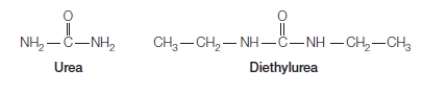 The figure shows the molecular structures of urea and diethylurea.Both molecules can pass through biological membranes via simple diffusion, but diethylurea will diffuse through a membrane at a rate 50 times greater than that of urea.This is because diethylurea is _______ nonpolar than urea.
 (Short Answer)
4.8/5 (65)
(65) Which is a correct pairing of a substance and the process by which it is transported across cell membranes?
(Multiple Choice)
4.9/5 (84)
(84) Refer to the image below. 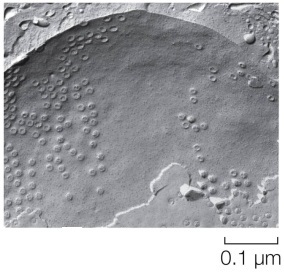 In order to study the distribution of proteins within membranes from different types of cells, a researcher could use the _______ technique to generate images by electron microscopy, such as the one shown above.
 (Short Answer)
4.8/5 (81)
(81) All of the following processes occur in normal cell development and metabolism.Which pair of processes is most important during development when cells are aggregating into tissues?
(Multiple Choice)
4.8/5 (68)
(68) If a shallow pan is filled with water, a drop of red ink is placed in one end of the pan, and a drop of green ink is placed in the other end, which of the following will be true at equilibrium?
(Multiple Choice)
4.9/5 (89)
(89) Adjacent animal cells may be bound together by _______, _______, and _______.
(Multiple Choice)
4.9/5 (91)
(91) Channels that run between pores of adjacent heart cells are called _______.
(Short Answer)
4.9/5 (80)
(80) Phagocytosis, pinocytosis, and receptor-mediated endocytosis all involve
(Multiple Choice)
4.7/5 (72)
(72) Refer to the figure below. 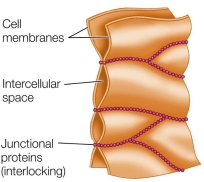 The type of cell junction shown is most efficient in
 (Multiple Choice)
4.8/5 (67)
(67) A species of fish that lives in the ocean has cells with a lower solute concentration than the surrounding ocean waters.To maintain cell homeostasis under these conditions, these fish
(Multiple Choice)
4.9/5 (71)
(71) Sponges are multicellular organisms whose bodies allow water to circulate freely.If isolated cells from one species were added to a solution of isolated cells from another species, what would you expect in terms of binding among the cells?
(Multiple Choice)
4.9/5 (81)
(81) Refer to the figure below, which shows the results of an experiment in which cells from two different species were fused to form a single large cell.Membrane proteins labeled with different-colored dyes were observed and found to undergo mixing and become uniformly distributed after 40 minutes. 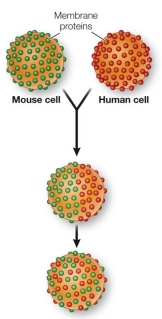 The experiment was repeated at a lower temperature, and the same uniform distribution was observed, but it required a much longer time to achieve.These results indicate that temperature affects the _______ of a biological membrane.
 (Short Answer)
4.9/5 (81)
(81) Binding that occurs between different molecules on different cells that have an affinity for each other, such as a mammalian egg and sperm cell, is referred to as _______ binding.
(Short Answer)
4.7/5 (76)
(76) Freeze-fracturing is a useful tool for revealing _______ proteins.
(Multiple Choice)
4.9/5 (90)
(90) Studies of isolated animal cells mixed together randomly and then placed in culture dishes have shown that they sort themselves out according to the types of membrane proteins they express.The figure below shows an example of this sorting-out process. 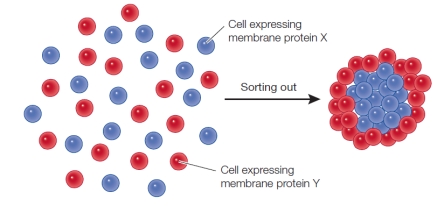 Explain the molecular basis for how cells sort themselves out and form attachments to one another in producing the end product shown.
 (Essay)
4.9/5 (68)
(68) 
Filters
- Essay(0)
- Multiple Choice(0)
- Short Answer(0)
- True False(0)
- Matching(0)