



 Chat with AI
Exam 6: Cell Membranes

Exam 1: Studying Life246 Questions
Exam 2: Small Molecules and the Chemistry of Life246 Questions
Exam 3: Proteins, Carbohydrates, and Lipids246 Questions
Exam 4: Nucleic Acids and the Origin of Life246 Questions
Exam 5: Cells: the Working Units of Life248 Questions
Exam 6: Cell Membranes246 Questions
Exam 7: Cell Communication and Multicellularity246 Questions
Exam 8: Energy, Enzymes, and Metabolism246 Questions
Exam 9: Pathways That Harvest Chemical Energy246 Questions
Exam 10: Photosynthesis: Energy From Sunlight242 Questions
Exam 11: The Cell Cycle and Cell Division260 Questions
Exam 12: Inheritance, Genes, and Chromosomes250 Questions
Exam 13: Dna and Its Role in Heredity257 Questions
Exam 14: From Dna to Protein: Gene Expression252 Questions
Exam 15: Gene Mutation and Molecular Medicine251 Questions
Exam 16: Regulation of Gene Expression245 Questions
Exam 17: Genomes249 Questions
Exam 18: Recombinant Dna and Biotechnology243 Questions
Exam 20: Mechanisms of Evolution243 Questions
Exam 21: Reconstructing and Using Phylogenies246 Questions
Exam 22: Speciation247 Questions
Exam 23: Evolution of Genes and Genomes252 Questions
Exam 24: The History of Life on Earth246 Questions
Exam 25: Bacteria, Archaea, and Viruses262 Questions
Exam 26: The Origin and Diversification of Eukaryotes252 Questions
Exam 27: Plants Without Seeds: From Water to Land251 Questions
Exam 28: The Evolution of Seed Plants259 Questions
Exam 29: The Evolution and Diversity of Fungi261 Questions
Exam 30: Animal Origins and the Evolution of Body Plans248 Questions
Exam 31: Protostome Animals244 Questions
Exam 32: Deuterostome Animals246 Questions
Exam 33: The Plant Body243 Questions
Exam 34: Transport in Plants248 Questions
Exam 35: Plant Nutrition247 Questions
Exam 36: Regulation of Plant Growth246 Questions
Exam 37: Reproduction in Flowering Plants247 Questions
Exam 38: Plant Responses to Environmental Challenges246 Questions
Exam 39: Physiology, Homeostasis, and Temperature Regulation258 Questions
Exam 40: Animal Hormones249 Questions
Exam 41: Immunology: Animal Defense Systems265 Questions
Exam 42: Animal Reproduction261 Questions
Exam 43: Animal Development261 Questions
Exam 44: Neurons, Glia, and Nervous Systems250 Questions
Exam 45: Sensory Systems249 Questions
Exam 46: The Mammalian Nervous System: Structure and Higher Functions254 Questions
Exam 47: Musculoskeletal Systems259 Questions
Exam 48: Gas Exchange247 Questions
Exam 49: Circulatory Systems252 Questions
Exam 50: Nutrition, Digestion, and Absorption259 Questions
Exam 51: Salt and Water Balance and Nitrogen Excretion251 Questions
Exam 52: Animal Behavior249 Questions
Exam 53: The Physical Environment and Biogeography of Life248 Questions
Exam 54: Populations259 Questions
Exam 55: Species Interactions254 Questions
Exam 56: Communities247 Questions
Exam 57: Ecosystems238 Questions
Exam 58: A Changing Biosphere222 Questions
Select questions type


In cells lining the stomach, the movement of chloride ions into the cells is coupled to the transport of bicarbonate ions out of the cells.This type of transport system most likely uses
(Multiple Choice)
4.9/5  (72)
(72) The compounds in a biological membrane that form a barrier to the movement of hydrophilic materials across the membrane are
(Multiple Choice)
4.8/5 (70)
(70) Refer to the two figures below. 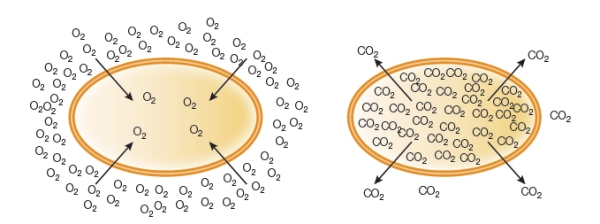 The figures show the interaction of the same human muscle cell with oxygen and carbon dioxide.Which statement is correct and supported by these figures?
 (Multiple Choice)
4.8/5 (81)
(81) Refer to the figure below. 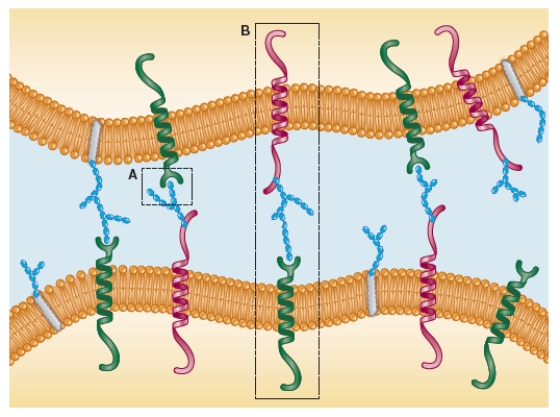 This diagram can be used to describe two cellular processes that involve membrane proteins.As shown in box A, the process of cell recognition refers to the specific interactions between carbohydrate groups and amino acid groups that allow one cell to identify another cell.As shown in box B, the process of cell _______ results from the strong linkage of two membrane-embedded molecules from two different cells.
 (Short Answer)
4.7/5 (81)
(81) The function of the clathrin molecules that coat vesicles in receptor-mediated endocytosis is to
(Multiple Choice)
4.8/5 (78)
(78) The speed and direction of ions as they move through channels in the cell membrane are determined by the
(Multiple Choice)
4.9/5 (77)
(77) Temperature has an effect on the fluidity of plasma membranes.Some organisms are able to maintain their membranes' fluidity when it is extremely cold by
(Multiple Choice)
5.0/5 (74)
(74) In a biological membrane, the phospholipids are arranged in a _______, with the _______.
(Multiple Choice)
4.8/5 (88)
(88) The process of osmosis allows water molecules to pass through specialized channels in membranes.Which statement about osmosis is true?
(Multiple Choice)
4.8/5 (66)
(66) Refer to the figure below. 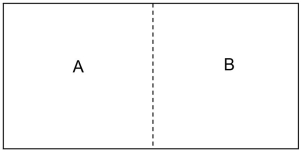 Areas A and B are separated by a membrane that is permeable to a substance X.Which set of conditions will result in the greatest rate of diffusion of X into area A?
 (Multiple Choice)
4.9/5 (72)
(72) Which experimental observation would provide evidence that a bacterial membrane protein transfers the sugar lactose into the cell via secondary active transport?
(Multiple Choice)
4.7/5 (78)
(78) When plant cells are placed in a hypotonic solution, water enters the cells and exerts pressure against the cell wall.This force is called _______.
(Short Answer)
4.8/5 (86)
(86) Refer to the figure below. 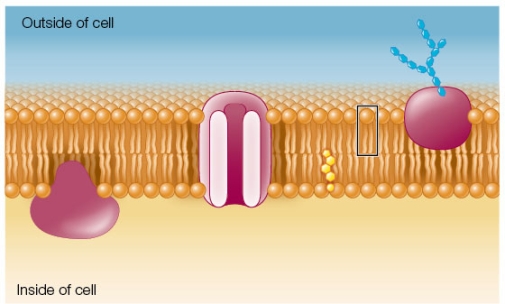 The molecule outlined by a black box represents a phospholipid, which has a phosphate head and two fatty acid tails.The head is _______ because it readily interacts with the aqueous environment.
 (Short Answer)
4.8/5 (74)
(74) Many animal cells have a sodium-potassium pump that moves Na+ ions out of the cell and K+ ions in.This is an example of a(n)
(Multiple Choice)
4.7/5 (88)
(88) If the hydrophilic side chains of a transmembrane protein were removed, the protein would most likely
(Multiple Choice)
5.0/5 (76)
(76) Male and female reproductive cells in animals can recognize each other via specific glycoproteins present on their cell surfaces.Each cell produces a different glycoprotein that recognizes the other.This is an example of _______ binding.
(Multiple Choice)
5.0/5 (74)
(74) Refer to the table below. 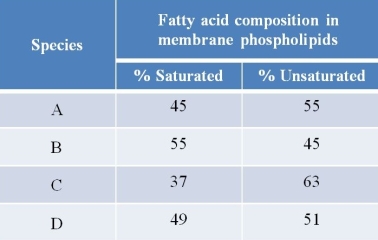 The table shows data collected from analyses of the phospholipid compositions of cell membranes isolated from four different animal species.Based on these data, species _______ is the one most likely to live in the Arctic.
 (Short Answer)
4.8/5 (80)
(80) Refer to the figures below. 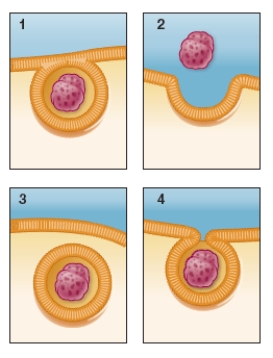 The correct sequence of figures for showing the process of endocytosis is _______.
 (Short Answer)
4.8/5 (75)
(75) Refer to the table below summarizing information about two membrane proteins. 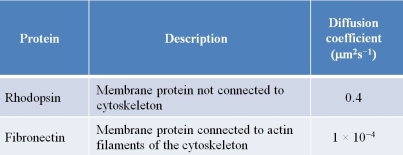 Diffusion coefficients indicate the rates at which proteins diffuse laterally through the cell membrane.What property of cell membranes is illustrated by a comparison of the information shown about these two proteins, and how does this property fit in with the current model used to describe the cell membrane?
 (Essay)
4.8/5 (82)
(82) 
Filters
- Essay(0)
- Multiple Choice(0)
- Short Answer(0)
- True False(0)
- Matching(0)