



 Chat with AI
Exam 6: Cell Membranes

Exam 1: Studying Life246 Questions
Exam 2: Small Molecules and the Chemistry of Life246 Questions
Exam 3: Proteins, Carbohydrates, and Lipids246 Questions
Exam 4: Nucleic Acids and the Origin of Life246 Questions
Exam 5: Cells: the Working Units of Life248 Questions
Exam 6: Cell Membranes246 Questions
Exam 7: Cell Communication and Multicellularity246 Questions
Exam 8: Energy, Enzymes, and Metabolism246 Questions
Exam 9: Pathways That Harvest Chemical Energy246 Questions
Exam 10: Photosynthesis: Energy From Sunlight242 Questions
Exam 11: The Cell Cycle and Cell Division260 Questions
Exam 12: Inheritance, Genes, and Chromosomes250 Questions
Exam 13: Dna and Its Role in Heredity257 Questions
Exam 14: From Dna to Protein: Gene Expression252 Questions
Exam 15: Gene Mutation and Molecular Medicine251 Questions
Exam 16: Regulation of Gene Expression245 Questions
Exam 17: Genomes249 Questions
Exam 18: Recombinant Dna and Biotechnology243 Questions
Exam 20: Mechanisms of Evolution243 Questions
Exam 21: Reconstructing and Using Phylogenies246 Questions
Exam 22: Speciation247 Questions
Exam 23: Evolution of Genes and Genomes252 Questions
Exam 24: The History of Life on Earth246 Questions
Exam 25: Bacteria, Archaea, and Viruses262 Questions
Exam 26: The Origin and Diversification of Eukaryotes252 Questions
Exam 27: Plants Without Seeds: From Water to Land251 Questions
Exam 28: The Evolution of Seed Plants259 Questions
Exam 29: The Evolution and Diversity of Fungi261 Questions
Exam 30: Animal Origins and the Evolution of Body Plans248 Questions
Exam 31: Protostome Animals244 Questions
Exam 32: Deuterostome Animals246 Questions
Exam 33: The Plant Body243 Questions
Exam 34: Transport in Plants248 Questions
Exam 35: Plant Nutrition247 Questions
Exam 36: Regulation of Plant Growth246 Questions
Exam 37: Reproduction in Flowering Plants247 Questions
Exam 38: Plant Responses to Environmental Challenges246 Questions
Exam 39: Physiology, Homeostasis, and Temperature Regulation258 Questions
Exam 40: Animal Hormones249 Questions
Exam 41: Immunology: Animal Defense Systems265 Questions
Exam 42: Animal Reproduction261 Questions
Exam 43: Animal Development261 Questions
Exam 44: Neurons, Glia, and Nervous Systems250 Questions
Exam 45: Sensory Systems249 Questions
Exam 46: The Mammalian Nervous System: Structure and Higher Functions254 Questions
Exam 47: Musculoskeletal Systems259 Questions
Exam 48: Gas Exchange247 Questions
Exam 49: Circulatory Systems252 Questions
Exam 50: Nutrition, Digestion, and Absorption259 Questions
Exam 51: Salt and Water Balance and Nitrogen Excretion251 Questions
Exam 52: Animal Behavior249 Questions
Exam 53: The Physical Environment and Biogeography of Life248 Questions
Exam 54: Populations259 Questions
Exam 55: Species Interactions254 Questions
Exam 56: Communities247 Questions
Exam 57: Ecosystems238 Questions
Exam 58: A Changing Biosphere222 Questions
Select questions type


What term is used to describe the nonspecific uptake of fluids and dissolved solutes by a cell?
(Multiple Choice)
4.8/5  (91)
(91) Refer to the figure below. 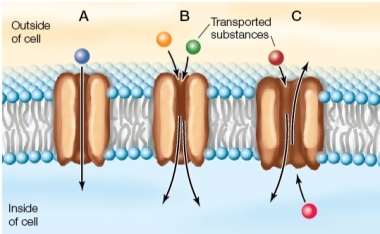 Name the three types of proteins involved in transport, represented by A, B, and C.
 (Essay)
4.8/5 (91)
(91) If a person becomes dehydrated and needs to acquire dissolved solutes rapidly, which cellular process will likely be accelerated?
(Multiple Choice)
4.9/5 (83)
(83) The fluid mosaic model of a biological membrane suggests that the membrane is made up of discrete units that can move freely.Which component most affects the fluidity of the membrane in an animal cell?
(Multiple Choice)
4.9/5 (83)
(83) Integrins are transmembrane proteins that can reversibly link the cytoskeleton of a cell to the extracellular matrix.When there is a transient period during which the cytoskeleton is not linked to the extracellular matrix, the result may be
(Multiple Choice)
4.9/5 (79)
(79) Refer to the table below. 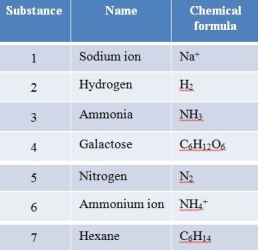 Which substances in the table can be predicted to pass, via simple diffusion, across a biological membrane?
 (Multiple Choice)
4.8/5 (77)
(77) Which of the following experimental designs can be expected to produce evidence that a membrane's fluidity is affected by temperature?
(Multiple Choice)
4.8/5 (87)
(87) Which process will occur if a cell needs to acquire cholesterol from the surrounding environment?
(Multiple Choice)
4.9/5 (74)
(74) Refer to the table below. 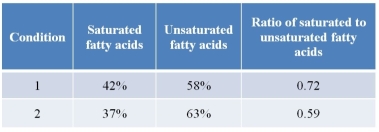 The phospholipids in the cell membranes of a fish species were observed to undergo a change in fatty acid composition when the fish were shifted from one environmental condition to another.Data from an investigation reporting these observations are shown in the table.What property of cell membranes is affected by this change, and how is this property affected?
 (Multiple Choice)
4.9/5 (77)
(77) Refer to the figure below showing the diffusion of a substance into a cell over time. 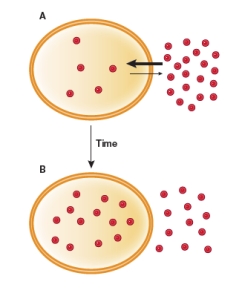 What kind of arrows, if any, should be shown in the part of the figure labeled B?
 (Multiple Choice)
4.7/5 (80)
(80) Two membrane components that serve as cell recognition sites are
(Multiple Choice)
4.7/5 (83)
(83) As shown in Figure 6.15 in the textbook, the uptake of glucose into cells uses energy gained from primary active transport by the sodium-potassium pump.Which statement best describes the use of this energy?
(Multiple Choice)
4.9/5 (90)
(90) Tissues are made up of specialized groups of cells with similar functions.Animal cells are able to arrange themselves through
(Multiple Choice)
4.8/5 (76)
(76) In animal cell junctions, _______ seal intercellular spaces, _______ reinforce attachments, and _______ allow for communication between cells.
(Multiple Choice)
4.9/5 (88)
(88) A cell membrane contains many types of proteins.Which type of protein would most easily be removed from the cell membrane in aqueous conditions in a laboratory experiment?
(Multiple Choice)
4.9/5 (83)
(83) Bacteria and other foreign particles that enter the body can be made harmless by
(Multiple Choice)
4.8/5 (94)
(94) Refer to the diagram below showing the fluid mosaic model. 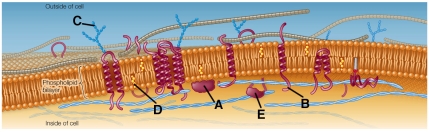 Which of the labeled components affects the fluidity of the animal cell membrane according to the numbers of this component that are present, as well as other characteristics?
 (Short Answer)
4.9/5 (79)
(79) Refer to the figure below showing active transport of amino acids from the intestine into cells lining the small intestine, followed by passive transport into the blood. 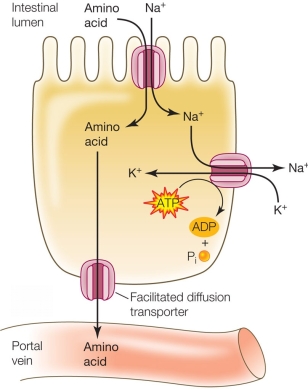 Based on this figure, what terms would be used to describe the mechanism of uptake of amino acids into intestinal cells?
 (Multiple Choice)
4.9/5 (71)
(71) 
Filters
- Essay(0)
- Multiple Choice(0)
- Short Answer(0)
- True False(0)
- Matching(0)