



 Chat with AI
Exam 6: Cell Membranes

Exam 1: Studying Life246 Questions
Exam 2: Small Molecules and the Chemistry of Life246 Questions
Exam 3: Proteins, Carbohydrates, and Lipids246 Questions
Exam 4: Nucleic Acids and the Origin of Life246 Questions
Exam 5: Cells: the Working Units of Life248 Questions
Exam 6: Cell Membranes246 Questions
Exam 7: Cell Communication and Multicellularity246 Questions
Exam 8: Energy, Enzymes, and Metabolism246 Questions
Exam 9: Pathways That Harvest Chemical Energy246 Questions
Exam 10: Photosynthesis: Energy From Sunlight242 Questions
Exam 11: The Cell Cycle and Cell Division260 Questions
Exam 12: Inheritance, Genes, and Chromosomes250 Questions
Exam 13: Dna and Its Role in Heredity257 Questions
Exam 14: From Dna to Protein: Gene Expression252 Questions
Exam 15: Gene Mutation and Molecular Medicine251 Questions
Exam 16: Regulation of Gene Expression245 Questions
Exam 17: Genomes249 Questions
Exam 18: Recombinant Dna and Biotechnology243 Questions
Exam 20: Mechanisms of Evolution243 Questions
Exam 21: Reconstructing and Using Phylogenies246 Questions
Exam 22: Speciation247 Questions
Exam 23: Evolution of Genes and Genomes252 Questions
Exam 24: The History of Life on Earth246 Questions
Exam 25: Bacteria, Archaea, and Viruses262 Questions
Exam 26: The Origin and Diversification of Eukaryotes252 Questions
Exam 27: Plants Without Seeds: From Water to Land251 Questions
Exam 28: The Evolution of Seed Plants259 Questions
Exam 29: The Evolution and Diversity of Fungi261 Questions
Exam 30: Animal Origins and the Evolution of Body Plans248 Questions
Exam 31: Protostome Animals244 Questions
Exam 32: Deuterostome Animals246 Questions
Exam 33: The Plant Body243 Questions
Exam 34: Transport in Plants248 Questions
Exam 35: Plant Nutrition247 Questions
Exam 36: Regulation of Plant Growth246 Questions
Exam 37: Reproduction in Flowering Plants247 Questions
Exam 38: Plant Responses to Environmental Challenges246 Questions
Exam 39: Physiology, Homeostasis, and Temperature Regulation258 Questions
Exam 40: Animal Hormones249 Questions
Exam 41: Immunology: Animal Defense Systems265 Questions
Exam 42: Animal Reproduction261 Questions
Exam 43: Animal Development261 Questions
Exam 44: Neurons, Glia, and Nervous Systems250 Questions
Exam 45: Sensory Systems249 Questions
Exam 46: The Mammalian Nervous System: Structure and Higher Functions254 Questions
Exam 47: Musculoskeletal Systems259 Questions
Exam 48: Gas Exchange247 Questions
Exam 49: Circulatory Systems252 Questions
Exam 50: Nutrition, Digestion, and Absorption259 Questions
Exam 51: Salt and Water Balance and Nitrogen Excretion251 Questions
Exam 52: Animal Behavior249 Questions
Exam 53: The Physical Environment and Biogeography of Life248 Questions
Exam 54: Populations259 Questions
Exam 55: Species Interactions254 Questions
Exam 56: Communities247 Questions
Exam 57: Ecosystems238 Questions
Exam 58: A Changing Biosphere222 Questions
Select questions type


The membrane components that enable a biological membrane to have fluidity are
(Multiple Choice)
4.7/5  (75)
(75) Refer to the figures below: 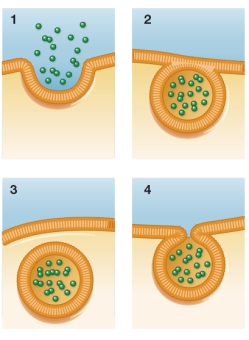 What is the correct sequence of these figures in the process of exocytosis?
 (Short Answer)
4.8/5 (93)
(93) Five statements about cell membranes are given.Which statement provides evidence supporting the fluid nature of the cell membrane?
(Multiple Choice)
4.9/5 (89)
(89) Membrane fragments from different areas of a cell are constantly breaking down, moving, and in some cases fusing with other parts of a membrane.This is possible because of
(Multiple Choice)
4.9/5 (81)
(81) Which is the most likely method for a cell to acquire one particular large molecule from the environment?
(Multiple Choice)
5.0/5 (92)
(92) Suppose you have two identical solutions of glucose, A and B.The solutions are separated by a membrane that will allow the movement of both solutes and water.You want to establish a concentration gradient so that more glucose in solution B will move into solution A.How can you manipulate your experimental setup so that the glucose will move in that direction?
(Multiple Choice)
4.9/5 (76)
(76) Aquaporins are membrane channels that are highly specific to the movement of water.If aquaporins are inserted into the membranes of a cell that does not normally contain them,
(Multiple Choice)
4.8/5 (80)
(80) Channel proteins allow ions that would not normally pass through the cell membrane to pass through via the channel.The property of the channel protein that makes this possible is its pore, which is composed of
(Multiple Choice)
4.9/5 (73)
(73) If hydrolysis of ATP is temporarily blocked, what will be the primary effect on the sodium-potassium pump?
(Multiple Choice)
5.0/5 (84)
(84) You are examining a membrane that contains a number of proteins that appear to be involved in transport of an ion across that membrane.Design an experiment that will allow you to determine whether these transporters are passive transporters or active transporters.
(Essay)
4.9/5 (78)
(78) Transporters that move two substances in the same direction are known as
(Multiple Choice)
4.9/5 (80)
(80) In animal cells, tight junctions and desmosomes differ from one another in that
(Multiple Choice)
4.9/5 (75)
(75) Refer to the figure below. 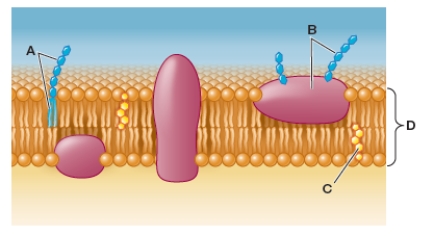 How should the indicated parts of the diagram be labeled?
 (Multiple Choice)
5.0/5 (86)
(86) Refer to the graphs below. 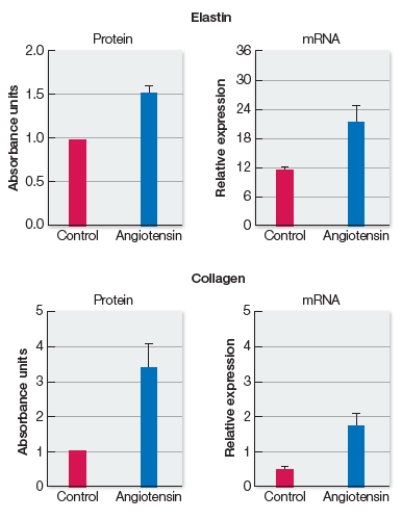 Blood vessels constrict in response to the hormone angiotensin.Researchers questioned the roles of elastin and collagen in this response because they are proteins produced and secreted into the extracellular matrix by smooth muscle cells in blood vessel walls.The graphs show protein and mRNA levels corresponding to elastin and collagen in mouse blood vessels under conditions of prolonged angiotensin exposure.Which statement is consistent with these data?
 (Multiple Choice)
4.9/5 (73)
(73) The plasma membrane of the bacterium Pseudomonas syringae is able to remain fluid when it is extremely cold.The bacterium most likely accomplishes this by
(Multiple Choice)
4.8/5 (72)
(72) Refer to the figures below. 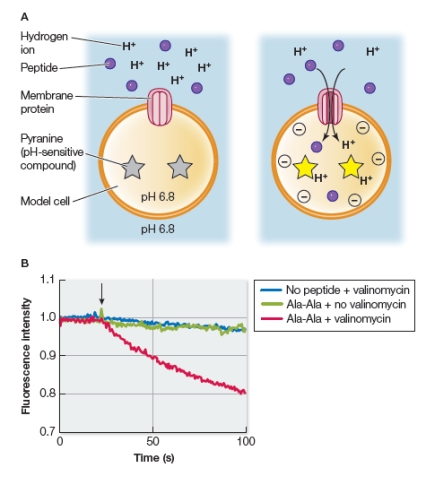 Researchers investigating the uptake of dipeptides by bacterial cells constructed model cells by embedding the membrane protein responsible for peptide transport in a lipid bilayer.They loaded the interior of the model cell with potassium ions and pyranine, a fluorescent molecule that undergoes a decrease in its fluorescence intensity at low pH.The researchers used the small molecule valinomycin to interact with the membrane lipids of the model cell to release potassium ions into the surrounding environment (no membrane protein is needed for this release).Upon doing this, the researchers observed an almost immediate change in fluorescence of the pyranine still inside the model cells, but only under certain conditions, as detailed in the graph.What do the results shown in the graph suggest about the membrane protein?
 (Multiple Choice)
4.8/5 (91)
(91) A barrier to the rapid movement of hydrophilic compounds across biological membranes is made up chiefly of
(Multiple Choice)
4.8/5 (65)
(65) 
Filters
- Essay(0)
- Multiple Choice(0)
- Short Answer(0)
- True False(0)
- Matching(0)