



 Chat with AI
Exam 6: Cell Membranes

Exam 1: Studying Life246 Questions
Exam 2: Small Molecules and the Chemistry of Life246 Questions
Exam 3: Proteins, Carbohydrates, and Lipids246 Questions
Exam 4: Nucleic Acids and the Origin of Life246 Questions
Exam 5: Cells: the Working Units of Life248 Questions
Exam 6: Cell Membranes246 Questions
Exam 7: Cell Communication and Multicellularity246 Questions
Exam 8: Energy, Enzymes, and Metabolism246 Questions
Exam 9: Pathways That Harvest Chemical Energy246 Questions
Exam 10: Photosynthesis: Energy From Sunlight242 Questions
Exam 11: The Cell Cycle and Cell Division260 Questions
Exam 12: Inheritance, Genes, and Chromosomes250 Questions
Exam 13: Dna and Its Role in Heredity257 Questions
Exam 14: From Dna to Protein: Gene Expression252 Questions
Exam 15: Gene Mutation and Molecular Medicine251 Questions
Exam 16: Regulation of Gene Expression245 Questions
Exam 17: Genomes249 Questions
Exam 18: Recombinant Dna and Biotechnology243 Questions
Exam 20: Mechanisms of Evolution243 Questions
Exam 21: Reconstructing and Using Phylogenies246 Questions
Exam 22: Speciation247 Questions
Exam 23: Evolution of Genes and Genomes252 Questions
Exam 24: The History of Life on Earth246 Questions
Exam 25: Bacteria, Archaea, and Viruses262 Questions
Exam 26: The Origin and Diversification of Eukaryotes252 Questions
Exam 27: Plants Without Seeds: From Water to Land251 Questions
Exam 28: The Evolution of Seed Plants259 Questions
Exam 29: The Evolution and Diversity of Fungi261 Questions
Exam 30: Animal Origins and the Evolution of Body Plans248 Questions
Exam 31: Protostome Animals244 Questions
Exam 32: Deuterostome Animals246 Questions
Exam 33: The Plant Body243 Questions
Exam 34: Transport in Plants248 Questions
Exam 35: Plant Nutrition247 Questions
Exam 36: Regulation of Plant Growth246 Questions
Exam 37: Reproduction in Flowering Plants247 Questions
Exam 38: Plant Responses to Environmental Challenges246 Questions
Exam 39: Physiology, Homeostasis, and Temperature Regulation258 Questions
Exam 40: Animal Hormones249 Questions
Exam 41: Immunology: Animal Defense Systems265 Questions
Exam 42: Animal Reproduction261 Questions
Exam 43: Animal Development261 Questions
Exam 44: Neurons, Glia, and Nervous Systems250 Questions
Exam 45: Sensory Systems249 Questions
Exam 46: The Mammalian Nervous System: Structure and Higher Functions254 Questions
Exam 47: Musculoskeletal Systems259 Questions
Exam 48: Gas Exchange247 Questions
Exam 49: Circulatory Systems252 Questions
Exam 50: Nutrition, Digestion, and Absorption259 Questions
Exam 51: Salt and Water Balance and Nitrogen Excretion251 Questions
Exam 52: Animal Behavior249 Questions
Exam 53: The Physical Environment and Biogeography of Life248 Questions
Exam 54: Populations259 Questions
Exam 55: Species Interactions254 Questions
Exam 56: Communities247 Questions
Exam 57: Ecosystems238 Questions
Exam 58: A Changing Biosphere222 Questions
Select questions type


A unicellular organism adapted to living in salt water is placed in a freshwater tank.What is the likely outcome?
(Multiple Choice)
4.8/5  (70)
(70) You are studying the effects of different substances on frog heart muscle cells.You treat the cells with a substance that blocks gap junctions.What do you expect will occur?
(Multiple Choice)
4.8/5 (81)
(81) Refer to the graph below showing the relationship between glucose concentration outside a cell and the rate of facilitated diffusion of glucose across a cell membrane via carrier proteins. 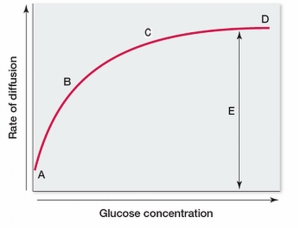 Which label on the graph represents saturation of the carrier proteins?
 (Short Answer)
4.8/5 (93)
(93) Very high cholesterol levels in those with familial hypercholesterolemia are cause by
(Multiple Choice)
5.0/5 (74)
(74) Refer to the figures below. 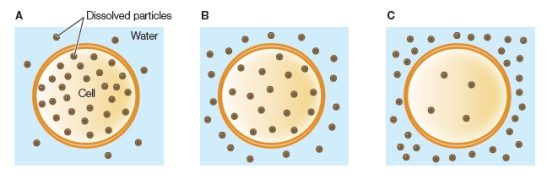 Which statement accurately describes the solutions surrounding the three cells shown in the figures, and in which case will there be a net flow of water out of the cell?
 (Multiple Choice)
4.8/5 (67)
(67) Refer to the figure and table below. 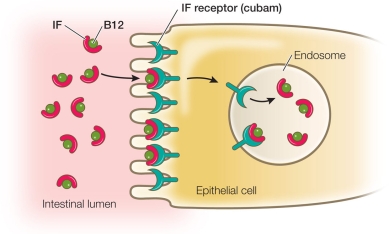
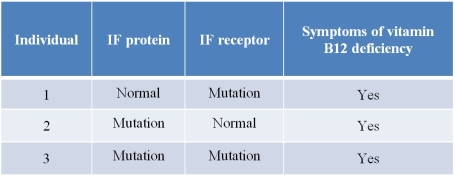 Vitamin B12 is an essential vitamin that humans must acquire from their diets.Within the small intestine, vitamin B12 is taken up by receptor-mediated endocytosis as shown in the figure.The protein labeled IF binds to vitamin B12 molecules in the intestinal lumen, forming a complex.This complex is recognized by the IF receptor present on intestinal cells and stimulates endocytosis when it binds.Vitamin B12 by itself does not bind to the receptor.Individuals known to carry a mutation in either the IF protein or the IF receptor are represented in the table, along with observations about whether symptoms of vitamin B12 deficiency are present.If a drug molecule could be produced that would bind to vitamin B12 and stimulate uptake by intestinal cells, which individual(s) would be expected to benefit, based on the information given?
 (Multiple Choice)
5.0/5 (92)
(92) Water moves across a cell membrane through a channel protein, whereas glucose moves across a cell membrane via a carrier protein.Which statement provides a valid comparison of these two membrane transport systems?
(Multiple Choice)
4.9/5 (73)
(73) Refer to the figure below, which is being created to illustrate secondary active transport. 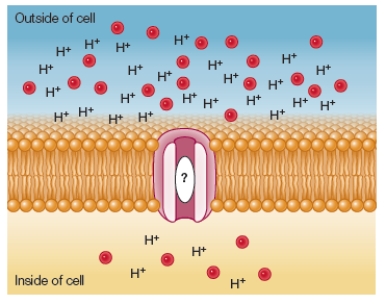 The small red circles represent the molecules being transported, and the H+ symbols represent hydrogen ions.The natural concentration gradient of the red molecules is shown.The hydrogen ion gradient was established by a membrane protein that is not shown.Given this information, which symbol should appear in the oval to indicate the direction of movement of hydrogen ions and red molecules?
 (Multiple Choice)
4.7/5 (77)
(77) Refer to the table below. 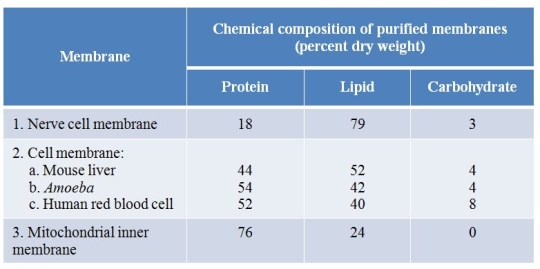 Which statement about biological membranes is supported by these data?
 (Multiple Choice)
4.9/5 (78)
(78) When placed in water, wilted plants regain their leaf turgor because of the
(Multiple Choice)
4.8/5 (85)
(85) Solution X is hypotonic relative to solution Y if X has a solute concentration that is _______ the solute concentration of Y.
(Short Answer)
4.8/5 (85)
(85) Primary active transport requires energy released from the hydrolysis of _______.
(Short Answer)
4.7/5 (81)
(81) Refer to the figure below. 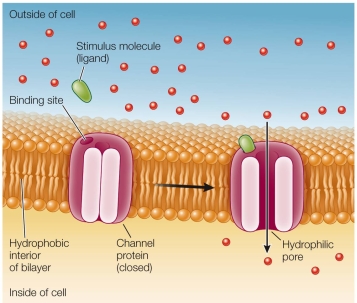 Which statement regarding channel proteins shown in the figure is false?
 (Multiple Choice)
4.9/5 (73)
(73) A biologist wants to compare the integral membrane protein content of cells from mouse liver, pancreas, and intestine.Which experimental procedure should she choose?
(Multiple Choice)
4.8/5 (82)
(82) Refer to the figure below. 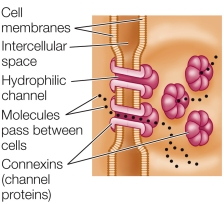 The type of cell junction shown is most efficient in
 (Multiple Choice)
4.8/5 (81)
(81) Refer to the figures below. 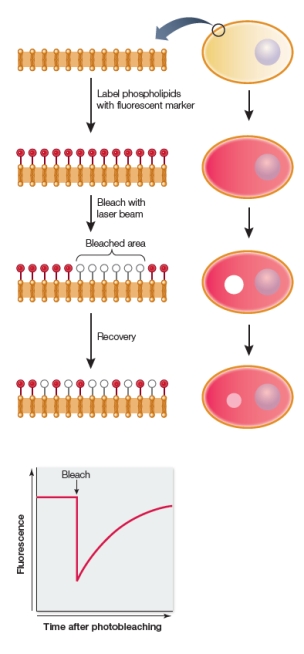 The figures show the experimental procedure and results of an investigation.The phospholipids of the cell membrane of a single cell were chemically reacted with a small fluorescent molecule so that there was uniform labeling of the fluorescent molecule across the membrane.The labeled cell was placed under a fluorescent microscope and observed as light from a laser was directed at a small region of the cell for a microsecond.The light bleached (damaged) the fluorescent molecules in that region so that the molecules were no longer able to fluoresce.In the time period following the bleaching event, recovery of fluorescence in the bleached region was observed and graphed.These results support which statement about cell membranes?
 (Multiple Choice)
4.9/5 (87)
(87) The sodium-potassium pump of cell membranes is an example of a membrane protein called a(n) _______ that moves two substances in opposite directions across a membrane.
(Short Answer)
4.8/5 (72)
(72) Osmosis, the movement of water though specialized membrane channels, is an example of
(Multiple Choice)
4.8/5 (56)
(56) If equal volumes of differently colored solutions are poured into opposite sides of a shallow pool of water, what will be the result at equilibrium?
(Multiple Choice)
4.8/5 (78)
(78) 
Filters
- Essay(0)
- Multiple Choice(0)
- Short Answer(0)
- True False(0)
- Matching(0)