



 Chat with AI
Exam 34: Transport in Plants

Exam 1: Studying Life246 Questions
Exam 2: Small Molecules and the Chemistry of Life246 Questions
Exam 3: Proteins, Carbohydrates, and Lipids246 Questions
Exam 4: Nucleic Acids and the Origin of Life246 Questions
Exam 5: Cells: the Working Units of Life248 Questions
Exam 6: Cell Membranes246 Questions
Exam 7: Cell Communication and Multicellularity246 Questions
Exam 8: Energy, Enzymes, and Metabolism246 Questions
Exam 9: Pathways That Harvest Chemical Energy246 Questions
Exam 10: Photosynthesis: Energy From Sunlight242 Questions
Exam 11: The Cell Cycle and Cell Division260 Questions
Exam 12: Inheritance, Genes, and Chromosomes250 Questions
Exam 13: Dna and Its Role in Heredity257 Questions
Exam 14: From Dna to Protein: Gene Expression252 Questions
Exam 15: Gene Mutation and Molecular Medicine251 Questions
Exam 16: Regulation of Gene Expression245 Questions
Exam 17: Genomes249 Questions
Exam 18: Recombinant Dna and Biotechnology243 Questions
Exam 20: Mechanisms of Evolution243 Questions
Exam 21: Reconstructing and Using Phylogenies246 Questions
Exam 22: Speciation247 Questions
Exam 23: Evolution of Genes and Genomes252 Questions
Exam 24: The History of Life on Earth246 Questions
Exam 25: Bacteria, Archaea, and Viruses262 Questions
Exam 26: The Origin and Diversification of Eukaryotes252 Questions
Exam 27: Plants Without Seeds: From Water to Land251 Questions
Exam 28: The Evolution of Seed Plants259 Questions
Exam 29: The Evolution and Diversity of Fungi261 Questions
Exam 30: Animal Origins and the Evolution of Body Plans248 Questions
Exam 31: Protostome Animals244 Questions
Exam 32: Deuterostome Animals246 Questions
Exam 33: The Plant Body243 Questions
Exam 34: Transport in Plants248 Questions
Exam 35: Plant Nutrition247 Questions
Exam 36: Regulation of Plant Growth246 Questions
Exam 37: Reproduction in Flowering Plants247 Questions
Exam 38: Plant Responses to Environmental Challenges246 Questions
Exam 39: Physiology, Homeostasis, and Temperature Regulation258 Questions
Exam 40: Animal Hormones249 Questions
Exam 41: Immunology: Animal Defense Systems265 Questions
Exam 42: Animal Reproduction261 Questions
Exam 43: Animal Development261 Questions
Exam 44: Neurons, Glia, and Nervous Systems250 Questions
Exam 45: Sensory Systems249 Questions
Exam 46: The Mammalian Nervous System: Structure and Higher Functions254 Questions
Exam 47: Musculoskeletal Systems259 Questions
Exam 48: Gas Exchange247 Questions
Exam 49: Circulatory Systems252 Questions
Exam 50: Nutrition, Digestion, and Absorption259 Questions
Exam 51: Salt and Water Balance and Nitrogen Excretion251 Questions
Exam 52: Animal Behavior249 Questions
Exam 53: The Physical Environment and Biogeography of Life248 Questions
Exam 54: Populations259 Questions
Exam 55: Species Interactions254 Questions
Exam 56: Communities247 Questions
Exam 57: Ecosystems238 Questions
Exam 58: A Changing Biosphere222 Questions
Select questions type


If a plant cell is placed in a solution whose solute concentration is lower than that inside the cell, the cell will

Free
(Multiple Choice)
4.8/5  (86)
(86) Correct Answer: Verified
B
_______ is primarily responsible for maintaining one continuous column of water within the xylem.
Free
(Short Answer)
4.8/5 (83)
(83) Correct Answer:Verified
VerifiedCohesion
Assume that two chambers of water are separated by a permeable membrane.The two chambers are under identical conditions, except that on one side of the membrane there is pure water, and on the other side there is a sucrose solution (i.e., sucrose dissolved in water).From measurements you determine that the side with the solution has a solute potential (s) of -2.3 MPa.Which of the following is also likely to be true?
Free
(Multiple Choice)
4.8/5 (78)
(78) Correct Answer:Verified
VerifiedC
In which of the following conditions do plants close their stomata?
(Multiple Choice)
5.0/5 (86)
(86) Increasing the flow of photosynthate to sinks is being investigated in agricultural systems as a mechanism for increasing the supply of
(Multiple Choice)
4.7/5 (76)
(76) The opening and closing of guard cells is most directly determined by uptake and release of
(Multiple Choice)
4.8/5 (66)
(66) Translocation results from the _______ transport of sucrose into the _______.
(Multiple Choice)
4.8/5 (72)
(72) Active transport enables K+ ions to move again the concentration gradient because
(Multiple Choice)
4.8/5 (90)
(90) All of the following stimulate stomata to open in most plants except
(Multiple Choice)
5.0/5 (84)
(84) The uptake of ions in plant cells is influenced by all of the following except
(Multiple Choice)
4.8/5 (78)
(78) The opening of stomata in the light involves _______, and their closing in the dark involves _______.
(Multiple Choice)
4.8/5 (82)
(82) Which of the following is true regarding the distinction between monocots and eudicots, with respect to controlling leaf gas exchange?
(Multiple Choice)
4.9/5 (92)
(92) You are working on a self-directed lab for an online-only general biology course.The instructions say to apply a stain to a section of spinach leaf, and that this stain will form color only in the apoplast.Which of the following will be colored?
(Multiple Choice)
4.8/5 (85)
(85) Refer to the table below. 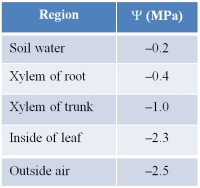 Assume that the table indicates water potential for a number of locations inside a healthy tree.Given the data, what can you conclude?
 (Multiple Choice)
4.9/5 (80)
(80) A researcher uses aphid stylets to collect the phloem sap from 27 different families of flowering plants.The most commonly found sugar in the phloem is likely to be
(Multiple Choice)
4.9/5 (63)
(63) Tension can develop in a column of water because water molecules are
(Multiple Choice)
5.0/5 (84)
(84) According to the theory of transpirationcohesiontension, what forces in addition to these three are needed to draw water through the xylem?
(Multiple Choice)
4.9/5 (75)
(75) The fact that there is one continuous column of water within the xylem is best explained by
(Multiple Choice)
4.9/5 (75)
(75) 
Filters
- Essay(0)
- Multiple Choice(0)
- Short Answer(0)
- True False(0)
- Matching(0)