



 Chat with AI
Exam 13: Dna and Its Role in Heredity

Exam 1: Studying Life246 Questions
Exam 2: Small Molecules and the Chemistry of Life246 Questions
Exam 3: Proteins, Carbohydrates, and Lipids246 Questions
Exam 4: Nucleic Acids and the Origin of Life246 Questions
Exam 5: Cells: the Working Units of Life248 Questions
Exam 6: Cell Membranes246 Questions
Exam 7: Cell Communication and Multicellularity246 Questions
Exam 8: Energy, Enzymes, and Metabolism246 Questions
Exam 9: Pathways That Harvest Chemical Energy246 Questions
Exam 10: Photosynthesis: Energy From Sunlight242 Questions
Exam 11: The Cell Cycle and Cell Division260 Questions
Exam 12: Inheritance, Genes, and Chromosomes250 Questions
Exam 13: Dna and Its Role in Heredity257 Questions
Exam 14: From Dna to Protein: Gene Expression252 Questions
Exam 15: Gene Mutation and Molecular Medicine251 Questions
Exam 16: Regulation of Gene Expression245 Questions
Exam 17: Genomes249 Questions
Exam 18: Recombinant Dna and Biotechnology243 Questions
Exam 20: Mechanisms of Evolution243 Questions
Exam 21: Reconstructing and Using Phylogenies246 Questions
Exam 22: Speciation247 Questions
Exam 23: Evolution of Genes and Genomes252 Questions
Exam 24: The History of Life on Earth246 Questions
Exam 25: Bacteria, Archaea, and Viruses262 Questions
Exam 26: The Origin and Diversification of Eukaryotes252 Questions
Exam 27: Plants Without Seeds: From Water to Land251 Questions
Exam 28: The Evolution of Seed Plants259 Questions
Exam 29: The Evolution and Diversity of Fungi261 Questions
Exam 30: Animal Origins and the Evolution of Body Plans248 Questions
Exam 31: Protostome Animals244 Questions
Exam 32: Deuterostome Animals246 Questions
Exam 33: The Plant Body243 Questions
Exam 34: Transport in Plants248 Questions
Exam 35: Plant Nutrition247 Questions
Exam 36: Regulation of Plant Growth246 Questions
Exam 37: Reproduction in Flowering Plants247 Questions
Exam 38: Plant Responses to Environmental Challenges246 Questions
Exam 39: Physiology, Homeostasis, and Temperature Regulation258 Questions
Exam 40: Animal Hormones249 Questions
Exam 41: Immunology: Animal Defense Systems265 Questions
Exam 42: Animal Reproduction261 Questions
Exam 43: Animal Development261 Questions
Exam 44: Neurons, Glia, and Nervous Systems250 Questions
Exam 45: Sensory Systems249 Questions
Exam 46: The Mammalian Nervous System: Structure and Higher Functions254 Questions
Exam 47: Musculoskeletal Systems259 Questions
Exam 48: Gas Exchange247 Questions
Exam 49: Circulatory Systems252 Questions
Exam 50: Nutrition, Digestion, and Absorption259 Questions
Exam 51: Salt and Water Balance and Nitrogen Excretion251 Questions
Exam 52: Animal Behavior249 Questions
Exam 53: The Physical Environment and Biogeography of Life248 Questions
Exam 54: Populations259 Questions
Exam 55: Species Interactions254 Questions
Exam 56: Communities247 Questions
Exam 57: Ecosystems238 Questions
Exam 58: A Changing Biosphere222 Questions
Select questions type


Meselson and Stahl used heavy nitrogen (15N) in their experiments to

Free
(Multiple Choice)
4.7/5  (81)
(81) Correct Answer: Verified
C
The molecules that function to replicate DNA in the cell are
Free
(Multiple Choice)
4.9/5 (76)
(76) Correct Answer:Verified
VerifiedB
If a G-T base pair is found in a newly replicated DNA molecule after proofreading, the _______ repair mechanism might replace the G with an A.
(Short Answer)
4.9/5 (92)
(92) Before Watson and Crick built their DNA model, the American chemist and Nobel laureate Linus Pauling proposed a triple-helix model for DNA.What evidence convinced Watson and Crick to reject this model for the double-helix model?
(Multiple Choice)
4.9/5 (87)
(87) If the proportion of C in a double-stranded DNA molecule is x, what is the proportion of T?
(Multiple Choice)
4.8/5 (87)
(87) What structural aspect of the DNA facilitates dissociation of the two DNA strands for replication?
a. Purine-pyrimidine pairing
b. Hydrogen bonding between paired bases
c. Covalent bonds between sugars and phosphate groups
d. 3 end phosphorylation
e. Antiparallel DNA strands
(Essay)
5.0/5 (76)
(76) An automated process that makes multiple copies of short regions of DNA in a test tube is called _______.
(Short Answer)
4.7/5 (69)
(69) Refer to the figure, which shows double-stranded DNA being prepared for DNA replication. 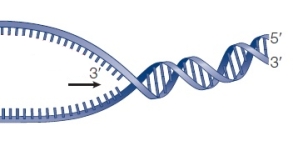 What proteins (not shown) act on the DNA to unwind and dissociate the strands, and what proteins (not shown) keep the template strands separated?
 (Essay)
5.0/5 (70)
(70) Refer to the chemical formula of dideoxycytidine. 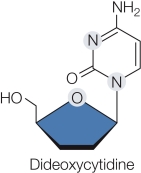 The drug dideoxycytidine, used to treat certain viral infections, is a nucleotide made with 2,3-dideoxyribose.This sugar lacks -OH groups at both the 2 and the 3 positions.What will happen if this nucleotide is incorporated into a growing DNA chain?
 (Essay)
4.7/5 (77)
(77) Refer to the figure. 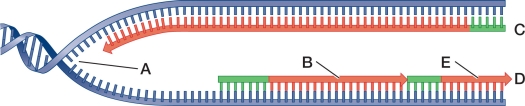 Which letter refers to an Okazaki fragment?
 (Multiple Choice)
4.9/5 (75)
(75) If a sequence of one strand of DNA is 5ʹ-ATGATGT-3ʹ, the complementary strand must be _______.(Include correct orientation.)
(Short Answer)
4.9/5 (82)
(82) The nucleoside analogue acyclovir, which is used to treat herpes simplex virus (HSV) infections, lacks a 3 hydroxyl group (-OH).Predict what will happen if the host cell DNA polymerase incorporates a molecule of acyclovir into an elongating strand of HSV DNA.
a. Acyclovir will block the activity of the DNA helicase.
b. The DNA polymerase will only incorporate acyclovir molecules.
c. The replication complex will no longer bind to origins of replication.
d. DNA polymerase will not be able to link a successive nucleotide.
e. Acyclovir will bind single-strand binding proteins.
(Essay)
4.9/5 (92)
(92) About how many rounds of PCR are required to produce a million DNA molecules from a single molecule, assuming that the PCR works perfectly?
(Multiple Choice)
4.8/5 (79)
(79) What structural feature of DNA can disrupt the specificity of a protein-DNA interaction?
(Multiple Choice)
4.8/5 (89)
(89) The proofreading DNA repair system differs from other types of DNA repair in that it
(Multiple Choice)
4.8/5 (68)
(68) If a sequence of one strand of DNA is 5-TGACTATC-3, what is the complementary strand?
a. 5-ACTGATAG-3
b. 3-ACTGATAG-5
c. 3-ACTGATAG-3
d. 3-TGACTATC-5
e. 5-TGACTATC-3
(Essay)
4.9/5 (83)
(83) Prior to the Hershey and Chase blender experiment, many biologists were skeptical that DNA was the genetic material.These biologists thought that proteins might be the genetic material because proteins
(Multiple Choice)
4.8/5 (87)
(87) Choose the correct order of the following four events in the excision repair of DNA:
(1) Base-paired DNA is made complementary to the template.
(2) Damaged bases are recognized.
(3) DNA ligase seals the new strand to existing DNA.
(4) Part of a single strand is excised.
a. 1, 2, 3, 4
b. 2, 1, 3, 4
c. 2, 4, 1, 3
d. 3, 4, 2, 1
e. 4, 2, 3, 1
(Essay)
4.8/5 (75)
(75) 
Filters
- Essay(0)
- Multiple Choice(0)
- Short Answer(0)
- True False(0)
- Matching(0)