



 Chat with AI
Exam 13: Dna and Its Role in Heredity

Exam 1: Studying Life246 Questions
Exam 2: Small Molecules and the Chemistry of Life246 Questions
Exam 3: Proteins, Carbohydrates, and Lipids246 Questions
Exam 4: Nucleic Acids and the Origin of Life246 Questions
Exam 5: Cells: the Working Units of Life248 Questions
Exam 6: Cell Membranes246 Questions
Exam 7: Cell Communication and Multicellularity246 Questions
Exam 8: Energy, Enzymes, and Metabolism246 Questions
Exam 9: Pathways That Harvest Chemical Energy246 Questions
Exam 10: Photosynthesis: Energy From Sunlight242 Questions
Exam 11: The Cell Cycle and Cell Division260 Questions
Exam 12: Inheritance, Genes, and Chromosomes250 Questions
Exam 13: Dna and Its Role in Heredity257 Questions
Exam 14: From Dna to Protein: Gene Expression252 Questions
Exam 15: Gene Mutation and Molecular Medicine251 Questions
Exam 16: Regulation of Gene Expression245 Questions
Exam 17: Genomes249 Questions
Exam 18: Recombinant Dna and Biotechnology243 Questions
Exam 20: Mechanisms of Evolution243 Questions
Exam 21: Reconstructing and Using Phylogenies246 Questions
Exam 22: Speciation247 Questions
Exam 23: Evolution of Genes and Genomes252 Questions
Exam 24: The History of Life on Earth246 Questions
Exam 25: Bacteria, Archaea, and Viruses262 Questions
Exam 26: The Origin and Diversification of Eukaryotes252 Questions
Exam 27: Plants Without Seeds: From Water to Land251 Questions
Exam 28: The Evolution of Seed Plants259 Questions
Exam 29: The Evolution and Diversity of Fungi261 Questions
Exam 30: Animal Origins and the Evolution of Body Plans248 Questions
Exam 31: Protostome Animals244 Questions
Exam 32: Deuterostome Animals246 Questions
Exam 33: The Plant Body243 Questions
Exam 34: Transport in Plants248 Questions
Exam 35: Plant Nutrition247 Questions
Exam 36: Regulation of Plant Growth246 Questions
Exam 37: Reproduction in Flowering Plants247 Questions
Exam 38: Plant Responses to Environmental Challenges246 Questions
Exam 39: Physiology, Homeostasis, and Temperature Regulation258 Questions
Exam 40: Animal Hormones249 Questions
Exam 41: Immunology: Animal Defense Systems265 Questions
Exam 42: Animal Reproduction261 Questions
Exam 43: Animal Development261 Questions
Exam 44: Neurons, Glia, and Nervous Systems250 Questions
Exam 45: Sensory Systems249 Questions
Exam 46: The Mammalian Nervous System: Structure and Higher Functions254 Questions
Exam 47: Musculoskeletal Systems259 Questions
Exam 48: Gas Exchange247 Questions
Exam 49: Circulatory Systems252 Questions
Exam 50: Nutrition, Digestion, and Absorption259 Questions
Exam 51: Salt and Water Balance and Nitrogen Excretion251 Questions
Exam 52: Animal Behavior249 Questions
Exam 53: The Physical Environment and Biogeography of Life248 Questions
Exam 54: Populations259 Questions
Exam 55: Species Interactions254 Questions
Exam 56: Communities247 Questions
Exam 57: Ecosystems238 Questions
Exam 58: A Changing Biosphere222 Questions
Select questions type


In the 1920s, a dye that stained DNA a bright purple was developed.From this dye, biologists concluded that
(Multiple Choice)
4.9/5  (77)
(77) In Griffith's experiment, why were S-type cells virulent and R-type cells not virulent?
(Multiple Choice)
4.9/5 (102)
(102) In bacteria, there is/are _______ origin(s) of replication and _______ replication fork(s).
(Multiple Choice)
4.9/5 (86)
(86) Starting from one double-stranded DNA molecule, 128 DNA molecules can be generated via _______ rounds of PCR (assuming that the process is 100 percent efficient).
(Short Answer)
4.9/5 (81)
(81) Bacteriophages are a DNA virus-their genetic material is DNA.In contrast, for some other types of viruses, RNA is the genetic material.Once it has entered a cell, one group of RNA viruses, which includes retroviruses, reverse transcribes the RNA into DNA using the enzyme reverse transcriptase.This protein is found bound to the viral RNA molecule.Suppose Hershey and Chase had unknowingly used a retrovirus for their classic blender experiment.Where would most of the 32P and the 35S be found at the conclusion of the experiment?
(Essay)
5.0/5 (84)
(84) The evidence suggesting that DNA is arranged in a double helix came from
(Multiple Choice)
4.9/5 (89)
(89) Refer to the figure showing replication. 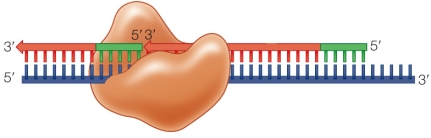 In the figure, the protein bound to the template DNA strand (blue) is DNA polymerase III.What is the next step in the replication process?
 (Multiple Choice)
4.7/5 (78)
(78) A researcher stains various types of cells from the same organism, using a dye that stains in direct proportion to the amount of DNA in the cell.The researcher finds that _______ cells have twice as much DNA in their nuclei as the organism's sperm do.
(Short Answer)
4.7/5 (93)
(93) The nitrogenous bases of the two complementary strands in the DNA double helix are held together by
(Multiple Choice)
4.8/5 (78)
(78) DNA polymerase from Thermus aquaticus is useful in PCR because it
(Multiple Choice)
5.0/5 (83)
(83) In a double-stranded molecule of DNA, _______ percent of the nitrogenous bases are purines.
(Short Answer)
4.8/5 (72)
(72) In eukaryotic cells, each chromosome has _______ origin(s) of replication.
(Multiple Choice)
4.8/5 (88)
(88) Which feature of the Watson and Crick model of DNA structure explains its ability to function in replication and gene expression?
(Multiple Choice)
4.9/5 (81)
(81) Which of the following does not demonstrate the stability of the DNA double helix?
a. High temperatures are required to denature it.
b. DNA helicases require ATP.
c. Single-strand binding proteins are required to keep the strands apart.
d. DNA synthesis requires energy.
e. Paired bases form hydrogen bonds.
(Essay)
4.9/5 (93)
(93) Refer to the figure. 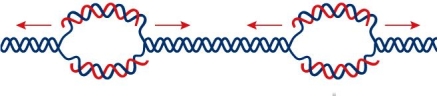 Which statement identifies the figure as representing eukaryotic replication?
 (Multiple Choice)
4.8/5 (81)
(81) Refer to the figure, which illustrates the chemical structure of DNA. 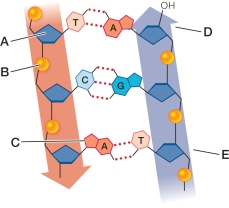 In which position would new DNA be added?
 (Multiple Choice)
4.7/5 (90)
(90) Double-stranded DNA looks like a ladder that has been twisted into a helix or spiral.The side supports of the ladder are
(Multiple Choice)
4.8/5 (80)
(80) The Meselson-Stahl experiment showed that DNA replication is
(Multiple Choice)
4.9/5 (74)
(74) 
Filters
- Essay(0)
- Multiple Choice(0)
- Short Answer(0)
- True False(0)
- Matching(0)