



 Chat with AI
Exam 13: Dna and Its Role in Heredity

Exam 1: Studying Life246 Questions
Exam 2: Small Molecules and the Chemistry of Life246 Questions
Exam 3: Proteins, Carbohydrates, and Lipids246 Questions
Exam 4: Nucleic Acids and the Origin of Life246 Questions
Exam 5: Cells: the Working Units of Life248 Questions
Exam 6: Cell Membranes246 Questions
Exam 7: Cell Communication and Multicellularity246 Questions
Exam 8: Energy, Enzymes, and Metabolism246 Questions
Exam 9: Pathways That Harvest Chemical Energy246 Questions
Exam 10: Photosynthesis: Energy From Sunlight242 Questions
Exam 11: The Cell Cycle and Cell Division260 Questions
Exam 12: Inheritance, Genes, and Chromosomes250 Questions
Exam 13: Dna and Its Role in Heredity257 Questions
Exam 14: From Dna to Protein: Gene Expression252 Questions
Exam 15: Gene Mutation and Molecular Medicine251 Questions
Exam 16: Regulation of Gene Expression245 Questions
Exam 17: Genomes249 Questions
Exam 18: Recombinant Dna and Biotechnology243 Questions
Exam 20: Mechanisms of Evolution243 Questions
Exam 21: Reconstructing and Using Phylogenies246 Questions
Exam 22: Speciation247 Questions
Exam 23: Evolution of Genes and Genomes252 Questions
Exam 24: The History of Life on Earth246 Questions
Exam 25: Bacteria, Archaea, and Viruses262 Questions
Exam 26: The Origin and Diversification of Eukaryotes252 Questions
Exam 27: Plants Without Seeds: From Water to Land251 Questions
Exam 28: The Evolution of Seed Plants259 Questions
Exam 29: The Evolution and Diversity of Fungi261 Questions
Exam 30: Animal Origins and the Evolution of Body Plans248 Questions
Exam 31: Protostome Animals244 Questions
Exam 32: Deuterostome Animals246 Questions
Exam 33: The Plant Body243 Questions
Exam 34: Transport in Plants248 Questions
Exam 35: Plant Nutrition247 Questions
Exam 36: Regulation of Plant Growth246 Questions
Exam 37: Reproduction in Flowering Plants247 Questions
Exam 38: Plant Responses to Environmental Challenges246 Questions
Exam 39: Physiology, Homeostasis, and Temperature Regulation258 Questions
Exam 40: Animal Hormones249 Questions
Exam 41: Immunology: Animal Defense Systems265 Questions
Exam 42: Animal Reproduction261 Questions
Exam 43: Animal Development261 Questions
Exam 44: Neurons, Glia, and Nervous Systems250 Questions
Exam 45: Sensory Systems249 Questions
Exam 46: The Mammalian Nervous System: Structure and Higher Functions254 Questions
Exam 47: Musculoskeletal Systems259 Questions
Exam 48: Gas Exchange247 Questions
Exam 49: Circulatory Systems252 Questions
Exam 50: Nutrition, Digestion, and Absorption259 Questions
Exam 51: Salt and Water Balance and Nitrogen Excretion251 Questions
Exam 52: Animal Behavior249 Questions
Exam 53: The Physical Environment and Biogeography of Life248 Questions
Exam 54: Populations259 Questions
Exam 55: Species Interactions254 Questions
Exam 56: Communities247 Questions
Exam 57: Ecosystems238 Questions
Exam 58: A Changing Biosphere222 Questions
Select questions type


In the 1920s, a dye that stained DNA was developed.If this dye showed that DNA was present in 4 units in a gamete of an organism, how many units of DNA would be present in a somatic cell of that organism?
(Multiple Choice)
4.8/5  (76)
(76) In Griffith's experiments, the S cells caused disease, but the R cells did not, because the R cells lacked an enzyme that catalyzes the synthesis of a _______.
(Short Answer)
4.9/5 (92)
(92) If the end of one of the sequences that you wish to amplify by PCR begins with TGTCGAT, the primer should _______ with _______.Note: All sequences are shown in the 5-to-3 orientation.
(Multiple Choice)
4.9/5 (60)
(60) Explain how the Hershey and Chase experiment demonstrated that DNA is the genetic material.
(Essay)
4.9/5 (74)
(74) The maximum amount of C in a double-stranded molecule of DNA is 50 percent.If the C is at this maximum, there are no As or _______ in the DNA molecule.
(Short Answer)
4.7/5 (76)
(76) Given the DNA sequence shown, what would the opposite (3-to-5) strand sequence be?
5-GCTAACTGTGATCGTATAAGCTGA-3
(Short Answer)
4.9/5 (89)
(89) If 30 percent of the bases in a double-stranded DNA molecule are T, _______ percent must be G.
(Multiple Choice)
4.8/5 (85)
(85) Refer to the chemical formula of dideoxycytidine. 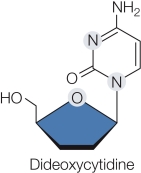 The drug dideoxycytidine, used to treat certain viral infections, is a nucleotide made with 2,3-dideoxyribose.This sugar lacks -OH groups at both the 2 and the 3 positions.This drug stops the growth of a DNA chain when added to DNA because
 (Multiple Choice)
4.8/5 (95)
(95) In any sample of double-stranded DNA, _______ percent of the bases are purines.
(Multiple Choice)
5.0/5 (70)
(70) In which mode of replication would fragments of both strands serve as the templates for generating two molecules from one double-helix DNA?
(Multiple Choice)
4.9/5 (88)
(88) DNA polymerase can only elongate preexisting polynucleotide strands.What problem does this create?
(Multiple Choice)
4.9/5 (86)
(86) Which base pairing represents a bond between a purine and a pyrimidine (in that order)?
(Multiple Choice)
4.8/5 (81)
(81) According to the Watson and Crick model for the structure of DNA, _______ are on the outside and _______ are on the inside of the double-stranded DNA molecule.The strands run _______.
(Multiple Choice)
4.8/5 (80)
(80) If 23 percent of the bases in a sample of double-stranded DNA are adenine, what percentage of the bases are uracil?
a. 0
b. 23
c. 27
d. 50
e. 73
(Essay)
4.9/5 (81)
(81) Refer to the figure, which shows DNA replication. 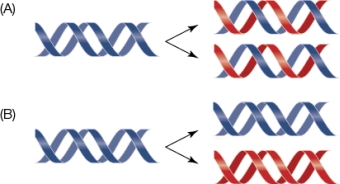 Which diagram (A or B) depicts the process of DNA replication that occurs in human cells?
 (Short Answer)
4.9/5 (87)
(87) In the positive control experiment run by Avery and his team, pure DNA from a cell-free extract containing the transforming substance was shown to cause _______ transformation.
(Short Answer)
4.8/5 (72)
(72) Suppose the actual transforming substance had been found to be protein and not DNA.Which scenario would be expected to produce a transformation that would cause mice to become sick?
(Multiple Choice)
4.8/5 (85)
(85) Using the following information, calculate the number of origins of DNA replication on a human chromosome: DNA polymerase adds nucleotides at 3,000 bp per minute in one direction; replication is bidirectional; S phase lasts 300 minutes; there are 120 million bp per chromosome.In a typical chromosome 3 m long, how many origins are there per micrometer?
(Essay)
5.0/5 (68)
(68) The nitrogenous bases classified as purines are adenine and _______.
(Short Answer)
4.8/5 (74)
(74) 
Filters
- Essay(0)
- Multiple Choice(0)
- Short Answer(0)
- True False(0)
- Matching(0)