



 Chat with AI
Exam 13: Dna and Its Role in Heredity

Exam 1: Studying Life246 Questions
Exam 2: Small Molecules and the Chemistry of Life246 Questions
Exam 3: Proteins, Carbohydrates, and Lipids246 Questions
Exam 4: Nucleic Acids and the Origin of Life246 Questions
Exam 5: Cells: the Working Units of Life248 Questions
Exam 6: Cell Membranes246 Questions
Exam 7: Cell Communication and Multicellularity246 Questions
Exam 8: Energy, Enzymes, and Metabolism246 Questions
Exam 9: Pathways That Harvest Chemical Energy246 Questions
Exam 10: Photosynthesis: Energy From Sunlight242 Questions
Exam 11: The Cell Cycle and Cell Division260 Questions
Exam 12: Inheritance, Genes, and Chromosomes250 Questions
Exam 13: Dna and Its Role in Heredity257 Questions
Exam 14: From Dna to Protein: Gene Expression252 Questions
Exam 15: Gene Mutation and Molecular Medicine251 Questions
Exam 16: Regulation of Gene Expression245 Questions
Exam 17: Genomes249 Questions
Exam 18: Recombinant Dna and Biotechnology243 Questions
Exam 20: Mechanisms of Evolution243 Questions
Exam 21: Reconstructing and Using Phylogenies246 Questions
Exam 22: Speciation247 Questions
Exam 23: Evolution of Genes and Genomes252 Questions
Exam 24: The History of Life on Earth246 Questions
Exam 25: Bacteria, Archaea, and Viruses262 Questions
Exam 26: The Origin and Diversification of Eukaryotes252 Questions
Exam 27: Plants Without Seeds: From Water to Land251 Questions
Exam 28: The Evolution of Seed Plants259 Questions
Exam 29: The Evolution and Diversity of Fungi261 Questions
Exam 30: Animal Origins and the Evolution of Body Plans248 Questions
Exam 31: Protostome Animals244 Questions
Exam 32: Deuterostome Animals246 Questions
Exam 33: The Plant Body243 Questions
Exam 34: Transport in Plants248 Questions
Exam 35: Plant Nutrition247 Questions
Exam 36: Regulation of Plant Growth246 Questions
Exam 37: Reproduction in Flowering Plants247 Questions
Exam 38: Plant Responses to Environmental Challenges246 Questions
Exam 39: Physiology, Homeostasis, and Temperature Regulation258 Questions
Exam 40: Animal Hormones249 Questions
Exam 41: Immunology: Animal Defense Systems265 Questions
Exam 42: Animal Reproduction261 Questions
Exam 43: Animal Development261 Questions
Exam 44: Neurons, Glia, and Nervous Systems250 Questions
Exam 45: Sensory Systems249 Questions
Exam 46: The Mammalian Nervous System: Structure and Higher Functions254 Questions
Exam 47: Musculoskeletal Systems259 Questions
Exam 48: Gas Exchange247 Questions
Exam 49: Circulatory Systems252 Questions
Exam 50: Nutrition, Digestion, and Absorption259 Questions
Exam 51: Salt and Water Balance and Nitrogen Excretion251 Questions
Exam 52: Animal Behavior249 Questions
Exam 53: The Physical Environment and Biogeography of Life248 Questions
Exam 54: Populations259 Questions
Exam 55: Species Interactions254 Questions
Exam 56: Communities247 Questions
Exam 57: Ecosystems238 Questions
Exam 58: A Changing Biosphere222 Questions
Select questions type


Griffith was able to distinguish two strains of pneumococcus by means of
(Multiple Choice)
4.8/5  (65)
(65) Thirty percent of the bases in a sample of DNA extracted from eukaryotic cells are adenine.What percentage of the bases are cytosine in this DNA?
(Multiple Choice)
4.9/5 (70)
(70) Refer to the figure, which illustrates the chemical structure of DNA. 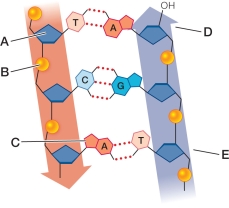 Which label corresponds to a phosphate group?
 (Multiple Choice)
4.9/5 (77)
(77) Exposure to sunlight induces thymine dimers in the DNA of skin fibroblasts.To protect against cancer development, the cells will use the _______ DNA repair mechanism to repair the damage.
(Short Answer)
4.9/5 (82)
(82) In the Meselson-Stahl experiment, which observation ruled out the conservative model of DNA replication?
(Multiple Choice)
4.9/5 (68)
(68) What local effect would an RNA synthesis inhibitor have on DNA replication?
(Multiple Choice)
4.8/5 (97)
(97) In a population of cells on the inner surface of the intestine, the cells frequently divide.Therefore, these cells are likely to
(Multiple Choice)
4.9/5 (85)
(85) In one Hershey and Chase experiment, bacteriophage nucleic acids were labeled by carrying out an infection of E.coli cells growing in
(Multiple Choice)
4.8/5 (68)
(68) What feature of DNA did Watson and Crick suggest would provide clues about how it is copied?
(Multiple Choice)
4.8/5 (86)
(86) Which physical feature of DNA is affected by the pairing of purines with pyrimidines?
(Multiple Choice)
4.8/5 (95)
(95) In the Hershey and Chase experiment an isotope of _______ was used to label protein.
(Multiple Choice)
4.8/5 (75)
(75) Without DNA repair, the error rate of DNA polymerase is about one for every 100,000 bases replicated.If an organism has a haploid genome of 1.5 billion base pairs, how many mutations should occur each time a diploid cell replicates its DNA?
(Multiple Choice)
4.9/5 (84)
(84) Evidence of the semiconservative nature of DNA replication came from
(Multiple Choice)
4.8/5 (91)
(91) If one more nucleotide were to be added to the unzipped end of this DNA molecule, to which exposed base would it bind?
(Short Answer)
4.9/5 (81)
(81) Xeroderma pigmentosum (XP) is a hereditary disease in which there is a defect in the repair system that repairs DNA after it is damaged by ultraviolet rays.The symptoms of XP are likely due to an _______ repair system.
(Multiple Choice)
4.9/5 (75)
(75) Refer to the figure, which represents one telomere of a eukaryotic chromosome following DNA replication.  The process has left nonreplicated nucleotides that form a 3 overhang.In a differentiated fibroblast, what will be the resolution of this 3 overhang? If the cell is a stem cell, what will be the resolution?
 (Essay)
5.0/5 (74)
(74) Which statement about DNA replication pertains specifically to synthesis of the leading strand?
(Multiple Choice)
4.8/5 (83)
(83) 
Filters
- Essay(0)
- Multiple Choice(0)
- Short Answer(0)
- True False(0)
- Matching(0)