



 Chat with AI
Exam 13: Dna and Its Role in Heredity

Exam 1: Studying Life246 Questions
Exam 2: Small Molecules and the Chemistry of Life246 Questions
Exam 3: Proteins, Carbohydrates, and Lipids246 Questions
Exam 4: Nucleic Acids and the Origin of Life246 Questions
Exam 5: Cells: the Working Units of Life248 Questions
Exam 6: Cell Membranes246 Questions
Exam 7: Cell Communication and Multicellularity246 Questions
Exam 8: Energy, Enzymes, and Metabolism246 Questions
Exam 9: Pathways That Harvest Chemical Energy246 Questions
Exam 10: Photosynthesis: Energy From Sunlight242 Questions
Exam 11: The Cell Cycle and Cell Division260 Questions
Exam 12: Inheritance, Genes, and Chromosomes250 Questions
Exam 13: Dna and Its Role in Heredity257 Questions
Exam 14: From Dna to Protein: Gene Expression252 Questions
Exam 15: Gene Mutation and Molecular Medicine251 Questions
Exam 16: Regulation of Gene Expression245 Questions
Exam 17: Genomes249 Questions
Exam 18: Recombinant Dna and Biotechnology243 Questions
Exam 20: Mechanisms of Evolution243 Questions
Exam 21: Reconstructing and Using Phylogenies246 Questions
Exam 22: Speciation247 Questions
Exam 23: Evolution of Genes and Genomes252 Questions
Exam 24: The History of Life on Earth246 Questions
Exam 25: Bacteria, Archaea, and Viruses262 Questions
Exam 26: The Origin and Diversification of Eukaryotes252 Questions
Exam 27: Plants Without Seeds: From Water to Land251 Questions
Exam 28: The Evolution of Seed Plants259 Questions
Exam 29: The Evolution and Diversity of Fungi261 Questions
Exam 30: Animal Origins and the Evolution of Body Plans248 Questions
Exam 31: Protostome Animals244 Questions
Exam 32: Deuterostome Animals246 Questions
Exam 33: The Plant Body243 Questions
Exam 34: Transport in Plants248 Questions
Exam 35: Plant Nutrition247 Questions
Exam 36: Regulation of Plant Growth246 Questions
Exam 37: Reproduction in Flowering Plants247 Questions
Exam 38: Plant Responses to Environmental Challenges246 Questions
Exam 39: Physiology, Homeostasis, and Temperature Regulation258 Questions
Exam 40: Animal Hormones249 Questions
Exam 41: Immunology: Animal Defense Systems265 Questions
Exam 42: Animal Reproduction261 Questions
Exam 43: Animal Development261 Questions
Exam 44: Neurons, Glia, and Nervous Systems250 Questions
Exam 45: Sensory Systems249 Questions
Exam 46: The Mammalian Nervous System: Structure and Higher Functions254 Questions
Exam 47: Musculoskeletal Systems259 Questions
Exam 48: Gas Exchange247 Questions
Exam 49: Circulatory Systems252 Questions
Exam 50: Nutrition, Digestion, and Absorption259 Questions
Exam 51: Salt and Water Balance and Nitrogen Excretion251 Questions
Exam 52: Animal Behavior249 Questions
Exam 53: The Physical Environment and Biogeography of Life248 Questions
Exam 54: Populations259 Questions
Exam 55: Species Interactions254 Questions
Exam 56: Communities247 Questions
Exam 57: Ecosystems238 Questions
Exam 58: A Changing Biosphere222 Questions
Select questions type


The enzyme _______ catalyzes the addition of nucleotides to a growing strand of DNA.
(Short Answer)
4.8/5  (67)
(67) If Meselson and Stahl had observed one intermediate, slightly smeared band after growing bacteria in the presence of 15N for one generation, and then after two generations in 14N again had found one slightly smeared band, they would most likely have concluded that DNA replicates
(Multiple Choice)
4.8/5 (77)
(77) Explain the method used by Meselson and Stahl in their experiments to discriminate between template DNA and newly synthesized DNA using density gradient.
(Essay)
4.8/5 (80)
(80) The energy necessary for making a DNA molecule comes directly from
(Multiple Choice)
5.0/5 (93)
(93) A researcher studies normal human fibroblast cells.They can be maintained in culture but die off after about 30 cell generations.Unexpectedly, a colony of cells continues to survive and divide past 30 generations.Which scenario is most likely true for these cells?
(Multiple Choice)
4.7/5 (75)
(75) Refer to the figure. 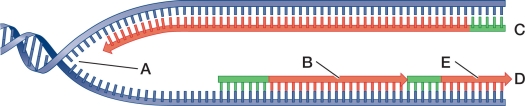 Which letter represents the leading strand?
 (Multiple Choice)
4.8/5 (69)
(69) A fundamental requirement for the functioning of genetic material is that it must be
(Multiple Choice)
4.8/5 (72)
(72) The enzyme that unwinds the DNA prior to replication is called
(Multiple Choice)
4.9/5 (64)
(64) New DNA molecules can be synthesized in a test tube containing _______ as substrate.
(Multiple Choice)
4.8/5 (81)
(81) The bases from DNA isolated from a newly discovered single-stranded virus are found to be 32 percent A, 18 percent C, 18 percent G, and 32 percent T.During replication, this DNA forms a complementary strand.The bases of the complementary DNA would be _______ percent A, _______ percent C, _______ percent G, and _______ percent T.
(Multiple Choice)
4.9/5 (77)
(77) DNA polymerases catalyze many polymerizations in a row each time they bind to a DNA molecule.Therefore, DNA polymerases are said to be _______.
(Short Answer)
4.8/5 (87)
(87) DNA polymerase lengthens a polynucleotide strand in a DNA molecule by
(Multiple Choice)
4.9/5 (72)
(72) The expression of the enzyme _______ is largely restricted to stem cells and gametes.However, it is expressed in 90 percent of human cancers and may be responsible for their ability to survive continuous division.
(Short Answer)
4.8/5 (76)
(76) If _______ was nonfunctional, then DNA polymerase could not replicate the 3ʹ-to-5ʹ strand of template DNA.
(Short Answer)
4.9/5 (70)
(70) In their experiment, Hershey and Chase tracked whether proteins or DNA entered the nucleus by using different _______ to label the proteins and DNA.
(Short Answer)
4.7/5 (87)
(87) An alien DNA-like molecule is isolated from the frozen remains of a life form found beneath the Martian polar ice caps.In this sample, for every base designated Q, there is twice that amount of base R; for every base Z, there is twice that amount of base S.If the molecule contains 33.33 percent S, you expect to find _______ percent Z.
(Multiple Choice)
4.9/5 (96)
(96) 
Filters
- Essay(0)
- Multiple Choice(0)
- Short Answer(0)
- True False(0)
- Matching(0)