



 Chat with AI
Exam 13: Dna and Its Role in Heredity

Exam 1: Studying Life246 Questions
Exam 2: Small Molecules and the Chemistry of Life246 Questions
Exam 3: Proteins, Carbohydrates, and Lipids246 Questions
Exam 4: Nucleic Acids and the Origin of Life246 Questions
Exam 5: Cells: the Working Units of Life248 Questions
Exam 6: Cell Membranes246 Questions
Exam 7: Cell Communication and Multicellularity246 Questions
Exam 8: Energy, Enzymes, and Metabolism246 Questions
Exam 9: Pathways That Harvest Chemical Energy246 Questions
Exam 10: Photosynthesis: Energy From Sunlight242 Questions
Exam 11: The Cell Cycle and Cell Division260 Questions
Exam 12: Inheritance, Genes, and Chromosomes250 Questions
Exam 13: Dna and Its Role in Heredity257 Questions
Exam 14: From Dna to Protein: Gene Expression252 Questions
Exam 15: Gene Mutation and Molecular Medicine251 Questions
Exam 16: Regulation of Gene Expression245 Questions
Exam 17: Genomes249 Questions
Exam 18: Recombinant Dna and Biotechnology243 Questions
Exam 20: Mechanisms of Evolution243 Questions
Exam 21: Reconstructing and Using Phylogenies246 Questions
Exam 22: Speciation247 Questions
Exam 23: Evolution of Genes and Genomes252 Questions
Exam 24: The History of Life on Earth246 Questions
Exam 25: Bacteria, Archaea, and Viruses262 Questions
Exam 26: The Origin and Diversification of Eukaryotes252 Questions
Exam 27: Plants Without Seeds: From Water to Land251 Questions
Exam 28: The Evolution of Seed Plants259 Questions
Exam 29: The Evolution and Diversity of Fungi261 Questions
Exam 30: Animal Origins and the Evolution of Body Plans248 Questions
Exam 31: Protostome Animals244 Questions
Exam 32: Deuterostome Animals246 Questions
Exam 33: The Plant Body243 Questions
Exam 34: Transport in Plants248 Questions
Exam 35: Plant Nutrition247 Questions
Exam 36: Regulation of Plant Growth246 Questions
Exam 37: Reproduction in Flowering Plants247 Questions
Exam 38: Plant Responses to Environmental Challenges246 Questions
Exam 39: Physiology, Homeostasis, and Temperature Regulation258 Questions
Exam 40: Animal Hormones249 Questions
Exam 41: Immunology: Animal Defense Systems265 Questions
Exam 42: Animal Reproduction261 Questions
Exam 43: Animal Development261 Questions
Exam 44: Neurons, Glia, and Nervous Systems250 Questions
Exam 45: Sensory Systems249 Questions
Exam 46: The Mammalian Nervous System: Structure and Higher Functions254 Questions
Exam 47: Musculoskeletal Systems259 Questions
Exam 48: Gas Exchange247 Questions
Exam 49: Circulatory Systems252 Questions
Exam 50: Nutrition, Digestion, and Absorption259 Questions
Exam 51: Salt and Water Balance and Nitrogen Excretion251 Questions
Exam 52: Animal Behavior249 Questions
Exam 53: The Physical Environment and Biogeography of Life248 Questions
Exam 54: Populations259 Questions
Exam 55: Species Interactions254 Questions
Exam 56: Communities247 Questions
Exam 57: Ecosystems238 Questions
Exam 58: A Changing Biosphere222 Questions
Select questions type


The proofreading, mismatch, and _______ repair systems use information from the parental strand of DNA to correct errors in the replicated strand.
(Short Answer)
4.9/5  (88)
(88) When double-stranded DNA is heated to temperatures above 90°C, it denatures.Denaturation is a process that
a. hydrolyzes DNA.
b. irreversibly destroys the double helical structure.
c. separates double-stranded DNA into two single strands.
d. causes new hydrogen bonds to form.
e. breaks covalent bonds.
(Essay)
5.0/5 (81)
(81) In DNA replication, nucleotides are added to the growing new strand at the _______ end, the end at which the DNA strand has a free _______ group.
(Multiple Choice)
5.0/5 (76)
(76) Which type of molecule functions to transfer information from one generation to the next in eukaryotes?
(Multiple Choice)
4.8/5 (75)
(75) The _______ DNA repair system operates together with DNA replication.
(Multiple Choice)
4.9/5 (74)
(74) Refer to the figure, which shows DNA complementary base pairing. 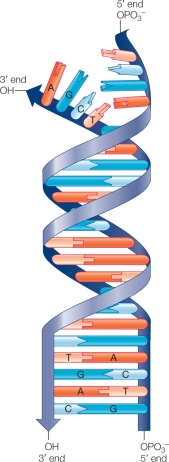 What are the first four bases that would pair (from top to bottom) with the exposed 3ʹ end strand?
 (Short Answer)
4.9/5 (77)
(77) An alien DNA-like molecule is isolated from the frozen remains of a life form found beneath the Martian polar ice caps.In this sample, for every base designated Q, there is twice that amount of base R; for every base Z, there is twice that amount of base S.Assuming that there is base bonding, a likely conclusion from these observed ratios is that one base _______ bonds with _______ base _______.
(Multiple Choice)
4.9/5 (87)
(87) Refer to the figure, which shows DNA replication. 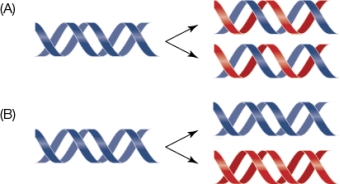 Which diagram (A or B) shows conservative replication?
 (Short Answer)
4.9/5 (82)
(82) What attribute of the DNA polymerase from the bacterium Thermus aquaticus makes it valuable in the PCR technique?
(Essay)
4.9/5 (87)
(87) Eggs and sperm must contain all the DNA of an organism.To ensure complete DNA, these cells would be expected to
(Multiple Choice)
4.9/5 (88)
(88) In skin fibroblasts heavily exposed to sunlight, the _______ DNA repair system would repair UV-induced mutations.
(Multiple Choice)
4.8/5 (103)
(103) In the Meselson‒Stahl experiment, cesium chloride solution
(Multiple Choice)
4.9/5 (68)
(68) If a mutation changes a G to an A on one strand of a DNA molecule, with a corresponding change in its complement, which attribute of DNA will most likely be affected?
(Multiple Choice)
4.7/5 (87)
(87) Comparison of the genomic sequences of parental and progeny viruses indicated a high level of error in replication.This information suggests that the DNA polymerase replicating the viral DNA lacked a _______ mechanism.
(Short Answer)
4.8/5 (73)
(73) 
Filters
- Essay(0)
- Multiple Choice(0)
- Short Answer(0)
- True False(0)
- Matching(0)