



 Chat with AI
Exam 13: Dna and Its Role in Heredity

Exam 1: Studying Life246 Questions
Exam 2: Small Molecules and the Chemistry of Life246 Questions
Exam 3: Proteins, Carbohydrates, and Lipids246 Questions
Exam 4: Nucleic Acids and the Origin of Life246 Questions
Exam 5: Cells: the Working Units of Life248 Questions
Exam 6: Cell Membranes246 Questions
Exam 7: Cell Communication and Multicellularity246 Questions
Exam 8: Energy, Enzymes, and Metabolism246 Questions
Exam 9: Pathways That Harvest Chemical Energy246 Questions
Exam 10: Photosynthesis: Energy From Sunlight242 Questions
Exam 11: The Cell Cycle and Cell Division260 Questions
Exam 12: Inheritance, Genes, and Chromosomes250 Questions
Exam 13: Dna and Its Role in Heredity257 Questions
Exam 14: From Dna to Protein: Gene Expression252 Questions
Exam 15: Gene Mutation and Molecular Medicine251 Questions
Exam 16: Regulation of Gene Expression245 Questions
Exam 17: Genomes249 Questions
Exam 18: Recombinant Dna and Biotechnology243 Questions
Exam 20: Mechanisms of Evolution243 Questions
Exam 21: Reconstructing and Using Phylogenies246 Questions
Exam 22: Speciation247 Questions
Exam 23: Evolution of Genes and Genomes252 Questions
Exam 24: The History of Life on Earth246 Questions
Exam 25: Bacteria, Archaea, and Viruses262 Questions
Exam 26: The Origin and Diversification of Eukaryotes252 Questions
Exam 27: Plants Without Seeds: From Water to Land251 Questions
Exam 28: The Evolution of Seed Plants259 Questions
Exam 29: The Evolution and Diversity of Fungi261 Questions
Exam 30: Animal Origins and the Evolution of Body Plans248 Questions
Exam 31: Protostome Animals244 Questions
Exam 32: Deuterostome Animals246 Questions
Exam 33: The Plant Body243 Questions
Exam 34: Transport in Plants248 Questions
Exam 35: Plant Nutrition247 Questions
Exam 36: Regulation of Plant Growth246 Questions
Exam 37: Reproduction in Flowering Plants247 Questions
Exam 38: Plant Responses to Environmental Challenges246 Questions
Exam 39: Physiology, Homeostasis, and Temperature Regulation258 Questions
Exam 40: Animal Hormones249 Questions
Exam 41: Immunology: Animal Defense Systems265 Questions
Exam 42: Animal Reproduction261 Questions
Exam 43: Animal Development261 Questions
Exam 44: Neurons, Glia, and Nervous Systems250 Questions
Exam 45: Sensory Systems249 Questions
Exam 46: The Mammalian Nervous System: Structure and Higher Functions254 Questions
Exam 47: Musculoskeletal Systems259 Questions
Exam 48: Gas Exchange247 Questions
Exam 49: Circulatory Systems252 Questions
Exam 50: Nutrition, Digestion, and Absorption259 Questions
Exam 51: Salt and Water Balance and Nitrogen Excretion251 Questions
Exam 52: Animal Behavior249 Questions
Exam 53: The Physical Environment and Biogeography of Life248 Questions
Exam 54: Populations259 Questions
Exam 55: Species Interactions254 Questions
Exam 56: Communities247 Questions
Exam 57: Ecosystems238 Questions
Exam 58: A Changing Biosphere222 Questions
Select questions type


The first repair of mistakes during DNA replication is made by
(Multiple Choice)
4.8/5  (84)
(84) Using Meselson and Stahl's experimental system for studying the mode of replication of DNA, researchers analyze the genetic information from a life-form from Mars.After the first round of replication, they see two distinct bands (a heavy one and a light one) in the cesium chloride gradient.This finding is consistent with the principle of _______ replication.
(Short Answer)
4.9/5 (76)
(76) Recall that two hydrogen bonds bind A and T, but three hydrogen bonds bind G and C.The stability of DNA is affected by the number of hydrogen bonds, with more bonds promoting more stability.Double-stranded DNA molecules that have greater stability require more heat to be broken into single strands.Which double-stranded DNA molecule would likely require the lowest temperature in PCR?
(Multiple Choice)
4.7/5 (74)
(74) The fragments of RNA and DNA found on the lagging strand of DNA before RNA removal and ligation are called _______.
(Short Answer)
4.8/5 (90)
(90) To determine whether DNA replication is semiconservative, conservative, or dispersive, Meselson and Stahl labeled E.coli DNA with a regimen of heavy nitrogen for one round of replication and then transferred these cells to a light nitrogen regimen for two more rounds of replication.Which statement would not have been true within the context of this experiment?
(Multiple Choice)
4.8/5 (76)
(76) The experiments of Meselson and Stahl established the _______ replication of DNA.
(Short Answer)
4.9/5 (94)
(94) A PCR primer has the sequence 5-ATTCCG-3.This primer will bind to the template sequence
(Multiple Choice)
4.8/5 (78)
(78) In Griffith's experiments, when heat-killed S strain pneumococci were injected into a mouse along with live R strain pneumococci,
(Multiple Choice)
4.8/5 (76)
(76) A researcher transfects mammalian cells with a gene of interest.However, expression of the gene will not confer a selectable phenotype.To differentiate between transfected and nontransfected cells in the transfection solution, the researcher should include a gene for a _______.
(Short Answer)
4.9/5 (73)
(73) Which of the following provides the correct order of events in the synthesis of the lagging strand?
(Multiple Choice)
4.8/5 (71)
(71) If human DNA polymerase is substituted for Thermus aquaticus DNA polymerase, what will be the effect on the PCR amplification of a template DNA?
(Multiple Choice)
4.8/5 (74)
(74) Refer to the figure, which illustrates the chemical structure of DNA. 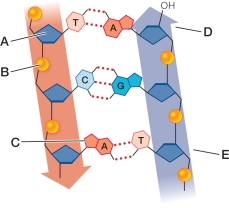 Which label corresponds to a deoxyribose sugar?
 (Multiple Choice)
4.8/5 (88)
(88) DNA proofreading relies upon recognition of correct _______ base pairing by the DNA polymerase complex.
(Short Answer)
4.8/5 (82)
(82) A mutation causes the sliding DNA clamp to operate less efficiently.What is the most likely consequence of this mutation?
(Multiple Choice)
4.8/5 (66)
(66) Suppose that there is a new DNA polymerase that can add nucleotides at both the 5 and 3 ends of DNA strands.Otherwise, this new DNA polymerase functions in the same way as other DNA polymerases.With such a DNA polymerase, which molecule(s) would not be required?
(Multiple Choice)
4.8/5 (82)
(82) The uniform diameter of the DNA structure provides evidence for
a. 3 end phosphorylation.
b. a double-stranded helix.
c. purine-pyrimidine pairing.
d. a right-handed helix.
e. antiparallel DNA strands.
(Essay)
4.7/5 (92)
(92) The enzyme _______ adds short strands of RNA to the lagging strand.
(Short Answer)
5.0/5 (71)
(71) 
Filters
- Essay(0)
- Multiple Choice(0)
- Short Answer(0)
- True False(0)
- Matching(0)