



 Chat with AI
Exam 13: Dna and Its Role in Heredity

Exam 1: Studying Life246 Questions
Exam 2: Small Molecules and the Chemistry of Life246 Questions
Exam 3: Proteins, Carbohydrates, and Lipids246 Questions
Exam 4: Nucleic Acids and the Origin of Life246 Questions
Exam 5: Cells: the Working Units of Life248 Questions
Exam 6: Cell Membranes246 Questions
Exam 7: Cell Communication and Multicellularity246 Questions
Exam 8: Energy, Enzymes, and Metabolism246 Questions
Exam 9: Pathways That Harvest Chemical Energy246 Questions
Exam 10: Photosynthesis: Energy From Sunlight242 Questions
Exam 11: The Cell Cycle and Cell Division260 Questions
Exam 12: Inheritance, Genes, and Chromosomes250 Questions
Exam 13: Dna and Its Role in Heredity257 Questions
Exam 14: From Dna to Protein: Gene Expression252 Questions
Exam 15: Gene Mutation and Molecular Medicine251 Questions
Exam 16: Regulation of Gene Expression245 Questions
Exam 17: Genomes249 Questions
Exam 18: Recombinant Dna and Biotechnology243 Questions
Exam 20: Mechanisms of Evolution243 Questions
Exam 21: Reconstructing and Using Phylogenies246 Questions
Exam 22: Speciation247 Questions
Exam 23: Evolution of Genes and Genomes252 Questions
Exam 24: The History of Life on Earth246 Questions
Exam 25: Bacteria, Archaea, and Viruses262 Questions
Exam 26: The Origin and Diversification of Eukaryotes252 Questions
Exam 27: Plants Without Seeds: From Water to Land251 Questions
Exam 28: The Evolution of Seed Plants259 Questions
Exam 29: The Evolution and Diversity of Fungi261 Questions
Exam 30: Animal Origins and the Evolution of Body Plans248 Questions
Exam 31: Protostome Animals244 Questions
Exam 32: Deuterostome Animals246 Questions
Exam 33: The Plant Body243 Questions
Exam 34: Transport in Plants248 Questions
Exam 35: Plant Nutrition247 Questions
Exam 36: Regulation of Plant Growth246 Questions
Exam 37: Reproduction in Flowering Plants247 Questions
Exam 38: Plant Responses to Environmental Challenges246 Questions
Exam 39: Physiology, Homeostasis, and Temperature Regulation258 Questions
Exam 40: Animal Hormones249 Questions
Exam 41: Immunology: Animal Defense Systems265 Questions
Exam 42: Animal Reproduction261 Questions
Exam 43: Animal Development261 Questions
Exam 44: Neurons, Glia, and Nervous Systems250 Questions
Exam 45: Sensory Systems249 Questions
Exam 46: The Mammalian Nervous System: Structure and Higher Functions254 Questions
Exam 47: Musculoskeletal Systems259 Questions
Exam 48: Gas Exchange247 Questions
Exam 49: Circulatory Systems252 Questions
Exam 50: Nutrition, Digestion, and Absorption259 Questions
Exam 51: Salt and Water Balance and Nitrogen Excretion251 Questions
Exam 52: Animal Behavior249 Questions
Exam 53: The Physical Environment and Biogeography of Life248 Questions
Exam 54: Populations259 Questions
Exam 55: Species Interactions254 Questions
Exam 56: Communities247 Questions
Exam 57: Ecosystems238 Questions
Exam 58: A Changing Biosphere222 Questions
Select questions type


In a growing DNA strand, to which carbon of the deoxyribose is each monomer added?
(Multiple Choice)
4.8/5  (84)
(84) The Hershey and Chase blender experiment persuaded most scientists that
(Multiple Choice)
5.0/5 (82)
(82) The repetitive sequences at the ends of many chromosomes are called _______.
(Short Answer)
4.9/5 (86)
(86) Differentiate between proofreading, mismatch repair, and excision repair.Which of these repair mechanisms is responsible for repairing a mutation that occurs in a skin cell from overexposure to the sun?
(Essay)
4.8/5 (70)
(70) If a high concentration of a particular nucleotide lacking a hydroxyl group at the 3ʹ end is added to a PCR reaction,
(Multiple Choice)
4.9/5 (73)
(73) Which molecular model describes the structure of the DNA molecule?
(Multiple Choice)
4.9/5 (81)
(81) To prove that DNA is the transforming substance, Avery, MacLeod, and McCarty demonstrated that DNA could transform nonvirulent strains of pneumococcus.The definitive evidence for transformation was
(Multiple Choice)
4.8/5 (70)
(70) Experiments designed to identify the transforming substance were based on
(Multiple Choice)
4.8/5 (89)
(89) According to Chargaff's rule, if 22 percent of the nitrogenous bases of a double-stranded molecule of DNA are C, then _______ percent will be T.
(Short Answer)
4.9/5 (85)
(85) An individual inherits two defective copies of the MLH1 gene, a protein involved in mismatch repair of DNA during its replication.What do you predict will be the consequences of deficient mismatch repair upon DNA replication?
(Multiple Choice)
4.9/5 (89)
(89) What effect would a primase inhibitor have on DNA replication?
a. DNA polymerase would not be able to add bases to the DNA.
b. DNA polymerase would not be able to use DNA as a template.
c. Primase would be blocked from joining the DNA replication complex.
d. Primase would not be able to provide primers for DNA polymerases.
e. There would be no effect on DNA replication.
(Essay)
4.8/5 (65)
(65) DNA replication in eukaryotes differs from replication in bacteria because
(Multiple Choice)
4.8/5 (81)
(81) Refer to the figure, showing two culture plates. 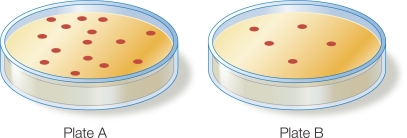 A researcher transfects bacteria with a gene that does not confer a selectable phenotype, so he also includes a gene for resistance to the antibiotic neomycin on a separate DNA strand.After the transfection, the researcher divides the culture into two equal fractions.Fraction 1 is spread onto a plate without neomycin (Plate A), and fraction 2 is spread onto a plate with neomycin (Plate B).Considering both plates, how many colonies in total are composed of bacteria that have been successfully transfected?
 (Multiple Choice)
4.9/5 (72)
(72) In the Meselson-Stahl experiment, the dispersive model of DNA replication was ruled out by which observation?
(Multiple Choice)
4.9/5 (80)
(80) 
Filters
- Essay(0)
- Multiple Choice(0)
- Short Answer(0)
- True False(0)
- Matching(0)