



 Chat with AI
Exam 54: Populations

Exam 1: Studying Life246 Questions
Exam 2: Small Molecules and the Chemistry of Life246 Questions
Exam 3: Proteins, Carbohydrates, and Lipids246 Questions
Exam 4: Nucleic Acids and the Origin of Life246 Questions
Exam 5: Cells: the Working Units of Life248 Questions
Exam 6: Cell Membranes246 Questions
Exam 7: Cell Communication and Multicellularity246 Questions
Exam 8: Energy, Enzymes, and Metabolism246 Questions
Exam 9: Pathways That Harvest Chemical Energy246 Questions
Exam 10: Photosynthesis: Energy From Sunlight242 Questions
Exam 11: The Cell Cycle and Cell Division260 Questions
Exam 12: Inheritance, Genes, and Chromosomes250 Questions
Exam 13: Dna and Its Role in Heredity257 Questions
Exam 14: From Dna to Protein: Gene Expression252 Questions
Exam 15: Gene Mutation and Molecular Medicine251 Questions
Exam 16: Regulation of Gene Expression245 Questions
Exam 17: Genomes249 Questions
Exam 18: Recombinant Dna and Biotechnology243 Questions
Exam 20: Mechanisms of Evolution243 Questions
Exam 21: Reconstructing and Using Phylogenies246 Questions
Exam 22: Speciation247 Questions
Exam 23: Evolution of Genes and Genomes252 Questions
Exam 24: The History of Life on Earth246 Questions
Exam 25: Bacteria, Archaea, and Viruses262 Questions
Exam 26: The Origin and Diversification of Eukaryotes252 Questions
Exam 27: Plants Without Seeds: From Water to Land251 Questions
Exam 28: The Evolution of Seed Plants259 Questions
Exam 29: The Evolution and Diversity of Fungi261 Questions
Exam 30: Animal Origins and the Evolution of Body Plans248 Questions
Exam 31: Protostome Animals244 Questions
Exam 32: Deuterostome Animals246 Questions
Exam 33: The Plant Body243 Questions
Exam 34: Transport in Plants248 Questions
Exam 35: Plant Nutrition247 Questions
Exam 36: Regulation of Plant Growth246 Questions
Exam 37: Reproduction in Flowering Plants247 Questions
Exam 38: Plant Responses to Environmental Challenges246 Questions
Exam 39: Physiology, Homeostasis, and Temperature Regulation258 Questions
Exam 40: Animal Hormones249 Questions
Exam 41: Immunology: Animal Defense Systems265 Questions
Exam 42: Animal Reproduction261 Questions
Exam 43: Animal Development261 Questions
Exam 44: Neurons, Glia, and Nervous Systems250 Questions
Exam 45: Sensory Systems249 Questions
Exam 46: The Mammalian Nervous System: Structure and Higher Functions254 Questions
Exam 47: Musculoskeletal Systems259 Questions
Exam 48: Gas Exchange247 Questions
Exam 49: Circulatory Systems252 Questions
Exam 50: Nutrition, Digestion, and Absorption259 Questions
Exam 51: Salt and Water Balance and Nitrogen Excretion251 Questions
Exam 52: Animal Behavior249 Questions
Exam 53: The Physical Environment and Biogeography of Life248 Questions
Exam 54: Populations259 Questions
Exam 55: Species Interactions254 Questions
Exam 56: Communities247 Questions
Exam 57: Ecosystems238 Questions
Exam 58: A Changing Biosphere222 Questions
Select questions type


Which sentence best explains the difference in position between the curve for r = 1.00 and the curve for r = 0.25? 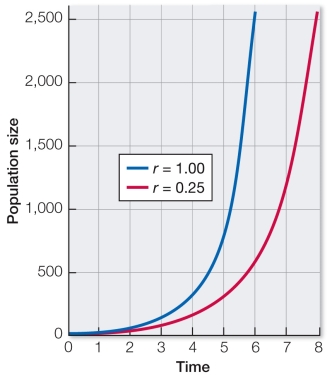

Free
(Multiple Choice)
4.8/5  (89)
(89) Correct Answer: Verified
A
Population X has 10,000 individuals; Population Y has 100,000 individuals.Both have a growth rate of 2 percent.During the first year, how many individuals will be added to each population?
Free
(Multiple Choice)
4.9/5 (70)
(70) Correct Answer:Verified
VerifiedC
Since Malthus's time, the carrying capacity of the human population has greatly increased, but most ecologists do not think this increase can be sustained.If the human carrying capacity levels off or declines, this change will most likely occur because humans have
Free
(Multiple Choice)
4.9/5 (74)
(74) Correct Answer:Verified
VerifiedB
Researchers are beginning a study of a field mouse population.To determine the best procedures to use for the mark-recapture method, they try different traps, baits, marking methods, and time intervals between first and second captures.In the first five trials, they have calculated these estimates of population size: 96, 172, 169, 168, and 174 mice.Which trial condition might account for the low estimate of 96 mice in the first trial?
(Multiple Choice)
4.7/5 (93)
(93) Zebra mussels were brought to North America from Europe and have rapidly spread through the Great Lakes and the Mississippi River.The adults attach to boats, piers, and other hard surfaces.They feed on plankton, clarifying the water but drastically decreasing the food available for native mussels and fish such as salmon and whitefish.The clearer water also promotes toxic algal blooms.Zebra fish can breed in a wide range of temperatures.A zebra mussel lives five years and produces five million eggs, of which 100,000 reach adulthood.The offspring of a single mussel will produce half a billion adult offspring.They have quickly become a major pest species in North America, although they were not pests in their native Europe. A scientist suggests limiting mussel populations by introducing a predator of zebra mussels into the waterways.In the past, such biological control has had varying effects, depending on the species involved.In this case, which situation is the least likely outcome of this form of biological control?
(Multiple Choice)
4.9/5 (70)
(70) When the per capita growth rate of a population is zero , the population is
(Multiple Choice)
4.9/5 (101)
(101) Which statement best describes the relationship of life history strategies to the management of wildlife populations?
(Multiple Choice)
4.9/5 (88)
(88) Wheat is a plant that reproduces only once, producing many seeds (grains of wheat) before it dies.This is an example of
(Multiple Choice)
4.9/5 (73)
(73) A population of aphids is growing logistically.If the carrying capacity is 2,000 and the per capita growth rate is 0.1 per day, at what size will the population be increasing by 50 aphids per day?
(Multiple Choice)
4.8/5 (74)
(74) Giant pandas live for about 20 years in the moist bamboo forests of southwestern China.Beginning around age 6, females give birth approximately every two years.One or two tiny offspring are born per successful mating, but usually only one is tended by the female over the first 18 months of its life.Which life history strategy fits most of these characteristics, and what type of survivorship curve would the giant panda most likely have?
(Multiple Choice)
4.9/5 (85)
(85) Suppose the starting size of a population (N0) is 5,000.Using the equation shown, calculate the population Nt after one year, given 35 births, 20 deaths, 150 immigrants, and 45 emigrants during this time. 
(Multiple Choice)
5.0/5 (75)
(75) In 2010, the United States conducted a census of all residents, from which life tables were constructed for towns, states, and the country.These census-based life tables are examples of what kind of life tables?
(Multiple Choice)
4.9/5 (75)
(75) The number of individuals in the population divided by the area of the space covered by the population is the _______.
(Short Answer)
4.9/5 (84)
(84) An introduced insect is devastating several related plant species within a diverse natural area.An environmental manager is tasked with developing and preserving the area.He decides to use a biological control method, a parasitic fly that feeds on the pest insect's larvae.Would this be considered a density-dependent or a density-independent approach to population control?
(Multiple Choice)
4.8/5 (75)
(75) Under ideal conditions, the per capita birth rate in a population of isopods is 0.12 offspring per day, and the per capita death rate is 0.04 offspring per day.If there are 700 individuals in the population, the population will produce how many isopods per day?
(Multiple Choice)
4.9/5 (84)
(84) Consider the logistic growth equation shown: 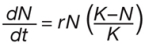 If the value for
 in this equation increased, the graph would change by
If the value for in this equation increased, the graph would change by (Multiple Choice)
4.8/5 (85)
(85) In a species of beetle, close proximity to another individual of the same species enhances survival.The resulting dispersion pattern for this species would most likely be _______.
(Short Answer)
4.9/5 (82)
(82) A person using information from a cohort life table multiplies the survivorship and fecundity values from each age class together and sums the results.This gives which population characteristic?
(Multiple Choice)
4.8/5 (93)
(93) You are managing a metapopulation of a threatened beetle that lives on a plant that is found in patches.Thus the beetle is also found in patches, which vary in size.You have limited resources and cannot save all of the beetle populations.On which patches should you concentrate your efforts, and why?
(Multiple Choice)
4.9/5 (81)
(81) If a population displays density-dependent effects, it is likely to have which trait?
(Multiple Choice)
5.0/5 (72)
(72) 
Filters
- Essay(0)
- Multiple Choice(0)
- Short Answer(0)
- True False(0)
- Matching(0)