



 Chat with AI
Exam 54: Populations

Exam 1: Studying Life246 Questions
Exam 2: Small Molecules and the Chemistry of Life246 Questions
Exam 3: Proteins, Carbohydrates, and Lipids246 Questions
Exam 4: Nucleic Acids and the Origin of Life246 Questions
Exam 5: Cells: the Working Units of Life248 Questions
Exam 6: Cell Membranes246 Questions
Exam 7: Cell Communication and Multicellularity246 Questions
Exam 8: Energy, Enzymes, and Metabolism246 Questions
Exam 9: Pathways That Harvest Chemical Energy246 Questions
Exam 10: Photosynthesis: Energy From Sunlight242 Questions
Exam 11: The Cell Cycle and Cell Division260 Questions
Exam 12: Inheritance, Genes, and Chromosomes250 Questions
Exam 13: Dna and Its Role in Heredity257 Questions
Exam 14: From Dna to Protein: Gene Expression252 Questions
Exam 15: Gene Mutation and Molecular Medicine251 Questions
Exam 16: Regulation of Gene Expression245 Questions
Exam 17: Genomes249 Questions
Exam 18: Recombinant Dna and Biotechnology243 Questions
Exam 20: Mechanisms of Evolution243 Questions
Exam 21: Reconstructing and Using Phylogenies246 Questions
Exam 22: Speciation247 Questions
Exam 23: Evolution of Genes and Genomes252 Questions
Exam 24: The History of Life on Earth246 Questions
Exam 25: Bacteria, Archaea, and Viruses262 Questions
Exam 26: The Origin and Diversification of Eukaryotes252 Questions
Exam 27: Plants Without Seeds: From Water to Land251 Questions
Exam 28: The Evolution of Seed Plants259 Questions
Exam 29: The Evolution and Diversity of Fungi261 Questions
Exam 30: Animal Origins and the Evolution of Body Plans248 Questions
Exam 31: Protostome Animals244 Questions
Exam 32: Deuterostome Animals246 Questions
Exam 33: The Plant Body243 Questions
Exam 34: Transport in Plants248 Questions
Exam 35: Plant Nutrition247 Questions
Exam 36: Regulation of Plant Growth246 Questions
Exam 37: Reproduction in Flowering Plants247 Questions
Exam 38: Plant Responses to Environmental Challenges246 Questions
Exam 39: Physiology, Homeostasis, and Temperature Regulation258 Questions
Exam 40: Animal Hormones249 Questions
Exam 41: Immunology: Animal Defense Systems265 Questions
Exam 42: Animal Reproduction261 Questions
Exam 43: Animal Development261 Questions
Exam 44: Neurons, Glia, and Nervous Systems250 Questions
Exam 45: Sensory Systems249 Questions
Exam 46: The Mammalian Nervous System: Structure and Higher Functions254 Questions
Exam 47: Musculoskeletal Systems259 Questions
Exam 48: Gas Exchange247 Questions
Exam 49: Circulatory Systems252 Questions
Exam 50: Nutrition, Digestion, and Absorption259 Questions
Exam 51: Salt and Water Balance and Nitrogen Excretion251 Questions
Exam 52: Animal Behavior249 Questions
Exam 53: The Physical Environment and Biogeography of Life248 Questions
Exam 54: Populations259 Questions
Exam 55: Species Interactions254 Questions
Exam 56: Communities247 Questions
Exam 57: Ecosystems238 Questions
Exam 58: A Changing Biosphere222 Questions
Select questions type


Which characteristic is typical of a K-strategist species?
(Multiple Choice)
4.9/5  (74)
(74) In a study of the population density of bullfrogs in a lake, 25 frogs are captured and marked in the first sampling.Five days later, 30 frogs are captured, 10 of which have marks.Based on these results, the estimated number of bullfrogs in this population is
(Multiple Choice)
4.8/5 (91)
(91) In the twenty-first century, what type of survivorship curve does the human population have? What would the type likely have been for early Homo sapiens, before the development of modern agriculture, industry, and medicine?
(Essay)
4.7/5 (79)
(79) Human activities are likely to affect the number of populations within a metapopulation by
(Multiple Choice)
4.9/5 (82)
(82) If the per capita growth rate of a population equals zero,
(Multiple Choice)
4.9/5 (83)
(83) Which factor would be involved in density-independent population growth?
(Multiple Choice)
4.7/5 (82)
(82) Refer to the graph shown. 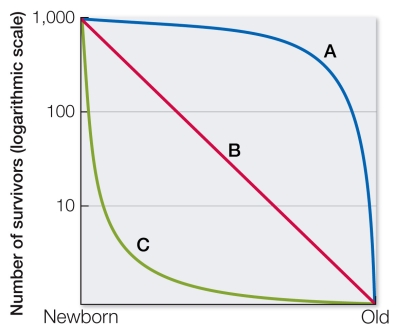 A species shows a survivorship curve similar to curve C.A biologist viewing this curve can deduce that this species likely has which characteristic?
 (Multiple Choice)
4.8/5 (90)
(90) As populations of giant clams in the Indo-Pacific become sparser, local extinctions of giant clam populations have increased.This situation is likely related to the Allee effect because, in sparser populations, clams
(Multiple Choice)
4.7/5 (82)
(82) Refer to the graph showing logistic growth. 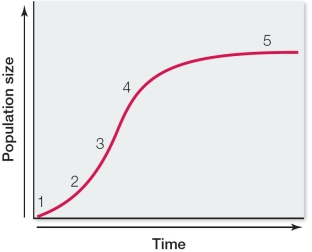 At which point would there be zero population growth (dN/dt = 0)?
 (Multiple Choice)
4.8/5 (74)
(74) To estimate the population size of a flock of starlings, a sample of 45 birds is netted, banded, and released.One week later, a second sample of 50 birds is netted, and 15 of these birds are found to have bands on them.Based on these data, what is the best estimate of the starling flock's population size?
(Multiple Choice)
4.8/5 (77)
(77) As a population's resources become limited, it begins to display a pattern called _______ growth.
(Short Answer)
4.8/5 (76)
(76) A survivorship curve for an organism that has a constant risk of mortality throughout its lifetime is likely to have a shape that is
(Multiple Choice)
4.9/5 (73)
(73) To be defined as migration, animal dispersion must include all of the following factors except
(Multiple Choice)
4.9/5 (83)
(83) In terms of relative size, what is the most likely relationship between populations, metapopulations, and geographic ranges of a single species of organism?
(Multiple Choice)
4.8/5 (84)
(84) For which of the following populations would biologists most likely use number of individuals per unit of volume, rather than number of individuals per unit of area, in measuring population density?
(Multiple Choice)
4.9/5 (83)
(83) The common chimpanzee, Pan troglodytes, is found in a wide but discontinuous area across Equatorial Africa between 13 degrees North and 7 degrees south latitude.This is a description of the chimpanzees' _______.
(Short Answer)
4.8/5 (70)
(70) On January 1, an animal population is 198.During the year, 60 animals are born into the population and 38 die.Another 14 enter the population from outside, and 10 leave.Using the population equation, determine the population size on December 31.Also determine the population growth rate.Is this population growing, stable, or declining?
(Essay)
4.9/5 (94)
(94) The table shows hypothetical colonization data for a population of barnacles.Describe the type of population growth for this population from days 0 to120.What is the carrying capacity of the population, and what factors might explain the change in population after day 120? 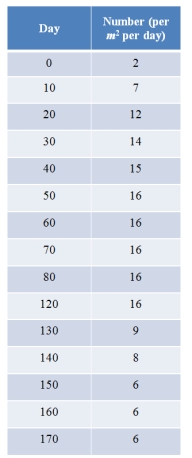
(Essay)
4.8/5 (77)
(77) The brown rat can breed year-round, with a female producing five litters of 7 to 14 offspring per year.Rats reach sexual maturity in about five weeks, and a rat population can increase by ten times in 15 weeks.The maximum lifespan is three years, and the yearly mortality rate is about 95 percent.In terms of life history strategy, brown rats can be said to be _______.
(Short Answer)
4.8/5 (76)
(76) A plant living in the understory of a forest would be least likely to use which method of seed dispersal?
(Multiple Choice)
4.8/5 (80)
(80) 
Filters
- Essay(0)
- Multiple Choice(0)
- Short Answer(0)
- True False(0)
- Matching(0)