



 Chat with AI
Exam 54: Populations

Exam 1: Studying Life246 Questions
Exam 2: Small Molecules and the Chemistry of Life246 Questions
Exam 3: Proteins, Carbohydrates, and Lipids246 Questions
Exam 4: Nucleic Acids and the Origin of Life246 Questions
Exam 5: Cells: the Working Units of Life248 Questions
Exam 6: Cell Membranes246 Questions
Exam 7: Cell Communication and Multicellularity246 Questions
Exam 8: Energy, Enzymes, and Metabolism246 Questions
Exam 9: Pathways That Harvest Chemical Energy246 Questions
Exam 10: Photosynthesis: Energy From Sunlight242 Questions
Exam 11: The Cell Cycle and Cell Division260 Questions
Exam 12: Inheritance, Genes, and Chromosomes250 Questions
Exam 13: Dna and Its Role in Heredity257 Questions
Exam 14: From Dna to Protein: Gene Expression252 Questions
Exam 15: Gene Mutation and Molecular Medicine251 Questions
Exam 16: Regulation of Gene Expression245 Questions
Exam 17: Genomes249 Questions
Exam 18: Recombinant Dna and Biotechnology243 Questions
Exam 20: Mechanisms of Evolution243 Questions
Exam 21: Reconstructing and Using Phylogenies246 Questions
Exam 22: Speciation247 Questions
Exam 23: Evolution of Genes and Genomes252 Questions
Exam 24: The History of Life on Earth246 Questions
Exam 25: Bacteria, Archaea, and Viruses262 Questions
Exam 26: The Origin and Diversification of Eukaryotes252 Questions
Exam 27: Plants Without Seeds: From Water to Land251 Questions
Exam 28: The Evolution of Seed Plants259 Questions
Exam 29: The Evolution and Diversity of Fungi261 Questions
Exam 30: Animal Origins and the Evolution of Body Plans248 Questions
Exam 31: Protostome Animals244 Questions
Exam 32: Deuterostome Animals246 Questions
Exam 33: The Plant Body243 Questions
Exam 34: Transport in Plants248 Questions
Exam 35: Plant Nutrition247 Questions
Exam 36: Regulation of Plant Growth246 Questions
Exam 37: Reproduction in Flowering Plants247 Questions
Exam 38: Plant Responses to Environmental Challenges246 Questions
Exam 39: Physiology, Homeostasis, and Temperature Regulation258 Questions
Exam 40: Animal Hormones249 Questions
Exam 41: Immunology: Animal Defense Systems265 Questions
Exam 42: Animal Reproduction261 Questions
Exam 43: Animal Development261 Questions
Exam 44: Neurons, Glia, and Nervous Systems250 Questions
Exam 45: Sensory Systems249 Questions
Exam 46: The Mammalian Nervous System: Structure and Higher Functions254 Questions
Exam 47: Musculoskeletal Systems259 Questions
Exam 48: Gas Exchange247 Questions
Exam 49: Circulatory Systems252 Questions
Exam 50: Nutrition, Digestion, and Absorption259 Questions
Exam 51: Salt and Water Balance and Nitrogen Excretion251 Questions
Exam 52: Animal Behavior249 Questions
Exam 53: The Physical Environment and Biogeography of Life248 Questions
Exam 54: Populations259 Questions
Exam 55: Species Interactions254 Questions
Exam 56: Communities247 Questions
Exam 57: Ecosystems238 Questions
Exam 58: A Changing Biosphere222 Questions
Select questions type


The equation ΔN = (B - D) can be used to represent the growth rate of a population.This equation is valid in which situations?
(Multiple Choice)
4.9/5  (81)
(81) African elephants take many years to reach sexual maturity.A female usually gives birth to one calf at a time and cares for the calf for several years.The best description for an African elephant population is
(Multiple Choice)
4.8/5 (85)
(85) Given that the amount of space on Earth has not changed since Malthus's time, what space-related factor has most enabled the great increase in the carrying capacity for humans?
(Multiple Choice)
4.9/5 (72)
(72) A graph of a population's logistic growth over time resembles which of the following shapes?
(Multiple Choice)
4.9/5 (84)
(84) Refer to the graph below. 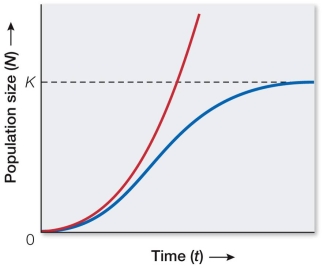 The size of a deer population in an enclosed, protected area was measured over several years and found to be following the red (left) growth curve shown.After several years of drought, its population size more closely followed the blue (right) curve.What factor probably caused the change in the deer's population growth?
 (Multiple Choice)
4.8/5 (74)
(74) Prey animals like bacteria, yeast, and phytoplankton often undergo "boom and bust" cycles: a population explosion followed by a population crash.Predators might be important to these cycles because they
(Multiple Choice)
4.8/5 (68)
(68) A population can grow at its maximum rate, that is, exponentially, under what circumstances?
(Multiple Choice)
5.0/5 (80)
(80) A forest manager takes a census of white-tailed deer in a forest during a single week in the spring.He counts all deer seen and divides them into estimated age classes.The life table he builds from these data will be a(n) _______ life table.
(Short Answer)
4.9/5 (76)
(76) Refer to the graph below, which shows the change in human life expectancy since 1840.(Values after 2000, indicated by a dashed line, are extrapolated.) 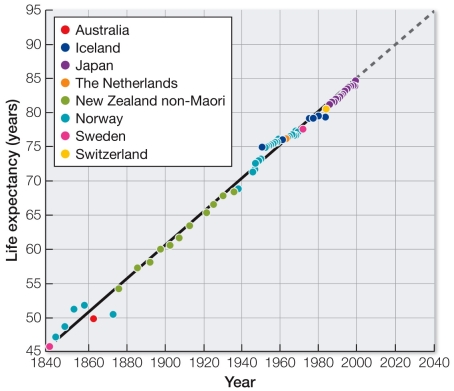 Which statement best expresses the reasons behind this continuing increase in life expectancy?
 (Multiple Choice)
4.8/5 (68)
(68) The peregrine falcon is widely distributed over all continents except Antarctica, due to its ability to survive a wide range of climatic conditions.This statement describes the peregrine falcon's
(Multiple Choice)
4.9/5 (82)
(82) Which change in the demographics of the United States is least likely to have an effect on the national rate of population growth?
(Multiple Choice)
4.9/5 (71)
(71) Refer to the mark-recapture equation below.  In an effort to measure the size of a bluegill population in a pond, you capture 40 bluegills, mark each with a tag on the tail fin, and then release them.A week later you return to the pond and catch 40 more bluegills, eight of which have tags on the tail fin.In the equation, n1 is the total number of individuals in the first sample (captured, marked, and released); n2 is the total number of individuals in the second sample; and M is the number of marked individuals recaptured in second sample.Which is the best estimate of the overall size of this bluegill population?
 (Multiple Choice)
4.9/5 (83)
(83) A small group of islands provides habitat for seabirds of a single species.The islands are close together, and although most seabirds usually nest on the same island, some fly from island to island and remain to mate with members of the local population.Would the seabirds on these islands be considered a metapopulation?
(Multiple Choice)
4.9/5 (84)
(84) Europeans brought domesticated honeybees to North America.The bees escaped to the wild and now live throughout the continent.A single queen lives up to 5 years and is the only reproducing female; she produces thousands of eggs over her lifetime.Workers live only for a summer.When the colony becomes too large, the queen goes on a flight (swarm) with some of the workers to locate a new colony site.A young queen takes over the original hive.Of the following honeybee life history characteristics, which is most likely to have contributed to their dispersal success?
(Multiple Choice)
4.7/5 (88)
(88) Refer to the equations shown. 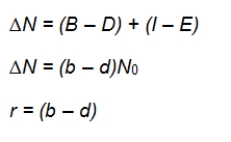 A starting population has 150 animals.During the year, 50 animals are born and 30 die.Ten animals immigrate into the population, and 5 emigrate.At the end of the year, what is the per capita growth rate for this population?
 (Multiple Choice)
4.7/5 (71)
(71) Members of a bird species defend a specific territory during the breeding season.Each breeding pair builds a nest within their territory and feeds its hatchlings from resources inside the territory.The male of the pair warns off others of the species who get too close.This situation represents which type of population dispersion?
(Multiple Choice)
4.7/5 (73)
(73) Thousands of grasshoppers of the same species live on a single plot of land.They feed on plants in the fields and gardens and reproduce within their own group.This group of grasshoppers represents a
(Multiple Choice)
4.8/5 (82)
(82) The largest grouping of organisms of one species would be described as its
(Multiple Choice)
4.9/5 (70)
(70) Some members of a species live in a cold environment.They spend much of their energy on maintaining body temperature and finding food, and they have few offspring.Members of the same species living in a more moderate environment allocate more of their energy to reproduction and have more offspring.The two species groups are illustrating the use of _______ to optimize their survival in different habitats.
(Short Answer)
4.8/5 (72)
(72) 
Filters
- Essay(0)
- Multiple Choice(0)
- Short Answer(0)
- True False(0)
- Matching(0)