



 Chat with AI
Exam 54: Populations

Exam 1: Studying Life246 Questions
Exam 2: Small Molecules and the Chemistry of Life246 Questions
Exam 3: Proteins, Carbohydrates, and Lipids246 Questions
Exam 4: Nucleic Acids and the Origin of Life246 Questions
Exam 5: Cells: the Working Units of Life248 Questions
Exam 6: Cell Membranes246 Questions
Exam 7: Cell Communication and Multicellularity246 Questions
Exam 8: Energy, Enzymes, and Metabolism246 Questions
Exam 9: Pathways That Harvest Chemical Energy246 Questions
Exam 10: Photosynthesis: Energy From Sunlight242 Questions
Exam 11: The Cell Cycle and Cell Division260 Questions
Exam 12: Inheritance, Genes, and Chromosomes250 Questions
Exam 13: Dna and Its Role in Heredity257 Questions
Exam 14: From Dna to Protein: Gene Expression252 Questions
Exam 15: Gene Mutation and Molecular Medicine251 Questions
Exam 16: Regulation of Gene Expression245 Questions
Exam 17: Genomes249 Questions
Exam 18: Recombinant Dna and Biotechnology243 Questions
Exam 20: Mechanisms of Evolution243 Questions
Exam 21: Reconstructing and Using Phylogenies246 Questions
Exam 22: Speciation247 Questions
Exam 23: Evolution of Genes and Genomes252 Questions
Exam 24: The History of Life on Earth246 Questions
Exam 25: Bacteria, Archaea, and Viruses262 Questions
Exam 26: The Origin and Diversification of Eukaryotes252 Questions
Exam 27: Plants Without Seeds: From Water to Land251 Questions
Exam 28: The Evolution of Seed Plants259 Questions
Exam 29: The Evolution and Diversity of Fungi261 Questions
Exam 30: Animal Origins and the Evolution of Body Plans248 Questions
Exam 31: Protostome Animals244 Questions
Exam 32: Deuterostome Animals246 Questions
Exam 33: The Plant Body243 Questions
Exam 34: Transport in Plants248 Questions
Exam 35: Plant Nutrition247 Questions
Exam 36: Regulation of Plant Growth246 Questions
Exam 37: Reproduction in Flowering Plants247 Questions
Exam 38: Plant Responses to Environmental Challenges246 Questions
Exam 39: Physiology, Homeostasis, and Temperature Regulation258 Questions
Exam 40: Animal Hormones249 Questions
Exam 41: Immunology: Animal Defense Systems265 Questions
Exam 42: Animal Reproduction261 Questions
Exam 43: Animal Development261 Questions
Exam 44: Neurons, Glia, and Nervous Systems250 Questions
Exam 45: Sensory Systems249 Questions
Exam 46: The Mammalian Nervous System: Structure and Higher Functions254 Questions
Exam 47: Musculoskeletal Systems259 Questions
Exam 48: Gas Exchange247 Questions
Exam 49: Circulatory Systems252 Questions
Exam 50: Nutrition, Digestion, and Absorption259 Questions
Exam 51: Salt and Water Balance and Nitrogen Excretion251 Questions
Exam 52: Animal Behavior249 Questions
Exam 53: The Physical Environment and Biogeography of Life248 Questions
Exam 54: Populations259 Questions
Exam 55: Species Interactions254 Questions
Exam 56: Communities247 Questions
Exam 57: Ecosystems238 Questions
Exam 58: A Changing Biosphere222 Questions
Select questions type


Since Malthus wrote his essay on population, the Earth's carrying capacity for humans has
(Multiple Choice)
4.8/5  (76)
(76) For most mobile organisms, population density can best be estimated by use of the _______ method.
(Short Answer)
4.8/5 (85)
(85) Sponges, sea anemones, corals, and other marine organisms are sessile as adults but have planktonic (floating) larval stages.As the oceans warm due to climate change, many of these organisms are increasingly unable to live in the ranges they now occupy.How might their larval stages enable them to survive climate change?
(Multiple Choice)
4.7/5 (74)
(74) Reindeer were introduced to Alaska's remote island of St.Matthew in 1944.They were meant to provide emergency food for 19 Coast Guard members, who abandoned the island when World War II ended in 1945.The reindeer remained on the island, which had an abundance of lichen, their favorite food.They had no predators.Their population started at 29, rose to 6,000, and then crashed to 42 in 1966.Which condition does not help explain the drastic change in the reindeer population?
(Multiple Choice)
4.8/5 (87)
(87) Which species of organism is most likely to show survivorship curve A, shown here? 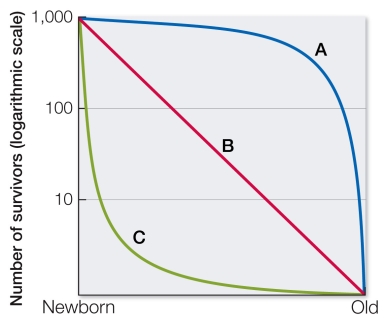
(Multiple Choice)
5.0/5 (82)
(82) For several small populations to be maintained within a metapopulation without extinctions, which factor must be present among the populations?
(Multiple Choice)
4.9/5 (79)
(79) A flood wipes out the population of a perennial plant in a lowland area.This is an example of a(n) _______ control on population size.
(Short Answer)
4.9/5 (82)
(82) Generally, we would expect a K-strategist, such as a whale, to be associated with all of these factors except
(Multiple Choice)
4.8/5 (81)
(81) Of 100 swan eggs that hatch in a population, 65 survive the first year.Survivorship for the first year is _______.
(Short Answer)
4.8/5 (88)
(88) Which statement about biological control would be a valid reason for not using it as a management strategy to control a pest population?
(Multiple Choice)
4.8/5 (76)
(76) Of the categories metapopulation, population, and geographic range, the smallest unit is the _______.
(Short Answer)
4.7/5 (60)
(60) Which assumption is not made in the development of the logistic growth equation?
(Multiple Choice)
4.8/5 (67)
(67) The Rocky Mountain Parnassian butterfly lives on separate meadows in Alberta, Canada.Individuals live in a single meadow but can fly among meadows.This arrangement would best be classified as a
(Multiple Choice)
4.8/5 (83)
(83) A herd of zebras living on the African savanna is visible from the air.What method would ecologists most likely use to determine the population size of the zebra herd?
(Multiple Choice)
4.7/5 (88)
(88) Life insurance companies use life tables containing data on thousands of people to calculate their rates for life insurance at different ages.What information would be most useful in determining these rates?
(Multiple Choice)
4.9/5 (85)
(85) An ecologist wishes to study the distribution of a plant species along a gradient of elevation up a mountainside.At various places around the base of the mountain, she attaches ropes, which she extends in a straight line up the mountainside.She then counts the number of plants present along each foot of the rope lines.This method of measuring the plant's population size is known as a(n) _______.
(Short Answer)
4.7/5 (79)
(79) A city has been trying to control its rat population by poisoning them.This kills up to 50 percent of the population, but the remaining rats then reproduce more rapidly, rebuilding the population.Given this response, a more effective method of rat control might be to
(Multiple Choice)
4.9/5 (80)
(80) Which situation is an example of density-independent population regulation?
(Multiple Choice)
4.9/5 (78)
(78) What piece of information can scientists obtain by using the per capita growth rate, r, that they do not obtain by using the population growth rate, ∆N?
(Multiple Choice)
4.9/5 (86)
(86) 
Filters
- Essay(0)
- Multiple Choice(0)
- Short Answer(0)
- True False(0)
- Matching(0)