



 Chat with AI
Exam 54: Populations

Exam 1: Studying Life246 Questions
Exam 2: Small Molecules and the Chemistry of Life246 Questions
Exam 3: Proteins, Carbohydrates, and Lipids246 Questions
Exam 4: Nucleic Acids and the Origin of Life246 Questions
Exam 5: Cells: the Working Units of Life248 Questions
Exam 6: Cell Membranes246 Questions
Exam 7: Cell Communication and Multicellularity246 Questions
Exam 8: Energy, Enzymes, and Metabolism246 Questions
Exam 9: Pathways That Harvest Chemical Energy246 Questions
Exam 10: Photosynthesis: Energy From Sunlight242 Questions
Exam 11: The Cell Cycle and Cell Division260 Questions
Exam 12: Inheritance, Genes, and Chromosomes250 Questions
Exam 13: Dna and Its Role in Heredity257 Questions
Exam 14: From Dna to Protein: Gene Expression252 Questions
Exam 15: Gene Mutation and Molecular Medicine251 Questions
Exam 16: Regulation of Gene Expression245 Questions
Exam 17: Genomes249 Questions
Exam 18: Recombinant Dna and Biotechnology243 Questions
Exam 20: Mechanisms of Evolution243 Questions
Exam 21: Reconstructing and Using Phylogenies246 Questions
Exam 22: Speciation247 Questions
Exam 23: Evolution of Genes and Genomes252 Questions
Exam 24: The History of Life on Earth246 Questions
Exam 25: Bacteria, Archaea, and Viruses262 Questions
Exam 26: The Origin and Diversification of Eukaryotes252 Questions
Exam 27: Plants Without Seeds: From Water to Land251 Questions
Exam 28: The Evolution of Seed Plants259 Questions
Exam 29: The Evolution and Diversity of Fungi261 Questions
Exam 30: Animal Origins and the Evolution of Body Plans248 Questions
Exam 31: Protostome Animals244 Questions
Exam 32: Deuterostome Animals246 Questions
Exam 33: The Plant Body243 Questions
Exam 34: Transport in Plants248 Questions
Exam 35: Plant Nutrition247 Questions
Exam 36: Regulation of Plant Growth246 Questions
Exam 37: Reproduction in Flowering Plants247 Questions
Exam 38: Plant Responses to Environmental Challenges246 Questions
Exam 39: Physiology, Homeostasis, and Temperature Regulation258 Questions
Exam 40: Animal Hormones249 Questions
Exam 41: Immunology: Animal Defense Systems265 Questions
Exam 42: Animal Reproduction261 Questions
Exam 43: Animal Development261 Questions
Exam 44: Neurons, Glia, and Nervous Systems250 Questions
Exam 45: Sensory Systems249 Questions
Exam 46: The Mammalian Nervous System: Structure and Higher Functions254 Questions
Exam 47: Musculoskeletal Systems259 Questions
Exam 48: Gas Exchange247 Questions
Exam 49: Circulatory Systems252 Questions
Exam 50: Nutrition, Digestion, and Absorption259 Questions
Exam 51: Salt and Water Balance and Nitrogen Excretion251 Questions
Exam 52: Animal Behavior249 Questions
Exam 53: The Physical Environment and Biogeography of Life248 Questions
Exam 54: Populations259 Questions
Exam 55: Species Interactions254 Questions
Exam 56: Communities247 Questions
Exam 57: Ecosystems238 Questions
Exam 58: A Changing Biosphere222 Questions
Select questions type


Due to the difficulty of following their populations over a complete life cycle, which population would more likely be studied by using a static, rather than a cohort, life table?
(Multiple Choice)
4.8/5  (87)
(87) Both schools of sardines and flocks of starlings move together as a group, which confuses predators.This behavior is more effective with more individuals in the group.This illustrates the _______ effect.
(Short Answer)
4.9/5 (88)
(88) Density-dependent regulatory factors include all of these except
(Multiple Choice)
4.9/5 (76)
(76) As an alternative to chemical pesticides, ecologists often recommend biological control: the introduction of predators or parasites of pests to control an undesirable population.Give one benefit and one risk of this strategy.
(Essay)
4.9/5 (87)
(87) Sustainable management of whale populations is generally considered more difficult than that of fish populations because whales
(Multiple Choice)
4.8/5 (81)
(81) All of the populations described below would be expected to be growing at or near their maximum rate except
(Multiple Choice)
4.9/5 (75)
(75) Which factor of population dynamics could not be determined from a cohort life table?
(Multiple Choice)
4.9/5 (87)
(87) Based on our current knowledge, it appears that the human life span
(Multiple Choice)
4.8/5 (73)
(73) In the logistic population growth curve shown here, the rate of growth is greatest at which point? 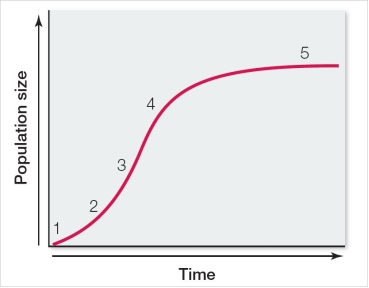
(Multiple Choice)
4.8/5 (80)
(80) Humans in most countries now have a life expectancy of 75 years or more, compared to 30-40 years in the 1800s.German researchers recently found that the average onset of puberty in 1860 was 16.6 years; by 2010, it had dropped to 10.5.These statistics provide evidence that life history changes with
(Multiple Choice)
4.9/5 (76)
(76) A population has 150 female and 100 male baboons.During a time period, 45 babies are born.The fecundity of the population for that time period is _______.
(Short Answer)
4.9/5 (80)
(80) The J-shaped exponential population growth curve occurs because the population changes by
(Multiple Choice)
4.8/5 (80)
(80) In an open population, the population growth rate can be estimated using the equation ∆N = B - D only if
(Multiple Choice)
4.8/5 (68)
(68) The quadrat method of estimating population size would likely be most appropriate for a population of
(Multiple Choice)
4.9/5 (69)
(69) Without strict management controls, which of these populations is most likely to be overharvested?
(Multiple Choice)
4.9/5 (81)
(81) Recent studies show that many types of animals besides humans have personalities.Behavioral differences (for example, variations in boldness or aggressiveness) persist across a population over time; that is, different levels of boldness and wariness coexist.Even though a trait for boldness might be dangerous for individuals who possess it, it might be adaptive in a population because, under certain circumstances, the bolder individuals are likely to
(Multiple Choice)
4.9/5 (91)
(91) Climate change is altering many aspects of current populations, including the ability to live in their usual habitats; the availability of food, water, and other resources; and even rates of reproduction.The primary type of limitation in this case is
(Multiple Choice)
4.9/5 (75)
(75) The mark-recapture method would be best suited for estimating the population size of
(Multiple Choice)
4.9/5 (76)
(76) The poisonous cane toad was introduced to Australia to control cane beetles.It had no effect on the beetles, but in the absence of predators, it has been consuming many other native species.This is an example of
(Multiple Choice)
4.9/5 (90)
(90) What difference, if any, is there in the management of r-strategist and K-strategist populations?
(Multiple Choice)
4.9/5 (91)
(91) 
Filters
- Essay(0)
- Multiple Choice(0)
- Short Answer(0)
- True False(0)
- Matching(0)