



 Chat with AI
Exam 54: Populations

Exam 1: Studying Life246 Questions
Exam 2: Small Molecules and the Chemistry of Life246 Questions
Exam 3: Proteins, Carbohydrates, and Lipids246 Questions
Exam 4: Nucleic Acids and the Origin of Life246 Questions
Exam 5: Cells: the Working Units of Life248 Questions
Exam 6: Cell Membranes246 Questions
Exam 7: Cell Communication and Multicellularity246 Questions
Exam 8: Energy, Enzymes, and Metabolism246 Questions
Exam 9: Pathways That Harvest Chemical Energy246 Questions
Exam 10: Photosynthesis: Energy From Sunlight242 Questions
Exam 11: The Cell Cycle and Cell Division260 Questions
Exam 12: Inheritance, Genes, and Chromosomes250 Questions
Exam 13: Dna and Its Role in Heredity257 Questions
Exam 14: From Dna to Protein: Gene Expression252 Questions
Exam 15: Gene Mutation and Molecular Medicine251 Questions
Exam 16: Regulation of Gene Expression245 Questions
Exam 17: Genomes249 Questions
Exam 18: Recombinant Dna and Biotechnology243 Questions
Exam 20: Mechanisms of Evolution243 Questions
Exam 21: Reconstructing and Using Phylogenies246 Questions
Exam 22: Speciation247 Questions
Exam 23: Evolution of Genes and Genomes252 Questions
Exam 24: The History of Life on Earth246 Questions
Exam 25: Bacteria, Archaea, and Viruses262 Questions
Exam 26: The Origin and Diversification of Eukaryotes252 Questions
Exam 27: Plants Without Seeds: From Water to Land251 Questions
Exam 28: The Evolution of Seed Plants259 Questions
Exam 29: The Evolution and Diversity of Fungi261 Questions
Exam 30: Animal Origins and the Evolution of Body Plans248 Questions
Exam 31: Protostome Animals244 Questions
Exam 32: Deuterostome Animals246 Questions
Exam 33: The Plant Body243 Questions
Exam 34: Transport in Plants248 Questions
Exam 35: Plant Nutrition247 Questions
Exam 36: Regulation of Plant Growth246 Questions
Exam 37: Reproduction in Flowering Plants247 Questions
Exam 38: Plant Responses to Environmental Challenges246 Questions
Exam 39: Physiology, Homeostasis, and Temperature Regulation258 Questions
Exam 40: Animal Hormones249 Questions
Exam 41: Immunology: Animal Defense Systems265 Questions
Exam 42: Animal Reproduction261 Questions
Exam 43: Animal Development261 Questions
Exam 44: Neurons, Glia, and Nervous Systems250 Questions
Exam 45: Sensory Systems249 Questions
Exam 46: The Mammalian Nervous System: Structure and Higher Functions254 Questions
Exam 47: Musculoskeletal Systems259 Questions
Exam 48: Gas Exchange247 Questions
Exam 49: Circulatory Systems252 Questions
Exam 50: Nutrition, Digestion, and Absorption259 Questions
Exam 51: Salt and Water Balance and Nitrogen Excretion251 Questions
Exam 52: Animal Behavior249 Questions
Exam 53: The Physical Environment and Biogeography of Life248 Questions
Exam 54: Populations259 Questions
Exam 55: Species Interactions254 Questions
Exam 56: Communities247 Questions
Exam 57: Ecosystems238 Questions
Exam 58: A Changing Biosphere222 Questions
Select questions type


Explain, in terms of the equations and in terms of resource availability, what happens in a population to cause it to change from exponential growth to logistic growth. 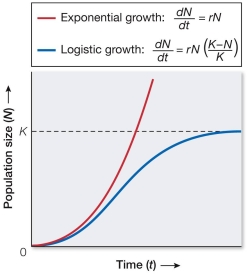
(Essay)
4.8/5  (76)
(76) Zebra mussels were brought to North America from Europe and have spread rapidly through the Great Lakes and Mississippi River.Attaching themselves to boats, piers, and other hard surfaces, the adults feed on plankton, which clarifies the water but drastically decreases the food available for native mussels and fish.The clearer water promotes toxic algal blooms.Zebra mussels can breed in a wide range of temperatures.A zebra mussel lives five years and produces five million eggs, of which 100,000 reach adulthood.The offspring of a single mussel will produce half a billion adult offspring. All of the following contribute to the fact that zebra mussels have become major pests except
(Multiple Choice)
4.8/5 (82)
(82) Two bird species, one an r-strategist and the other a K-strategist, are near extinction.Intense conservation efforts are undertaken, and both species begin to recover and increase in number.Which, if either, species should increase more quickly, and why?
(Multiple Choice)
4.8/5 (84)
(84) Emigration and immigration are assumed to be equal in a population whose per capita growth is being estimated.However, if a population is experiencing more emigration than immigration, estimation of population size according to the equation r = b - d will cause the population size to be
(Multiple Choice)
4.8/5 (89)
(89) A metapopulation of wood thrushes is found in an area of the Midwest.Individual thrush populations exist in forest patches interspersed with farm fields.Monitoring over several years showed several types of populations: I.Populations with negative birth rates that went extinct
II)New populations that occasionally formed in previously bare patches
III)Populations with positive birth rates that maintained population equilibrium
Which of these types would be considered source populations, and which would be considered sink populations?
(Multiple Choice)
4.8/5 (73)
(73) How will harvesting affect a population with density-dependent growth?
(Multiple Choice)
4.8/5 (83)
(83) The number of individuals within a given area or volume is the
(Multiple Choice)
4.8/5 (86)
(86) Refer to the table below, which shows hypothetical data for a cohort of robins. 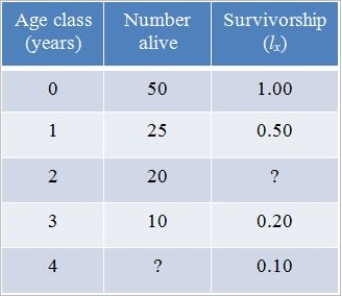 For the age class of 4 years, how many robins are alive?
 (Multiple Choice)
5.0/5 (72)
(72) When white pine seeds are blown by wind into an open field, young pine trees grow wherever the seeds land.As the pine trees get larger, they begin crowding each other and competing for space and light.Many pine trees die, and those that live are each located at a distance from their nearest neighbors.Which statement is the best description of the dispersion pattern of a white pine population over time?
(Multiple Choice)
4.9/5 (88)
(88) In the two species of Lobelia from Mount Kenya discussed in the text, L.telekii, which lives on dry rocky slopes, is semelparous, produces many seeds, and has a short life span.L.keniensis, which lives in moist valleys, is iteroparous, produces fewer large seeds, and lives longer.The differences in these two species suggest that their
(Multiple Choice)
4.7/5 (76)
(76) Ecologists measure population characteristics over several years in a metapopulation of insects.They find that, in Population A, birth rates exceed death rates.In Populations B and C, death rates exceed birth rates.The sizes of Populations A and C remain relatively stable, whereas Population B declines and eventually goes extinct.How could these three populations best be described?
(Multiple Choice)
4.8/5 (71)
(71) In studying a tiny nematode worm, scientists found differences in egg number, egg size, and body mass when the worms were tested at two temperatures.At 12°C, but not at 24°C, the nematodes showed a negative correlation between egg size and egg number.At 24°C, they found a positive correlation between egg size and body mass.They also found genetic correlations for these traits, which varied in the same direction as temperature.What is the strongest conclusion that can be drawn about the contributions of environment and genetics to life history in these nematodes?
(Multiple Choice)
4.9/5 (79)
(79) Compared to K-strategists, r-strategists are more adapted to what kind of environment?
(Multiple Choice)
4.8/5 (71)
(71) Two populations are growing exponentially.At the end of one year, Population X has added 10 individuals and its final Nt = 1,010, while Population Y has added 100 individuals, and its final Nt = 10,100.What factor is likely different in the two populations?
(Multiple Choice)
4.9/5 (75)
(75) North Pacific humpback whale populations declined dramatically due to hunting by humans.But when hunting was banned, the population grew from 1,400 whales in 1966 to almost 20,000 in 2006.This change was due to
(Multiple Choice)
4.8/5 (87)
(87) Refer to the graph below. 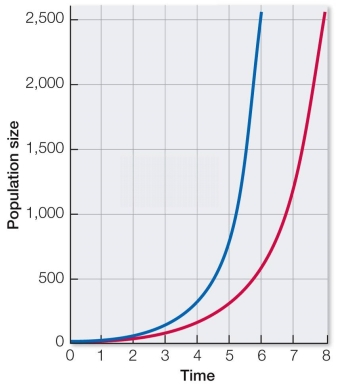 In the graph shown, what factor causes the difference in placement between the left and right growth curves?
 (Multiple Choice)
4.9/5 (81)
(81) The starting size of Population A is 1,000, and the starting size of Population B is 10,000.Both are growing at a rate of r = 1.00.Over a 10-year period, how will exponential growth affect these populations?
(Multiple Choice)
4.9/5 (78)
(78) In the early twentieth century, a plant species was widely distributed in large grasslands across the Midwest.As agriculture advanced, the grasslands were fragmented, forming much smaller habitats.Because the plant's seeds were dispersed by wind, many of the smaller fragments were able to receive seeds from nearby fragments.The change in the spatial distribution of this species can be described in all of these ways except as a
(Multiple Choice)
4.9/5 (71)
(71) Mountain sheep in Southern California are separated into small populations on different mountains within one range.Fenced highways bound two sides of these population areas.Of the small populations in this area, which would be considered part of a metapopulation?
(Multiple Choice)
4.8/5 (69)
(69) 
Filters
- Essay(0)
- Multiple Choice(0)
- Short Answer(0)
- True False(0)
- Matching(0)