



 Chat with AI
Exam 54: Populations

Exam 1: Studying Life246 Questions
Exam 2: Small Molecules and the Chemistry of Life246 Questions
Exam 3: Proteins, Carbohydrates, and Lipids246 Questions
Exam 4: Nucleic Acids and the Origin of Life246 Questions
Exam 5: Cells: the Working Units of Life248 Questions
Exam 6: Cell Membranes246 Questions
Exam 7: Cell Communication and Multicellularity246 Questions
Exam 8: Energy, Enzymes, and Metabolism246 Questions
Exam 9: Pathways That Harvest Chemical Energy246 Questions
Exam 10: Photosynthesis: Energy From Sunlight242 Questions
Exam 11: The Cell Cycle and Cell Division260 Questions
Exam 12: Inheritance, Genes, and Chromosomes250 Questions
Exam 13: Dna and Its Role in Heredity257 Questions
Exam 14: From Dna to Protein: Gene Expression252 Questions
Exam 15: Gene Mutation and Molecular Medicine251 Questions
Exam 16: Regulation of Gene Expression245 Questions
Exam 17: Genomes249 Questions
Exam 18: Recombinant Dna and Biotechnology243 Questions
Exam 20: Mechanisms of Evolution243 Questions
Exam 21: Reconstructing and Using Phylogenies246 Questions
Exam 22: Speciation247 Questions
Exam 23: Evolution of Genes and Genomes252 Questions
Exam 24: The History of Life on Earth246 Questions
Exam 25: Bacteria, Archaea, and Viruses262 Questions
Exam 26: The Origin and Diversification of Eukaryotes252 Questions
Exam 27: Plants Without Seeds: From Water to Land251 Questions
Exam 28: The Evolution of Seed Plants259 Questions
Exam 29: The Evolution and Diversity of Fungi261 Questions
Exam 30: Animal Origins and the Evolution of Body Plans248 Questions
Exam 31: Protostome Animals244 Questions
Exam 32: Deuterostome Animals246 Questions
Exam 33: The Plant Body243 Questions
Exam 34: Transport in Plants248 Questions
Exam 35: Plant Nutrition247 Questions
Exam 36: Regulation of Plant Growth246 Questions
Exam 37: Reproduction in Flowering Plants247 Questions
Exam 38: Plant Responses to Environmental Challenges246 Questions
Exam 39: Physiology, Homeostasis, and Temperature Regulation258 Questions
Exam 40: Animal Hormones249 Questions
Exam 41: Immunology: Animal Defense Systems265 Questions
Exam 42: Animal Reproduction261 Questions
Exam 43: Animal Development261 Questions
Exam 44: Neurons, Glia, and Nervous Systems250 Questions
Exam 45: Sensory Systems249 Questions
Exam 46: The Mammalian Nervous System: Structure and Higher Functions254 Questions
Exam 47: Musculoskeletal Systems259 Questions
Exam 48: Gas Exchange247 Questions
Exam 49: Circulatory Systems252 Questions
Exam 50: Nutrition, Digestion, and Absorption259 Questions
Exam 51: Salt and Water Balance and Nitrogen Excretion251 Questions
Exam 52: Animal Behavior249 Questions
Exam 53: The Physical Environment and Biogeography of Life248 Questions
Exam 54: Populations259 Questions
Exam 55: Species Interactions254 Questions
Exam 56: Communities247 Questions
Exam 57: Ecosystems238 Questions
Exam 58: A Changing Biosphere222 Questions
Select questions type


In the guppies studied by David Resnick, variations in levels of predation (and environmental variability) eventually led to _______ change in the guppy populations.
(Short Answer)
4.8/5  (82)
(82) A species of frog occupies a habitat consisting of wetlands that dry up seasonally, forming a region of aquatic and terrestrial patches.During the rainy season, the entire area is wet, and frogs range throughout the habitat, mating with any available frog and laying their eggs anywhere.During the dry season, frogs remain in the nearest aquatic patch.Would the frogs in this habitat be considered a metapopulation?
(Multiple Choice)
4.8/5 (80)
(80) The events that bring new members into a population are birth and _______.
(Short Answer)
4.9/5 (71)
(71) The human population growth rate has slowed since reaching its maximum rate in the 1960s.A decrease in which factor is most likely responsible for slowing the growth rate?
(Multiple Choice)
4.8/5 (79)
(79) If the per capita death rate within a population exceeds the per capita birth rate, the population size is
(Multiple Choice)
5.0/5 (79)
(79) Refer to the figure showing three basic dispersion patterns. 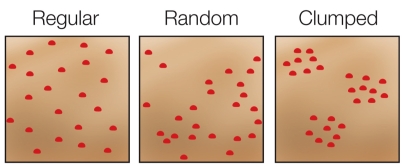 Which organisms would be most likely to show a random dispersion?
 (Multiple Choice)
4.8/5 (92)
(92) A study of red oak trees in a particular forest showed that, on average, there are 5.3 trees per 10 m2 quadrat.This result describes the red oak population's
(Multiple Choice)
4.9/5 (74)
(74) American bullfrogs have three life stages: egg, tadpole, and adult.Adults live 6 to 7 years and can reproduce each year.To determine the fecundity schedule of a bullfrog population, one would need to determine
(Multiple Choice)
4.8/5 (75)
(75) Two equations are often used to describe population growth: 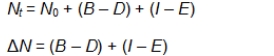 What is the difference between the solutions of these two equations, Nt and ∆N?
 (Multiple Choice)
4.9/5 (71)
(71) A study of pikas in a mountainous region of California finds 50 discrete population patches.Counts of the number of individuals in each population are done every 5 years.These counts show that all populations are in decline.After 10 years, 7 populations have become extinct, and after 20 years, 21 have become extinct.None of the patches that went extinct at year 10 are populated again at year 20.This scenario illustrates
(Multiple Choice)
4.8/5 (72)
(72) An organic farmer releases parasitic wasps to eat the aphids that are attacking the leaves of his plants.This form of plant management is known as _______.
(Short Answer)
4.9/5 (73)
(73) The sage plant secretes toxins that kill off surrounding plants in a circle around each plant.This results in which type of dispersion pattern?
(Multiple Choice)
4.7/5 (81)
(81) A fishery manager is trying to recover a population that has been overfished.To maximize the number of fish that can be harvested from this population, the manager should try to keep the population
(Multiple Choice)
4.8/5 (69)
(69) If 400 robins are found in a ten-hectare plot, the density of robins in that plot is
(Multiple Choice)
4.9/5 (81)
(81) Researchers are studying a pod of dolphins near the California coast.They watch the dolphins from boats and are able to recognize individual dolphins by characteristic shapes and scarring on their dorsal fins.They document these differences with photographs and have access to occasional airplane surveillance of the pod.The best method for determining the population size of this pod would be the _______ method.
(Short Answer)
4.8/5 (87)
(87) In which situation is the growth rate and size of a population most likely to be limited by space?
(Multiple Choice)
4.7/5 (85)
(85) Intensive fishing of the black rockfish population in the Pacific Northwest changed the average size of individual rockfish.Later generations of rockfish became smaller because fishermen selective-caught the _______ fish.
(Short Answer)
4.7/5 (73)
(73) For a population of bears, birth and death rates are equal during one year.According to the population growth equation, any change in population size will be determined by
(Multiple Choice)
4.7/5 (79)
(79) A fruit fly population is kept in bottles in the lab and fed with yeast.Initially, the yeast is growing more quickly than the fruit fly population, but as the fruit fly population grows, it begins to deplete the yeast population.When this occurs, the fruit fly population will begin to exhibit what type of growth?
(Multiple Choice)
4.7/5 (86)
(86) 
Filters
- Essay(0)
- Multiple Choice(0)
- Short Answer(0)
- True False(0)
- Matching(0)