



 Chat with AI
Exam 54: Populations

Exam 1: Studying Life246 Questions
Exam 2: Small Molecules and the Chemistry of Life246 Questions
Exam 3: Proteins, Carbohydrates, and Lipids246 Questions
Exam 4: Nucleic Acids and the Origin of Life246 Questions
Exam 5: Cells: the Working Units of Life248 Questions
Exam 6: Cell Membranes246 Questions
Exam 7: Cell Communication and Multicellularity246 Questions
Exam 8: Energy, Enzymes, and Metabolism246 Questions
Exam 9: Pathways That Harvest Chemical Energy246 Questions
Exam 10: Photosynthesis: Energy From Sunlight242 Questions
Exam 11: The Cell Cycle and Cell Division260 Questions
Exam 12: Inheritance, Genes, and Chromosomes250 Questions
Exam 13: Dna and Its Role in Heredity257 Questions
Exam 14: From Dna to Protein: Gene Expression252 Questions
Exam 15: Gene Mutation and Molecular Medicine251 Questions
Exam 16: Regulation of Gene Expression245 Questions
Exam 17: Genomes249 Questions
Exam 18: Recombinant Dna and Biotechnology243 Questions
Exam 20: Mechanisms of Evolution243 Questions
Exam 21: Reconstructing and Using Phylogenies246 Questions
Exam 22: Speciation247 Questions
Exam 23: Evolution of Genes and Genomes252 Questions
Exam 24: The History of Life on Earth246 Questions
Exam 25: Bacteria, Archaea, and Viruses262 Questions
Exam 26: The Origin and Diversification of Eukaryotes252 Questions
Exam 27: Plants Without Seeds: From Water to Land251 Questions
Exam 28: The Evolution of Seed Plants259 Questions
Exam 29: The Evolution and Diversity of Fungi261 Questions
Exam 30: Animal Origins and the Evolution of Body Plans248 Questions
Exam 31: Protostome Animals244 Questions
Exam 32: Deuterostome Animals246 Questions
Exam 33: The Plant Body243 Questions
Exam 34: Transport in Plants248 Questions
Exam 35: Plant Nutrition247 Questions
Exam 36: Regulation of Plant Growth246 Questions
Exam 37: Reproduction in Flowering Plants247 Questions
Exam 38: Plant Responses to Environmental Challenges246 Questions
Exam 39: Physiology, Homeostasis, and Temperature Regulation258 Questions
Exam 40: Animal Hormones249 Questions
Exam 41: Immunology: Animal Defense Systems265 Questions
Exam 42: Animal Reproduction261 Questions
Exam 43: Animal Development261 Questions
Exam 44: Neurons, Glia, and Nervous Systems250 Questions
Exam 45: Sensory Systems249 Questions
Exam 46: The Mammalian Nervous System: Structure and Higher Functions254 Questions
Exam 47: Musculoskeletal Systems259 Questions
Exam 48: Gas Exchange247 Questions
Exam 49: Circulatory Systems252 Questions
Exam 50: Nutrition, Digestion, and Absorption259 Questions
Exam 51: Salt and Water Balance and Nitrogen Excretion251 Questions
Exam 52: Animal Behavior249 Questions
Exam 53: The Physical Environment and Biogeography of Life248 Questions
Exam 54: Populations259 Questions
Exam 55: Species Interactions254 Questions
Exam 56: Communities247 Questions
Exam 57: Ecosystems238 Questions
Exam 58: A Changing Biosphere222 Questions
Select questions type


Population A starts with 100 rabbits and grows at 10 percent per year.Population B starts with 100 rabbits and grows at 15 percent per year.Which shows the total number of individuals in each population after three years?
(Multiple Choice)
4.8/5  (69)
(69) If 300 mice in a mouse colony are born in January and 150 of them are still alive in September, what is the survivorship rate of these mice from January to September?
(Multiple Choice)
4.8/5 (80)
(80) Organisms carry out life history trade-offs because they have a limited amount of _______ that they must allocate among survival, growth, and reproduction.
(Short Answer)
4.8/5 (68)
(68) Eighty-one pocket gophers were present in Maddox Field at the start of 2015.During that year, 24 individuals were born and 19 died.Twelve individuals immigrated, and 10 emigrated.How many pocket gophers were present in Maddox Field at the start of 2016?
(Multiple Choice)
4.9/5 (79)
(79) Women in the twenty-first century are waiting longer to have children than in past generations.This suggests that they are likely making a life history trade-off; that is, they are maximizing
(Multiple Choice)
4.8/5 (92)
(92) Refer to the mark-recapture equation below.  Suppose researchers mark 20 Pacific giant salamanders on the first day of sampling.On the second day, 50 salamanders are captured, of which 10 are marked.In the equation, n1 is the total number of individuals in the first sample (captured, marked, and released); n2 is the total number of individuals in the second sample; and M is the number of marked individuals recaptured in the second sample.Which is the best estimate of the overall size of this salamander population?
 (Multiple Choice)
4.7/5 (78)
(78) In a study of the population density of apple maggot flies, 150 flies are captured and marked in the first sampling.Two days later, 300 flies are captured, 15 of which have marks.Based on these results, the estimated number of apple maggot flies in this population would be
(Multiple Choice)
4.9/5 (83)
(83) A group of ecologists is studying a metapopulation of native bees.The species, an important pollinator, is on the verge of extinction.The ecologists hope to preserve and increase the population.For the greatest chance of success, they should probably focus on
(Multiple Choice)
4.7/5 (77)
(77) One year, a garden has many tiger swallowtail butterflies.The next year, there is an extreme drought; the flowers do not bloom, and there are no butterflies.In the third year, there is plenty of rain, the flowers bloom, and the butterflies reappear.Why did the butterflies likely reappear?
(Essay)
4.9/5 (70)
(70) The patterns and processes of changes in populations are called population
(Multiple Choice)
4.7/5 (80)
(80) A laboratory population of fruit flies in ideal environmental conditions begins with 100 flies and quickly increases to 124 flies.What is the value of r for this time period?
(Multiple Choice)
4.8/5 (79)
(79) A clumped dispersion pattern would most likely be found in
(Multiple Choice)
4.7/5 (79)
(79) Suppose the r value for the population growth curve on this graph equals 1.00.Describe how the curve would appear if the r value were 1.50 instead of 1.00.Explain why this would happen. 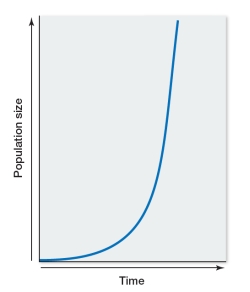
(Essay)
4.8/5 (91)
(91) The maximum number of individuals of a given species that the environment can support is the environment's _______.
(Short Answer)
4.9/5 (77)
(77) Of 150 mice alive at the start of September, 120 are still alive at the start of October.What was the mortality rate during the month of September?
(Multiple Choice)
4.9/5 (75)
(75) When Pacific salmon migrate to freshwater streams to spawn, they bring with them marine nutrients.These nutrients fertilize the freshwater habitats when the salmon dies, improving the habitat for juvenile salmon that hatch several months later.Thus, the density of the migrating salmon affects the ability of the new generation to survive.This is an example of the
(Multiple Choice)
4.9/5 (70)
(70) Advanced fishing technology has made overharvesting of fish populations much easier in the late twentieth and early twenty-first centuries.That is, fishers harvest the fish faster than fish reproduction can replace them.Also, fishers preferentially catch larger fish rather than smaller ones.List two things fishery managers might do to decrease the impact of overharvesting.
(Essay)
4.9/5 (73)
(73) Which statement about the South American cane toads that were introduced into Australia as biological control agents is false?
(Multiple Choice)
4.8/5 (67)
(67) A dog has a very large population of intestinal roundworms.As the population of roundworms increases, the parasites begin to produce fewer eggs.This is an example of population control by
(Multiple Choice)
4.8/5 (79)
(79) When scientists calculate a per capita birth or death rate, what aspect of the calculation differs from the calculation of a population growth rate?
(Multiple Choice)
4.8/5 (77)
(77) 
Filters
- Essay(0)
- Multiple Choice(0)
- Short Answer(0)
- True False(0)
- Matching(0)