



 Chat with AI
Exam 54: Populations

Exam 1: Studying Life246 Questions
Exam 2: Small Molecules and the Chemistry of Life246 Questions
Exam 3: Proteins, Carbohydrates, and Lipids246 Questions
Exam 4: Nucleic Acids and the Origin of Life246 Questions
Exam 5: Cells: the Working Units of Life248 Questions
Exam 6: Cell Membranes246 Questions
Exam 7: Cell Communication and Multicellularity246 Questions
Exam 8: Energy, Enzymes, and Metabolism246 Questions
Exam 9: Pathways That Harvest Chemical Energy246 Questions
Exam 10: Photosynthesis: Energy From Sunlight242 Questions
Exam 11: The Cell Cycle and Cell Division260 Questions
Exam 12: Inheritance, Genes, and Chromosomes250 Questions
Exam 13: Dna and Its Role in Heredity257 Questions
Exam 14: From Dna to Protein: Gene Expression252 Questions
Exam 15: Gene Mutation and Molecular Medicine251 Questions
Exam 16: Regulation of Gene Expression245 Questions
Exam 17: Genomes249 Questions
Exam 18: Recombinant Dna and Biotechnology243 Questions
Exam 20: Mechanisms of Evolution243 Questions
Exam 21: Reconstructing and Using Phylogenies246 Questions
Exam 22: Speciation247 Questions
Exam 23: Evolution of Genes and Genomes252 Questions
Exam 24: The History of Life on Earth246 Questions
Exam 25: Bacteria, Archaea, and Viruses262 Questions
Exam 26: The Origin and Diversification of Eukaryotes252 Questions
Exam 27: Plants Without Seeds: From Water to Land251 Questions
Exam 28: The Evolution of Seed Plants259 Questions
Exam 29: The Evolution and Diversity of Fungi261 Questions
Exam 30: Animal Origins and the Evolution of Body Plans248 Questions
Exam 31: Protostome Animals244 Questions
Exam 32: Deuterostome Animals246 Questions
Exam 33: The Plant Body243 Questions
Exam 34: Transport in Plants248 Questions
Exam 35: Plant Nutrition247 Questions
Exam 36: Regulation of Plant Growth246 Questions
Exam 37: Reproduction in Flowering Plants247 Questions
Exam 38: Plant Responses to Environmental Challenges246 Questions
Exam 39: Physiology, Homeostasis, and Temperature Regulation258 Questions
Exam 40: Animal Hormones249 Questions
Exam 41: Immunology: Animal Defense Systems265 Questions
Exam 42: Animal Reproduction261 Questions
Exam 43: Animal Development261 Questions
Exam 44: Neurons, Glia, and Nervous Systems250 Questions
Exam 45: Sensory Systems249 Questions
Exam 46: The Mammalian Nervous System: Structure and Higher Functions254 Questions
Exam 47: Musculoskeletal Systems259 Questions
Exam 48: Gas Exchange247 Questions
Exam 49: Circulatory Systems252 Questions
Exam 50: Nutrition, Digestion, and Absorption259 Questions
Exam 51: Salt and Water Balance and Nitrogen Excretion251 Questions
Exam 52: Animal Behavior249 Questions
Exam 53: The Physical Environment and Biogeography of Life248 Questions
Exam 54: Populations259 Questions
Exam 55: Species Interactions254 Questions
Exam 56: Communities247 Questions
Exam 57: Ecosystems238 Questions
Exam 58: A Changing Biosphere222 Questions
Select questions type


In this equation for the per capita growth rate, suppose the value for d increases while the value for b remains the same.  What happens to the value for r, and to the change in population, ΔN?
 (Multiple Choice)
4.8/5  (85)
(85) The use of parasitic wasps to limit outbreaks of blowflies is an example of _______ control.
(Short Answer)
4.7/5 (92)
(92) Discuss why you would use different methods to estimate the size of populations of large and distinct individuals, compared to populations of small, similar-looking individuals.Specify the method or methods used in each case.
(Essay)
4.9/5 (88)
(88) In an environment with scarce food resources, the size of a population is most likely to be controlled by
(Multiple Choice)
4.9/5 (78)
(78) A biologist constructs a life table of a population of Thompson gazelles, using data taken during a single sampling.What type of life table is she constructing?
(Multiple Choice)
4.7/5 (82)
(82) Species that are first to colonize a new habitat (for example, after a disaster such as a fire) are often r-strategists.Characteristics that prepare them to survive in these conditions include all of these except that they
(Multiple Choice)
4.7/5 (79)
(79) Refer to the table below, which shows hypothetical data for a cohort of robins. 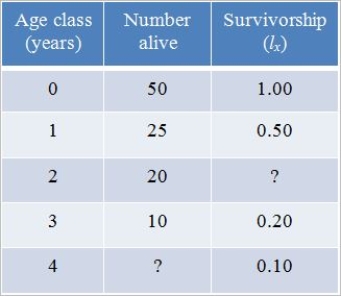 The best explanation of survivorship (lx) is that it is
 (Multiple Choice)
4.8/5 (78)
(78) Study the three dispersion types (A-C) below.Name them, briefly explain the conditions under which each occurs, and provide an example of each. 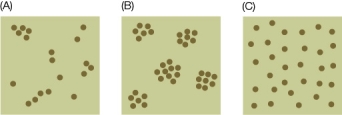
(Essay)
4.7/5 (74)
(74) Humans can reproduce many times throughout their lives.This is an example of a(n) _______ reproductive strategy.
(Short Answer)
4.9/5 (90)
(90) Density-independent regulatory factors include all of these except
(Multiple Choice)
4.8/5 (84)
(84) Refer to the paragraph below. The African wild dog is highly endangered as a result of habitat fragmentation, hunting pressure, and contagious diseases contracted from domestic dogs as humans encroach on the wild dogs' habitat.Hunting, breeding, and pup and adult survival depend on a large pack size, in which individuals cooperate and help one another.This is particularly important because the dogs are relatively small.Historically, the average pack size was about 60 animals; today it ranges from 10 to 20.
According to the Allee effect, what is the likely effect on the population of this much smaller pack size?
(Multiple Choice)
4.8/5 (69)
(69) Five hundred members of a foreign insect species are brought to a new location with a favorable climate, abundant food and shelter, no predators, and no diseases.Over the first few years, one would expect this population to exhibit _______ population growth.
(Short Answer)
4.9/5 (78)
(78) Which situation is an example of a density-independent limiting effect?
(Multiple Choice)
4.8/5 (69)
(69) When a single bacterium is placed in a culture medium, the resulting population at first grows very quickly; however, as the population expands and uses up its resources, the growth rate eventually slows and stops.Mathematically, this growth pattern is called _______ growth.
(Short Answer)
5.0/5 (79)
(79) A young hen is removed from an uncrowded cage and placed in a small space with many other hens.Which factor is most likely to increase in the hen's new environment?
(Multiple Choice)
4.9/5 (83)
(83) If the birth rate is 0.07 and the death rate is 0.14, then the per capita growth rate (r) in a population (assuming that there is no immigration or emigration) is
(Multiple Choice)
4.8/5 (84)
(84) Barnacles are crustaceans that attach themselves to rocks, shells, or other objects in marine habitats.An ecologist who wants to estimate the population of a species of barnacle living along the mid-Atlantic coast would most likely
(Multiple Choice)
4.9/5 (72)
(72) Kangaroos of the genus Macropus live in specific regions of Australia.M.giganteus is found on the eastern one-third of the continent, M.fuliginosus in the southern and western part, and M.rufus in the semiarid interior.This suggests that the range of these kangaroos is controlled by
(Multiple Choice)
4.9/5 (62)
(62) 
Filters
- Essay(0)
- Multiple Choice(0)
- Short Answer(0)
- True False(0)
- Matching(0)