



 Chat with AI
Exam 54: Populations

Exam 1: Studying Life246 Questions
Exam 2: Small Molecules and the Chemistry of Life246 Questions
Exam 3: Proteins, Carbohydrates, and Lipids246 Questions
Exam 4: Nucleic Acids and the Origin of Life246 Questions
Exam 5: Cells: the Working Units of Life248 Questions
Exam 6: Cell Membranes246 Questions
Exam 7: Cell Communication and Multicellularity246 Questions
Exam 8: Energy, Enzymes, and Metabolism246 Questions
Exam 9: Pathways That Harvest Chemical Energy246 Questions
Exam 10: Photosynthesis: Energy From Sunlight242 Questions
Exam 11: The Cell Cycle and Cell Division260 Questions
Exam 12: Inheritance, Genes, and Chromosomes250 Questions
Exam 13: Dna and Its Role in Heredity257 Questions
Exam 14: From Dna to Protein: Gene Expression252 Questions
Exam 15: Gene Mutation and Molecular Medicine251 Questions
Exam 16: Regulation of Gene Expression245 Questions
Exam 17: Genomes249 Questions
Exam 18: Recombinant Dna and Biotechnology243 Questions
Exam 20: Mechanisms of Evolution243 Questions
Exam 21: Reconstructing and Using Phylogenies246 Questions
Exam 22: Speciation247 Questions
Exam 23: Evolution of Genes and Genomes252 Questions
Exam 24: The History of Life on Earth246 Questions
Exam 25: Bacteria, Archaea, and Viruses262 Questions
Exam 26: The Origin and Diversification of Eukaryotes252 Questions
Exam 27: Plants Without Seeds: From Water to Land251 Questions
Exam 28: The Evolution of Seed Plants259 Questions
Exam 29: The Evolution and Diversity of Fungi261 Questions
Exam 30: Animal Origins and the Evolution of Body Plans248 Questions
Exam 31: Protostome Animals244 Questions
Exam 32: Deuterostome Animals246 Questions
Exam 33: The Plant Body243 Questions
Exam 34: Transport in Plants248 Questions
Exam 35: Plant Nutrition247 Questions
Exam 36: Regulation of Plant Growth246 Questions
Exam 37: Reproduction in Flowering Plants247 Questions
Exam 38: Plant Responses to Environmental Challenges246 Questions
Exam 39: Physiology, Homeostasis, and Temperature Regulation258 Questions
Exam 40: Animal Hormones249 Questions
Exam 41: Immunology: Animal Defense Systems265 Questions
Exam 42: Animal Reproduction261 Questions
Exam 43: Animal Development261 Questions
Exam 44: Neurons, Glia, and Nervous Systems250 Questions
Exam 45: Sensory Systems249 Questions
Exam 46: The Mammalian Nervous System: Structure and Higher Functions254 Questions
Exam 47: Musculoskeletal Systems259 Questions
Exam 48: Gas Exchange247 Questions
Exam 49: Circulatory Systems252 Questions
Exam 50: Nutrition, Digestion, and Absorption259 Questions
Exam 51: Salt and Water Balance and Nitrogen Excretion251 Questions
Exam 52: Animal Behavior249 Questions
Exam 53: The Physical Environment and Biogeography of Life248 Questions
Exam 54: Populations259 Questions
Exam 55: Species Interactions254 Questions
Exam 56: Communities247 Questions
Exam 57: Ecosystems238 Questions
Exam 58: A Changing Biosphere222 Questions
Select questions type


Individuals of a species that interact with one another within a given area at a particular time are known as a(n) _______.
(Short Answer)
4.8/5  (74)
(74) Young rainbow trout were sampled at locations one kilometer apart along a river.Scale samples were taken from each trout, and trout age (0 or 1) determined by counting annual rings on the scales.In the first location, 92 trout were captured and marked.In the recapture one week later, 108 trout were captured; of these, 36 were marked.Using the mark-recapture equation, estimate the population size of young trout in this section of the river.
(Essay)
4.8/5 (80)
(80) If 2,400 oak trees are counted in a 6 km × 2 km rectangular patch of land, the density of the oak trees is
(Multiple Choice)
4.9/5 (81)
(81) When the per capita birth rate exceeds the per capita death rate within a population, the population size is
(Multiple Choice)
4.7/5 (74)
(74) Some fish, such as guppies, use most of their energy to reproduce early in life; thus, adult guppies remain small and more vulnerable to predation.Other fish, such as bluegills, grow larger and have their first reproductive event later in life.One likely disadvantage bluegills will face by having their first reproduction later in life is that
(Multiple Choice)
4.8/5 (87)
(87) If the birth rate is 0.05 and the death rate is 0.02, the per capita growth rate (r) in a population (assuming that there is no immigration or emigration) is
(Multiple Choice)
4.7/5 (78)
(78) In the Trinidad guppy populations studied by Reznick and colleagues, the differences in life-history strategies between high-predation and low-predation sites resulted from changes in the population's _______.
(Short Answer)
4.7/5 (86)
(86) Refer to the graph shown. 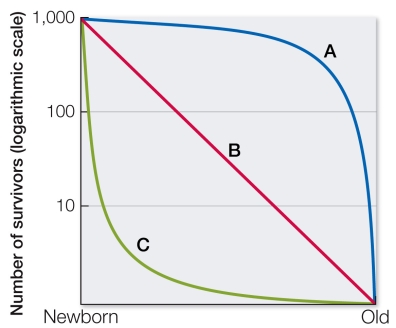 The cactus finch has high mortality rates during the juvenile stage, an adult stage with low mortality rates, and an "old age" with high mortality rates.This life history would result in a survivorship curve that is
 (Multiple Choice)
4.9/5 (74)
(74) If r = 1.0 for a given population, then the population is
(Multiple Choice)
4.9/5 (101)
(101) Connections between patches or populations within a metapopulation are maintained by _______ among the populations.
(Short Answer)
4.8/5 (73)
(73) The graph shows the history of human population growth.Approximately how long did it take the human population to reach a total of 1 billion? To go from 1 to 7.4 billion? Briefly explain the reasons for the rapid increase in population since the year 1825. 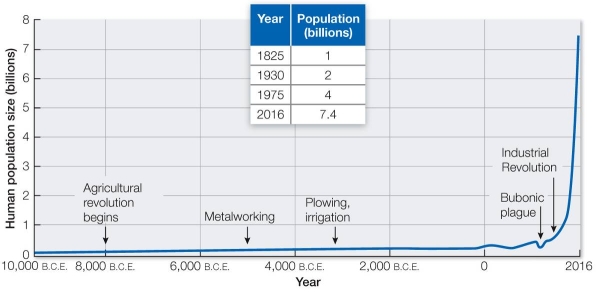
(Essay)
4.9/5 (80)
(80) The way in which an organism partitions time and energy among growing, reproducing, and maintaining themselves is referred to as its
(Multiple Choice)
4.8/5 (86)
(86) Nearly all mammals are iteroparous.This is probably because, in these larger, longer-lived animals,
(Multiple Choice)
4.8/5 (87)
(87) Consider a population of bullfrogs in a small pond.Briefly describe how the population dynamics of the bullfrogs might be affected by the physical environment, by interactions with other members of the pond community, and by dispersal.
(Essay)
4.9/5 (77)
(77) Which characteristic is typical of an r-strategist species?
(Multiple Choice)
4.8/5 (71)
(71) In a goldfish population, the fitness of the population is greater (that is, survival rate is higher) when the school of goldfish is larger.This is evidence of a(n)
(Multiple Choice)
4.8/5 (76)
(76) A population grows exponentially from a starting number of 100 individuals, with per capita monthly growth rate (r) equal to 0.2.What will be the sizes of the population at the end of each of the next three months?
(Multiple Choice)
4.9/5 (69)
(69) For a fish species with a high reproductive capacity, the management strategy that would allow the highest harvest rate would be one that maintained the fish population
(Multiple Choice)
4.8/5 (89)
(89) Species have differing life history strategies, based on the predictability of their environments.Organisms that reproduce only once during their life spans but have large numbers of offspring to ensure high population growth are called _______.
(Short Answer)
4.9/5 (73)
(73) 
Filters
- Essay(0)
- Multiple Choice(0)
- Short Answer(0)
- True False(0)
- Matching(0)