



 Chat with AI
Exam 54: Populations

Exam 1: Studying Life246 Questions
Exam 2: Small Molecules and the Chemistry of Life246 Questions
Exam 3: Proteins, Carbohydrates, and Lipids246 Questions
Exam 4: Nucleic Acids and the Origin of Life246 Questions
Exam 5: Cells: the Working Units of Life248 Questions
Exam 6: Cell Membranes246 Questions
Exam 7: Cell Communication and Multicellularity246 Questions
Exam 8: Energy, Enzymes, and Metabolism246 Questions
Exam 9: Pathways That Harvest Chemical Energy246 Questions
Exam 10: Photosynthesis: Energy From Sunlight242 Questions
Exam 11: The Cell Cycle and Cell Division260 Questions
Exam 12: Inheritance, Genes, and Chromosomes250 Questions
Exam 13: Dna and Its Role in Heredity257 Questions
Exam 14: From Dna to Protein: Gene Expression252 Questions
Exam 15: Gene Mutation and Molecular Medicine251 Questions
Exam 16: Regulation of Gene Expression245 Questions
Exam 17: Genomes249 Questions
Exam 18: Recombinant Dna and Biotechnology243 Questions
Exam 20: Mechanisms of Evolution243 Questions
Exam 21: Reconstructing and Using Phylogenies246 Questions
Exam 22: Speciation247 Questions
Exam 23: Evolution of Genes and Genomes252 Questions
Exam 24: The History of Life on Earth246 Questions
Exam 25: Bacteria, Archaea, and Viruses262 Questions
Exam 26: The Origin and Diversification of Eukaryotes252 Questions
Exam 27: Plants Without Seeds: From Water to Land251 Questions
Exam 28: The Evolution of Seed Plants259 Questions
Exam 29: The Evolution and Diversity of Fungi261 Questions
Exam 30: Animal Origins and the Evolution of Body Plans248 Questions
Exam 31: Protostome Animals244 Questions
Exam 32: Deuterostome Animals246 Questions
Exam 33: The Plant Body243 Questions
Exam 34: Transport in Plants248 Questions
Exam 35: Plant Nutrition247 Questions
Exam 36: Regulation of Plant Growth246 Questions
Exam 37: Reproduction in Flowering Plants247 Questions
Exam 38: Plant Responses to Environmental Challenges246 Questions
Exam 39: Physiology, Homeostasis, and Temperature Regulation258 Questions
Exam 40: Animal Hormones249 Questions
Exam 41: Immunology: Animal Defense Systems265 Questions
Exam 42: Animal Reproduction261 Questions
Exam 43: Animal Development261 Questions
Exam 44: Neurons, Glia, and Nervous Systems250 Questions
Exam 45: Sensory Systems249 Questions
Exam 46: The Mammalian Nervous System: Structure and Higher Functions254 Questions
Exam 47: Musculoskeletal Systems259 Questions
Exam 48: Gas Exchange247 Questions
Exam 49: Circulatory Systems252 Questions
Exam 50: Nutrition, Digestion, and Absorption259 Questions
Exam 51: Salt and Water Balance and Nitrogen Excretion251 Questions
Exam 52: Animal Behavior249 Questions
Exam 53: The Physical Environment and Biogeography of Life248 Questions
Exam 54: Populations259 Questions
Exam 55: Species Interactions254 Questions
Exam 56: Communities247 Questions
Exam 57: Ecosystems238 Questions
Exam 58: A Changing Biosphere222 Questions
Select questions type


At the beginning of 2013, a yellow-bellied marmot population has 15 members.During the year, 12 new marmots are born and 2 marmots die, while 7 marmots immigrate into the area and 1 marmot emigrates.What is the population size at the end of the year?
(Multiple Choice)
4.8/5  (69)
(69) Most mammals have relatively few offspring but sometimes spend years caring for each one.Which trade-off in terms of energy investment are these mammals making?
(Multiple Choice)
4.9/5 (74)
(74) If a certain age interval in a population contains 10 individuals and has a mortality rate of 1.00, how many individuals are in the next-older age interval?
(Multiple Choice)
4.8/5 (87)
(87) Refer to the equations shown. 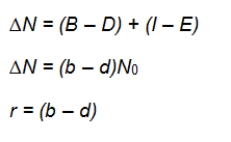 A starting population has 150 animals.During the year, 50 animals are born and 30 die.Ten animals immigrate into the population, and 5 emigrate.Which represents the change in population size at the end of the year?
 (Multiple Choice)
4.9/5 (89)
(89) Refer to the term shown.  How does this term affect the shape of the population growth curve when it is multiplied by the right side of the equation given below?

How does this term affect the shape of the population growth curve when it is multiplied by the right side of the equation given below? (Multiple Choice)
4.9/5 (86)
(86) In which environment would K-strategists most likely be favored over r-strategists?
(Multiple Choice)
4.7/5 (75)
(75) Which population of organisms would be most likely to show a Type I survivorship curve?
(Multiple Choice)
4.8/5 (89)
(89) A ship accidentally discharges a species of rat onto an island.At first, resources are abundant, and the rat population grows rapidly.But, as population density increases and resources become increasingly scarce, the population size approaches its environment's _______.
(Short Answer)
5.0/5 (70)
(70) A gardener decides to estimate the population of cabbage butterflies in her garden.She captures and marks 80 butterflies with a dot of red nail polish.She sets traps, and over the next three weeks captures 250 butterflies.Of these, 50 have red dots.What is the estimated population of cabbage butterflies in this garden?
(Multiple Choice)
4.9/5 (77)
(77) People concerned with calculating Social Security benefits would be most interested in which predictive life table calculation?
(Multiple Choice)
4.9/5 (75)
(75) Most humans live close together in cities, and the rest are scattered in small towns and rural areas.Overall, the human population could be said to have a(n) _______ dispersion pattern.
(Short Answer)
5.0/5 (81)
(81) Regarding its carrying capacity, a well-managed fish population should probably be maintained
(Multiple Choice)
4.9/5 (75)
(75) In a life table, the proportion of individuals in a cohort that are alive at age class x is the _______.
(Short Answer)
4.9/5 (91)
(91) In the graph below, which of the expressions of the exponential growth equation would need to be increased for curve 1 to become more like curve 2? 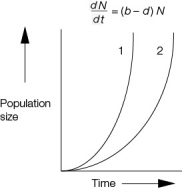
(Multiple Choice)
4.7/5 (67)
(67) The mark-recapture method of estimating population size is most appropriate for use in populations that are
(Multiple Choice)
4.9/5 (75)
(75) Refer to the table below, which shows hypothetical data for a cohort of robins. 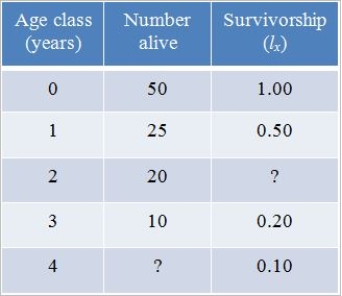 What is the survivorship value for the age class of 2 years?
 (Multiple Choice)
4.9/5 (81)
(81) The average life span of the human population is steadily increasing and may reach 100 years long before the end of the twenty-first century.Much of this increase has been due to improvements in health care and nutrition.If, for some reason, these artificial methods of maintenance were no longer available, would the life span of the human population change? If so, how and why?
(Essay)
4.8/5 (86)
(86) Refer to the figure comparing exponential and logistic growth. 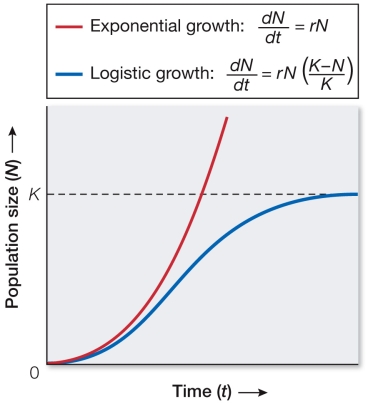 The extra term
 in the logistic equation takes into account which factor(s)?
The extra term in the logistic equation takes into account which factor(s)? (Multiple Choice)
4.7/5 (80)
(80) In the spring, each male redwing blackbird establishes a breeding territory and prevents other males in its population from entering.The distribution pattern of these male redwing blackbirds is
(Multiple Choice)
4.8/5 (79)
(79) 
Filters
- Essay(0)
- Multiple Choice(0)
- Short Answer(0)
- True False(0)
- Matching(0)