



 Chat with AI
Exam 29: The Evolution and Diversity of Fungi

Exam 1: Studying Life246 Questions
Exam 2: Small Molecules and the Chemistry of Life246 Questions
Exam 3: Proteins, Carbohydrates, and Lipids246 Questions
Exam 4: Nucleic Acids and the Origin of Life246 Questions
Exam 5: Cells: the Working Units of Life248 Questions
Exam 6: Cell Membranes246 Questions
Exam 7: Cell Communication and Multicellularity246 Questions
Exam 8: Energy, Enzymes, and Metabolism246 Questions
Exam 9: Pathways That Harvest Chemical Energy246 Questions
Exam 10: Photosynthesis: Energy From Sunlight242 Questions
Exam 11: The Cell Cycle and Cell Division260 Questions
Exam 12: Inheritance, Genes, and Chromosomes250 Questions
Exam 13: Dna and Its Role in Heredity257 Questions
Exam 14: From Dna to Protein: Gene Expression252 Questions
Exam 15: Gene Mutation and Molecular Medicine251 Questions
Exam 16: Regulation of Gene Expression245 Questions
Exam 17: Genomes249 Questions
Exam 18: Recombinant Dna and Biotechnology243 Questions
Exam 20: Mechanisms of Evolution243 Questions
Exam 21: Reconstructing and Using Phylogenies246 Questions
Exam 22: Speciation247 Questions
Exam 23: Evolution of Genes and Genomes252 Questions
Exam 24: The History of Life on Earth246 Questions
Exam 25: Bacteria, Archaea, and Viruses262 Questions
Exam 26: The Origin and Diversification of Eukaryotes252 Questions
Exam 27: Plants Without Seeds: From Water to Land251 Questions
Exam 28: The Evolution of Seed Plants259 Questions
Exam 29: The Evolution and Diversity of Fungi261 Questions
Exam 30: Animal Origins and the Evolution of Body Plans248 Questions
Exam 31: Protostome Animals244 Questions
Exam 32: Deuterostome Animals246 Questions
Exam 33: The Plant Body243 Questions
Exam 34: Transport in Plants248 Questions
Exam 35: Plant Nutrition247 Questions
Exam 36: Regulation of Plant Growth246 Questions
Exam 37: Reproduction in Flowering Plants247 Questions
Exam 38: Plant Responses to Environmental Challenges246 Questions
Exam 39: Physiology, Homeostasis, and Temperature Regulation258 Questions
Exam 40: Animal Hormones249 Questions
Exam 41: Immunology: Animal Defense Systems265 Questions
Exam 42: Animal Reproduction261 Questions
Exam 43: Animal Development261 Questions
Exam 44: Neurons, Glia, and Nervous Systems250 Questions
Exam 45: Sensory Systems249 Questions
Exam 46: The Mammalian Nervous System: Structure and Higher Functions254 Questions
Exam 47: Musculoskeletal Systems259 Questions
Exam 48: Gas Exchange247 Questions
Exam 49: Circulatory Systems252 Questions
Exam 50: Nutrition, Digestion, and Absorption259 Questions
Exam 51: Salt and Water Balance and Nitrogen Excretion251 Questions
Exam 52: Animal Behavior249 Questions
Exam 53: The Physical Environment and Biogeography of Life248 Questions
Exam 54: Populations259 Questions
Exam 55: Species Interactions254 Questions
Exam 56: Communities247 Questions
Exam 57: Ecosystems238 Questions
Exam 58: A Changing Biosphere222 Questions
Select questions type


Which event can never take place after plasmogamy but before karyogamy in fungal hyphae?

Free
(Multiple Choice)
4.9/5  (80)
(80) Correct Answer: Verified
B
Under the right conditions, _______ organize into a fruiting structure for reproduction.
Free
(Multiple Choice)
4.9/5 (78)
(78) Correct Answer:Verified
VerifiedB
If speed of nutrient uptake is directly proportional to surface area-to-volume ratio (S:V), then a fungal mycelium with an S:V of 4:1 will have nutrient uptake that is _______ as fast as one with an S:V of 8:1.
Free
(Short Answer)
4.9/5 (83)
(83) Correct Answer:Verified
Verifiedone-half
Which of the following is an important source of citric acid production for food preservation and flavor?
(Multiple Choice)
5.0/5 (71)
(71) Refer to the figure. 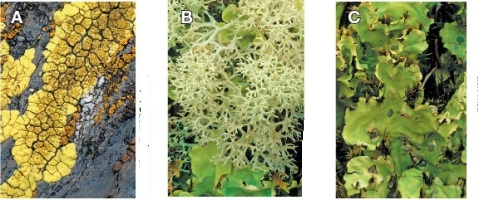 The figure shows three different types of lichen labeled A, B, and C.Which of these body forms would best suit a lichen contributing to new soil formation in rocky terrain; why?
 (Multiple Choice)
4.8/5 (83)
(83) _______ are found in terrestrial, marine, and freshwater habitats; their spores form inside a microscopic sac, and they include baker's, or brewer's, yeast.
(Multiple Choice)
4.8/5 (84)
(84) Lichens can reproduce asexually by fragmentation of the _______.
(Short Answer)
4.9/5 (83)
(83) Which of the following is not a source of carbon for saprobic fungi?
(Multiple Choice)
4.9/5 (83)
(83) Assume that one haploid nucleus of a fungus with a dikaryotic life cycle contains 16 chromosomes.At the ascospore stage, the fungus has _______ chromosomes.
(Multiple Choice)
4.8/5 (82)
(82) Six strains of the same bacterium are being grown together with Penicillium mold.One of the bacterial strains has grown up to the edge of the mold colony, while the other five have not.Which of the following is the best explanation for this difference?
(Multiple Choice)
4.7/5 (71)
(71) Refer to the figure, which shows the life cycle of Ascomycota fungi. 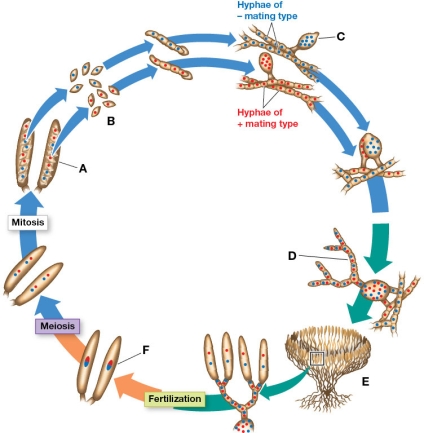 What is the dispersal stage of the fungus? Identify its label.
 (Short Answer)
4.9/5 (91)
(91) Which of the following are used as an air quality indicator because of their sensitivity to atmospheric pollutants?
(Multiple Choice)
4.8/5 (69)
(69) Assume that one haploid nucleus of a fungus with a dikaryotic life cycle contains 16 chromosomes.At the basidiospore stage, the fungus has _______ chromosomes.
(Multiple Choice)
4.9/5 (70)
(70) Compared with a mycelium with a surface area-to-volume ratio of 3:1, a mycelium with a surface area-to-volume ratio of 4:1 will
(Multiple Choice)
4.7/5 (87)
(87) Due to the absence of_______, scientists initially believed that microsporidia represented an early eukaryotic lineage that predated modern eukaryotes.
(Short Answer)
4.9/5 (77)
(77) Which of the following is likely to be associated with parasitic relationships between plants and fungi?
(Multiple Choice)
4.7/5 (63)
(63) One adaptation that fungi have for absorptive nutrition, in which nutrients are absorbed across the surfaces of their hyphae, is
(Multiple Choice)
4.9/5 (80)
(80) 
Filters
- Essay(0)
- Multiple Choice(0)
- Short Answer(0)
- True False(0)
- Matching(0)