



 Chat with AI
Exam 29: The Evolution and Diversity of Fungi

Exam 1: Studying Life246 Questions
Exam 2: Small Molecules and the Chemistry of Life246 Questions
Exam 3: Proteins, Carbohydrates, and Lipids246 Questions
Exam 4: Nucleic Acids and the Origin of Life246 Questions
Exam 5: Cells: the Working Units of Life248 Questions
Exam 6: Cell Membranes246 Questions
Exam 7: Cell Communication and Multicellularity246 Questions
Exam 8: Energy, Enzymes, and Metabolism246 Questions
Exam 9: Pathways That Harvest Chemical Energy246 Questions
Exam 10: Photosynthesis: Energy From Sunlight242 Questions
Exam 11: The Cell Cycle and Cell Division260 Questions
Exam 12: Inheritance, Genes, and Chromosomes250 Questions
Exam 13: Dna and Its Role in Heredity257 Questions
Exam 14: From Dna to Protein: Gene Expression252 Questions
Exam 15: Gene Mutation and Molecular Medicine251 Questions
Exam 16: Regulation of Gene Expression245 Questions
Exam 17: Genomes249 Questions
Exam 18: Recombinant Dna and Biotechnology243 Questions
Exam 20: Mechanisms of Evolution243 Questions
Exam 21: Reconstructing and Using Phylogenies246 Questions
Exam 22: Speciation247 Questions
Exam 23: Evolution of Genes and Genomes252 Questions
Exam 24: The History of Life on Earth246 Questions
Exam 25: Bacteria, Archaea, and Viruses262 Questions
Exam 26: The Origin and Diversification of Eukaryotes252 Questions
Exam 27: Plants Without Seeds: From Water to Land251 Questions
Exam 28: The Evolution of Seed Plants259 Questions
Exam 29: The Evolution and Diversity of Fungi261 Questions
Exam 30: Animal Origins and the Evolution of Body Plans248 Questions
Exam 31: Protostome Animals244 Questions
Exam 32: Deuterostome Animals246 Questions
Exam 33: The Plant Body243 Questions
Exam 34: Transport in Plants248 Questions
Exam 35: Plant Nutrition247 Questions
Exam 36: Regulation of Plant Growth246 Questions
Exam 37: Reproduction in Flowering Plants247 Questions
Exam 38: Plant Responses to Environmental Challenges246 Questions
Exam 39: Physiology, Homeostasis, and Temperature Regulation258 Questions
Exam 40: Animal Hormones249 Questions
Exam 41: Immunology: Animal Defense Systems265 Questions
Exam 42: Animal Reproduction261 Questions
Exam 43: Animal Development261 Questions
Exam 44: Neurons, Glia, and Nervous Systems250 Questions
Exam 45: Sensory Systems249 Questions
Exam 46: The Mammalian Nervous System: Structure and Higher Functions254 Questions
Exam 47: Musculoskeletal Systems259 Questions
Exam 48: Gas Exchange247 Questions
Exam 49: Circulatory Systems252 Questions
Exam 50: Nutrition, Digestion, and Absorption259 Questions
Exam 51: Salt and Water Balance and Nitrogen Excretion251 Questions
Exam 52: Animal Behavior249 Questions
Exam 53: The Physical Environment and Biogeography of Life248 Questions
Exam 54: Populations259 Questions
Exam 55: Species Interactions254 Questions
Exam 56: Communities247 Questions
Exam 57: Ecosystems238 Questions
Exam 58: A Changing Biosphere222 Questions
Select questions type


The primary biochemical component(s) of the fungal cell wall is/are
(Multiple Choice)
4.8/5  (61)
(61) Refer to the figure, which shows the phylogeny of the fungi. 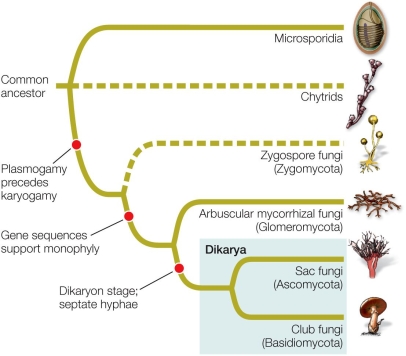 What is the fungal group to which the Ascomycota are least closely related?
 (Short Answer)
4.9/5 (74)
(74) Like other opisthokonts, some fungi have _______ flagellum/flagella in a(n) _______ position.
(Multiple Choice)
5.0/5 (69)
(69) A chytrid fungus produces gametes through the process of _______.
(Short Answer)
4.9/5 (71)
(71) The scientific term for the "mushroom" part of a club fungus is _______.
(Short Answer)
4.8/5 (85)
(85) Refer to the figure, which shows the anatomy of a lichen. 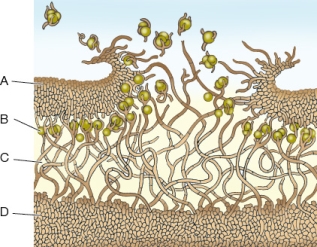 Which layer(s) of the lichen is/are capable of mineral absorption?
 (Short Answer)
4.8/5 (74)
(74) Which environment would most likely harbor diverse and prolific fungal populations?
(Multiple Choice)
4.9/5 (91)
(91) Lichens are vulnerable to air pollution because they are unable to excrete toxic substances.They may be prone to taking up these substances because of the
(Multiple Choice)
4.9/5 (88)
(88) Assume that one haploid nucleus of a fungus with a dikaryotic life cycle contains 16 chromosomes.At the zygote stage, the fungus has _______ chromosomes.
(Multiple Choice)
4.7/5 (78)
(78) You can be certain that an unknown organism is not a member of the Fungi if it
(Multiple Choice)
4.9/5 (91)
(91) Within lichens, fungal hyphae tightly press against their photosynthetic symbiont, sometimes breaching the cell wall to invade these cells and encourage the "leak" of photosynthetic products.Despite the effect fungi have on their photosynthetic counterparts, what evidence supports the claim that lichens are an example of mutualism?
(Multiple Choice)
4.8/5 (85)
(85) Refer to the figure, which shows a fungal interaction with a plant cell.  Which statement is an accurate description of this interaction?
 (Multiple Choice)
4.9/5 (81)
(81) The hyphae of a multicellular fungus are organized into profusely branching complexes called
(Multiple Choice)
4.9/5 (75)
(75) 
Filters
- Essay(0)
- Multiple Choice(0)
- Short Answer(0)
- True False(0)
- Matching(0)