



 Chat with AI
Exam 29: The Evolution and Diversity of Fungi

Exam 1: Studying Life246 Questions
Exam 2: Small Molecules and the Chemistry of Life246 Questions
Exam 3: Proteins, Carbohydrates, and Lipids246 Questions
Exam 4: Nucleic Acids and the Origin of Life246 Questions
Exam 5: Cells: the Working Units of Life248 Questions
Exam 6: Cell Membranes246 Questions
Exam 7: Cell Communication and Multicellularity246 Questions
Exam 8: Energy, Enzymes, and Metabolism246 Questions
Exam 9: Pathways That Harvest Chemical Energy246 Questions
Exam 10: Photosynthesis: Energy From Sunlight242 Questions
Exam 11: The Cell Cycle and Cell Division260 Questions
Exam 12: Inheritance, Genes, and Chromosomes250 Questions
Exam 13: Dna and Its Role in Heredity257 Questions
Exam 14: From Dna to Protein: Gene Expression252 Questions
Exam 15: Gene Mutation and Molecular Medicine251 Questions
Exam 16: Regulation of Gene Expression245 Questions
Exam 17: Genomes249 Questions
Exam 18: Recombinant Dna and Biotechnology243 Questions
Exam 20: Mechanisms of Evolution243 Questions
Exam 21: Reconstructing and Using Phylogenies246 Questions
Exam 22: Speciation247 Questions
Exam 23: Evolution of Genes and Genomes252 Questions
Exam 24: The History of Life on Earth246 Questions
Exam 25: Bacteria, Archaea, and Viruses262 Questions
Exam 26: The Origin and Diversification of Eukaryotes252 Questions
Exam 27: Plants Without Seeds: From Water to Land251 Questions
Exam 28: The Evolution of Seed Plants259 Questions
Exam 29: The Evolution and Diversity of Fungi261 Questions
Exam 30: Animal Origins and the Evolution of Body Plans248 Questions
Exam 31: Protostome Animals244 Questions
Exam 32: Deuterostome Animals246 Questions
Exam 33: The Plant Body243 Questions
Exam 34: Transport in Plants248 Questions
Exam 35: Plant Nutrition247 Questions
Exam 36: Regulation of Plant Growth246 Questions
Exam 37: Reproduction in Flowering Plants247 Questions
Exam 38: Plant Responses to Environmental Challenges246 Questions
Exam 39: Physiology, Homeostasis, and Temperature Regulation258 Questions
Exam 40: Animal Hormones249 Questions
Exam 41: Immunology: Animal Defense Systems265 Questions
Exam 42: Animal Reproduction261 Questions
Exam 43: Animal Development261 Questions
Exam 44: Neurons, Glia, and Nervous Systems250 Questions
Exam 45: Sensory Systems249 Questions
Exam 46: The Mammalian Nervous System: Structure and Higher Functions254 Questions
Exam 47: Musculoskeletal Systems259 Questions
Exam 48: Gas Exchange247 Questions
Exam 49: Circulatory Systems252 Questions
Exam 50: Nutrition, Digestion, and Absorption259 Questions
Exam 51: Salt and Water Balance and Nitrogen Excretion251 Questions
Exam 52: Animal Behavior249 Questions
Exam 53: The Physical Environment and Biogeography of Life248 Questions
Exam 54: Populations259 Questions
Exam 55: Species Interactions254 Questions
Exam 56: Communities247 Questions
Exam 57: Ecosystems238 Questions
Exam 58: A Changing Biosphere222 Questions
Select questions type


During times of limited food supply, how do most fungi respond? How is this beneficial to the fungus?
(Essay)
4.7/5  (89)
(89) Which is not a benefit of using lichen as an indicator of air quality over traditional methods?
(Multiple Choice)
4.9/5 (72)
(72) All of the following are directly involved with the fungal process in bread making except
(Multiple Choice)
4.8/5 (78)
(78) 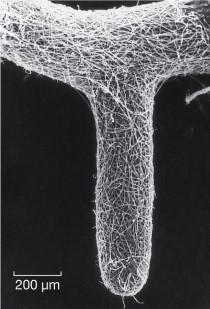 The figure shows
In Ascomycota, the ascospores are _______ and the hyphae are _______.When the hyphae of two different mating types fuse, a _______ results.
(Multiple Choice)
4.7/5 (78)
(78) The sister groups to the fungi are the _______ and the animals.
(Short Answer)
4.8/5 (80)
(80) Fusarium mold, a sac fungus, is of current research interest for
(Multiple Choice)
4.8/5 (76)
(76) Which of the following would be a likely indication of a mutualistic relationship between plants and fungi?
(Multiple Choice)
4.9/5 (76)
(76) _______ produce antibiotic chemicals that can be used to treat bacterial infections.
(Multiple Choice)
4.9/5 (71)
(71) Which of the following is not a feature that applies to all members of the Fungi?
(Multiple Choice)
4.8/5 (88)
(88) Refer to the figure. 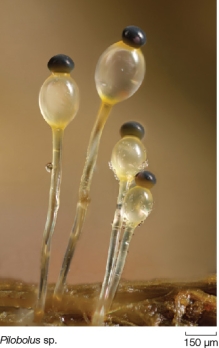 What is the name for the elongate structures?
 (Short Answer)
4.9/5 (90)
(90) Refer to the figure, which shows the anatomy of a lichen. 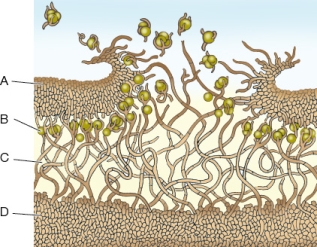 What is the name for the structures breaking free at the top of the lichen?
 (Short Answer)
4.9/5 (78)
(78) Why is it difficult to develop drugs that specifically target parasitic fungi in human hosts?
(Multiple Choice)
4.8/5 (71)
(71) Though members of the _______ fungi have a dikaryotic stage during their sexual life cycle, they do not belong to the Dikarya clade.
(Short Answer)
4.9/5 (79)
(79) 
Filters
- Essay(0)
- Multiple Choice(0)
- Short Answer(0)
- True False(0)
- Matching(0)