



 Chat with AI
Exam 29: The Evolution and Diversity of Fungi

Exam 1: Studying Life246 Questions
Exam 2: Small Molecules and the Chemistry of Life246 Questions
Exam 3: Proteins, Carbohydrates, and Lipids246 Questions
Exam 4: Nucleic Acids and the Origin of Life246 Questions
Exam 5: Cells: the Working Units of Life248 Questions
Exam 6: Cell Membranes246 Questions
Exam 7: Cell Communication and Multicellularity246 Questions
Exam 8: Energy, Enzymes, and Metabolism246 Questions
Exam 9: Pathways That Harvest Chemical Energy246 Questions
Exam 10: Photosynthesis: Energy From Sunlight242 Questions
Exam 11: The Cell Cycle and Cell Division260 Questions
Exam 12: Inheritance, Genes, and Chromosomes250 Questions
Exam 13: Dna and Its Role in Heredity257 Questions
Exam 14: From Dna to Protein: Gene Expression252 Questions
Exam 15: Gene Mutation and Molecular Medicine251 Questions
Exam 16: Regulation of Gene Expression245 Questions
Exam 17: Genomes249 Questions
Exam 18: Recombinant Dna and Biotechnology243 Questions
Exam 20: Mechanisms of Evolution243 Questions
Exam 21: Reconstructing and Using Phylogenies246 Questions
Exam 22: Speciation247 Questions
Exam 23: Evolution of Genes and Genomes252 Questions
Exam 24: The History of Life on Earth246 Questions
Exam 25: Bacteria, Archaea, and Viruses262 Questions
Exam 26: The Origin and Diversification of Eukaryotes252 Questions
Exam 27: Plants Without Seeds: From Water to Land251 Questions
Exam 28: The Evolution of Seed Plants259 Questions
Exam 29: The Evolution and Diversity of Fungi261 Questions
Exam 30: Animal Origins and the Evolution of Body Plans248 Questions
Exam 31: Protostome Animals244 Questions
Exam 32: Deuterostome Animals246 Questions
Exam 33: The Plant Body243 Questions
Exam 34: Transport in Plants248 Questions
Exam 35: Plant Nutrition247 Questions
Exam 36: Regulation of Plant Growth246 Questions
Exam 37: Reproduction in Flowering Plants247 Questions
Exam 38: Plant Responses to Environmental Challenges246 Questions
Exam 39: Physiology, Homeostasis, and Temperature Regulation258 Questions
Exam 40: Animal Hormones249 Questions
Exam 41: Immunology: Animal Defense Systems265 Questions
Exam 42: Animal Reproduction261 Questions
Exam 43: Animal Development261 Questions
Exam 44: Neurons, Glia, and Nervous Systems250 Questions
Exam 45: Sensory Systems249 Questions
Exam 46: The Mammalian Nervous System: Structure and Higher Functions254 Questions
Exam 47: Musculoskeletal Systems259 Questions
Exam 48: Gas Exchange247 Questions
Exam 49: Circulatory Systems252 Questions
Exam 50: Nutrition, Digestion, and Absorption259 Questions
Exam 51: Salt and Water Balance and Nitrogen Excretion251 Questions
Exam 52: Animal Behavior249 Questions
Exam 53: The Physical Environment and Biogeography of Life248 Questions
Exam 54: Populations259 Questions
Exam 55: Species Interactions254 Questions
Exam 56: Communities247 Questions
Exam 57: Ecosystems238 Questions
Exam 58: A Changing Biosphere222 Questions
Select questions type


Individual filaments that anchor chytrids and some other fungi to their substrate are called _______.
(Short Answer)
4.9/5  (91)
(91) Based on the features present in the chytrids, what is the most likely ancestral habitat of this fungal group?
(Multiple Choice)
5.0/5 (88)
(88) Which strategy would be most effective against a microsporidian parasite living within a lobster (crustacean) farm?
(Multiple Choice)
4.9/5 (72)
(72) Refer to the figure, which shows the phylogeny of the fungi. 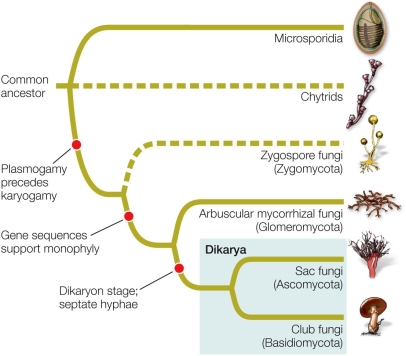 What are two synapomorphies that Basidiomycota do not share with the chytrids and microsporidia?
 (Short Answer)
4.8/5 (78)
(78) Microsporidia penetrate their host cell using a _______ through which they inject the contents of the spore.
(Short Answer)
4.7/5 (74)
(74) You and your roommate open a jar of jelly that has been sitting in the back of your refrigerator for months.Your roommate is surprised to see black mold growing around the mouth of the jar and says that the refrigerator should be too cold and the jelly too hypertonic to support bacterial growth.Explain to your roommate what kind of organism is growing in the jar and why it is able to do so.
(Essay)
4.7/5 (77)
(77) Individual filaments that anchor some chytrids to their substrate are called
(Multiple Choice)
4.9/5 (75)
(75) Which statement about fungal endophytes of grasses is false?
(Multiple Choice)
4.8/5 (76)
(76) Refer to the figure, which shows the anatomy of a lichen. 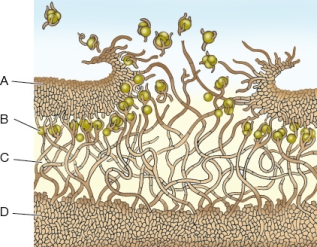 Which layer(s) of the lichen is/are photosynthetic?
 (Short Answer)
4.9/5 (94)
(94) If the solute concentration in the cytoplasm of a fungal hypha and a bacterial cell are equal, then an environmental solute concentration that is _______ would favor fungal growth over bacterial growth.
(Multiple Choice)
4.9/5 (81)
(81) During sexual reproduction in fungi, which structures are dikaryotic?
(Multiple Choice)
4.7/5 (75)
(75) Your instructor provides you with three different specimens (A, B, and C) of the same dikaryotic fungal species and asks you to determine whether or not they are the same mating type.Without the aid of DNA sequencing, design an experiment to answer your instructor's question.
(Essay)
4.9/5 (66)
(66) A sexually produced spore (n) that buds from the surface of a gilled fruiting body is called a
(Multiple Choice)
4.9/5 (76)
(76) 
Filters
- Essay(0)
- Multiple Choice(0)
- Short Answer(0)
- True False(0)
- Matching(0)