



 Chat with AI
Exam 15: Gene Mutation and Molecular Medicine

Exam 1: Studying Life246 Questions
Exam 2: Small Molecules and the Chemistry of Life246 Questions
Exam 3: Proteins, Carbohydrates, and Lipids246 Questions
Exam 4: Nucleic Acids and the Origin of Life246 Questions
Exam 5: Cells: the Working Units of Life248 Questions
Exam 6: Cell Membranes246 Questions
Exam 7: Cell Communication and Multicellularity246 Questions
Exam 8: Energy, Enzymes, and Metabolism246 Questions
Exam 9: Pathways That Harvest Chemical Energy246 Questions
Exam 10: Photosynthesis: Energy From Sunlight242 Questions
Exam 11: The Cell Cycle and Cell Division260 Questions
Exam 12: Inheritance, Genes, and Chromosomes250 Questions
Exam 13: Dna and Its Role in Heredity257 Questions
Exam 14: From Dna to Protein: Gene Expression252 Questions
Exam 15: Gene Mutation and Molecular Medicine251 Questions
Exam 16: Regulation of Gene Expression245 Questions
Exam 17: Genomes249 Questions
Exam 18: Recombinant Dna and Biotechnology243 Questions
Exam 20: Mechanisms of Evolution243 Questions
Exam 21: Reconstructing and Using Phylogenies246 Questions
Exam 22: Speciation247 Questions
Exam 23: Evolution of Genes and Genomes252 Questions
Exam 24: The History of Life on Earth246 Questions
Exam 25: Bacteria, Archaea, and Viruses262 Questions
Exam 26: The Origin and Diversification of Eukaryotes252 Questions
Exam 27: Plants Without Seeds: From Water to Land251 Questions
Exam 28: The Evolution of Seed Plants259 Questions
Exam 29: The Evolution and Diversity of Fungi261 Questions
Exam 30: Animal Origins and the Evolution of Body Plans248 Questions
Exam 31: Protostome Animals244 Questions
Exam 32: Deuterostome Animals246 Questions
Exam 33: The Plant Body243 Questions
Exam 34: Transport in Plants248 Questions
Exam 35: Plant Nutrition247 Questions
Exam 36: Regulation of Plant Growth246 Questions
Exam 37: Reproduction in Flowering Plants247 Questions
Exam 38: Plant Responses to Environmental Challenges246 Questions
Exam 39: Physiology, Homeostasis, and Temperature Regulation258 Questions
Exam 40: Animal Hormones249 Questions
Exam 41: Immunology: Animal Defense Systems265 Questions
Exam 42: Animal Reproduction261 Questions
Exam 43: Animal Development261 Questions
Exam 44: Neurons, Glia, and Nervous Systems250 Questions
Exam 45: Sensory Systems249 Questions
Exam 46: The Mammalian Nervous System: Structure and Higher Functions254 Questions
Exam 47: Musculoskeletal Systems259 Questions
Exam 48: Gas Exchange247 Questions
Exam 49: Circulatory Systems252 Questions
Exam 50: Nutrition, Digestion, and Absorption259 Questions
Exam 51: Salt and Water Balance and Nitrogen Excretion251 Questions
Exam 52: Animal Behavior249 Questions
Exam 53: The Physical Environment and Biogeography of Life248 Questions
Exam 54: Populations259 Questions
Exam 55: Species Interactions254 Questions
Exam 56: Communities247 Questions
Exam 57: Ecosystems238 Questions
Exam 58: A Changing Biosphere222 Questions
Select questions type


Refer to the table.  A bacterial cell has been exposed to a powerful mutagen.In the table shown, a sequence from this cell is compared with the same sequence from its ancestral cell.Intervening sequences where the ancestral and descendant cells have identical sequences are represented by dots.In the mutated cell there have been ________ transition(s) and _______ transversion(s).
Free
(Multiple Choice)
5.0/5  (80)
(80) Correct Answer: Verified
E
Which disease would be most difficult to detect with standard pedigree analysis?
Free
(Multiple Choice)
4.9/5 (71)
(71) Correct Answer:Verified
VerifiedA
Describe the expected effects of a somatic cell mutation that results in the loss of function of a tumor suppressor gene.
(Essay)
4.8/5 (73)
(73) Refer to the table.  A bacterial cell has been exposed to a powerful mutagen.The chromosomal sequences of the ancestral cell and the descendant cell are shown.(The ellipses represent intervening sequences that are identical.) The sequences show that there have been _______ transitions and 1 transversion.
 (Short Answer)
4.7/5 (78)
(78) Mutations that are not due to the presence or activity of a mutagen are referred to as _______ mutations.
(Multiple Choice)
4.8/5 (90)
(90) Which mutation requires that two homologous chromosomes break?
(Multiple Choice)
4.9/5 (91)
(91) To test an individual's genotype for the sickle-cell mutation, a _______ test would use a probe for normal hemoglobin and a probe for the sickle-cell mutation.
(Multiple Choice)
4.8/5 (91)
(91) Which mutation is least likely to be a frame-shift mutation?
(Multiple Choice)
4.9/5 (83)
(83) DNA sequencing reveals a base change in a gene, but there is no effect upon the functional activity of the encoded protein.This mutation can be considered a(n) _______ mutation.
(Multiple Choice)
4.9/5 (75)
(75) When a clinical _______ is identified that is linked to one gene, DNA analysis can identify the mutations in the gene that cause the abnormal protein function.
(Short Answer)
4.9/5 (77)
(77) Refer to the figure, which shows the genetic code. 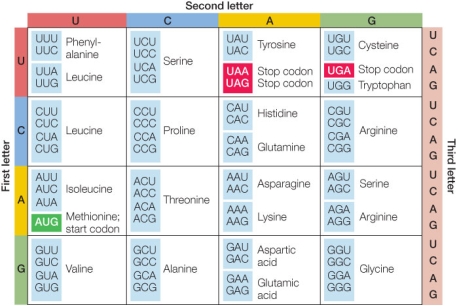 Determine which of the following changes would lead to a nonsense mutation.Note that the sequences offered as choices are from the nontemplate DNA strand.
 (Multiple Choice)
5.0/5 (82)
(82) Which type of variation would be most detectable by gel electrophoresis if the differences in the DNA were between two recognition sites for a restriction enzyme?
(Multiple Choice)
4.9/5 (83)
(83) Phenylketonuria (PKU) and Duchenne muscular dystrophy (DMD) are both molecular diseases that are caused by mutations in particular genes, yet PKU is easier to treat than muscular dystrophy.Why?
(Multiple Choice)
4.8/5 (91)
(91) For which type of mutation would you most expect the phenotypic effects of the affected alleles to become worse in successive generations?
(Multiple Choice)
4.7/5 (79)
(79) 
Filters
- Essay(0)
- Multiple Choice(0)
- Short Answer(0)
- True False(0)
- Matching(0)