



 Chat with AI
Exam 15: Gene Mutation and Molecular Medicine

Exam 1: Studying Life246 Questions
Exam 2: Small Molecules and the Chemistry of Life246 Questions
Exam 3: Proteins, Carbohydrates, and Lipids246 Questions
Exam 4: Nucleic Acids and the Origin of Life246 Questions
Exam 5: Cells: the Working Units of Life248 Questions
Exam 6: Cell Membranes246 Questions
Exam 7: Cell Communication and Multicellularity246 Questions
Exam 8: Energy, Enzymes, and Metabolism246 Questions
Exam 9: Pathways That Harvest Chemical Energy246 Questions
Exam 10: Photosynthesis: Energy From Sunlight242 Questions
Exam 11: The Cell Cycle and Cell Division260 Questions
Exam 12: Inheritance, Genes, and Chromosomes250 Questions
Exam 13: Dna and Its Role in Heredity257 Questions
Exam 14: From Dna to Protein: Gene Expression252 Questions
Exam 15: Gene Mutation and Molecular Medicine251 Questions
Exam 16: Regulation of Gene Expression245 Questions
Exam 17: Genomes249 Questions
Exam 18: Recombinant Dna and Biotechnology243 Questions
Exam 20: Mechanisms of Evolution243 Questions
Exam 21: Reconstructing and Using Phylogenies246 Questions
Exam 22: Speciation247 Questions
Exam 23: Evolution of Genes and Genomes252 Questions
Exam 24: The History of Life on Earth246 Questions
Exam 25: Bacteria, Archaea, and Viruses262 Questions
Exam 26: The Origin and Diversification of Eukaryotes252 Questions
Exam 27: Plants Without Seeds: From Water to Land251 Questions
Exam 28: The Evolution of Seed Plants259 Questions
Exam 29: The Evolution and Diversity of Fungi261 Questions
Exam 30: Animal Origins and the Evolution of Body Plans248 Questions
Exam 31: Protostome Animals244 Questions
Exam 32: Deuterostome Animals246 Questions
Exam 33: The Plant Body243 Questions
Exam 34: Transport in Plants248 Questions
Exam 35: Plant Nutrition247 Questions
Exam 36: Regulation of Plant Growth246 Questions
Exam 37: Reproduction in Flowering Plants247 Questions
Exam 38: Plant Responses to Environmental Challenges246 Questions
Exam 39: Physiology, Homeostasis, and Temperature Regulation258 Questions
Exam 40: Animal Hormones249 Questions
Exam 41: Immunology: Animal Defense Systems265 Questions
Exam 42: Animal Reproduction261 Questions
Exam 43: Animal Development261 Questions
Exam 44: Neurons, Glia, and Nervous Systems250 Questions
Exam 45: Sensory Systems249 Questions
Exam 46: The Mammalian Nervous System: Structure and Higher Functions254 Questions
Exam 47: Musculoskeletal Systems259 Questions
Exam 48: Gas Exchange247 Questions
Exam 49: Circulatory Systems252 Questions
Exam 50: Nutrition, Digestion, and Absorption259 Questions
Exam 51: Salt and Water Balance and Nitrogen Excretion251 Questions
Exam 52: Animal Behavior249 Questions
Exam 53: The Physical Environment and Biogeography of Life248 Questions
Exam 54: Populations259 Questions
Exam 55: Species Interactions254 Questions
Exam 56: Communities247 Questions
Exam 57: Ecosystems238 Questions
Exam 58: A Changing Biosphere222 Questions
Select questions type


Linkage analysis is a type of reverse genetics that makes use of family genetic histories, or _______.
(Short Answer)
4.9/5  (75)
(75) In families with the fragile-X chromosomal abnormality, males with a moderate number of triplet repeats are usually unaffected and are considered to be _______.
(Short Answer)
4.8/5 (72)
(72) Describe the expected effects of a somatic cell mutation that results in the gain of function of an oncogene.
(Essay)
4.9/5 (76)
(76) In _______ gene therapy, target cells are removed from the individual, given the new gene, and then reinserted into the individual.
(Short Answer)
4.7/5 (90)
(90) Refer to the figure. 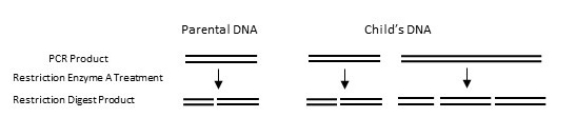 Through the use of linkage analysis, a researcher has identified a candidate gene responsible for a novel neurological disease.To obtain enough sample for DNA fingerprinting, the researcher uses PCR to amplify the gene.From the parent's DNA, PCR amplifies one band.From the child's DNA, the same size band plus a second larger band is amplified.Based on the published sequence of the gene, the researcher knows that restriction enzyme A will cut the wild-type allele into two fragments.The fragment sizes identified by DNA gel electrophoresis are shown in the figure.What technique should the researcher next use to identify the nature of the mutation with certainty?
 (Multiple Choice)
4.8/5 (79)
(79) The infection of cells by the human immunodeficiency virus (HIV) requires the virus to bind to the cell surface molecule CD3 and a second coreceptor molecule, CCR5 or CXCR4.In Scandinavian populations a mutation in CCR5 results in functional loss of CCR5 expression and exists at an allelic frequency of about 10 to 18 percent.Homozygous loss-of-function carriers are protected from infection by HIV strains that bind CCR5, and this mutation is also believed to have been protective against smallpox infection.This CCR5 mutation is evidence that mutations
(Multiple Choice)
4.9/5 (75)
(75) In the past, it was common for people with phenylketonuria (PKU) who were placed on a low-phenylalanine diet after birth to be allowed to return to a normal diet during their teenage years.Although the levels of phenylalanine in their blood were high, their brains were thought to be beyond the stage when they could be harmed.If a woman with PKU becomes pregnant, however, a problem arises.Typically, the fetus is heterozygous but is unable, at early stages of development, to metabolize the high levels of phenylalanine that arrive from the mother's blood.(a) Why is the fetus likely to be heterozygous? (b) What do you think would happen to the fetus during this "maternal PKU" situation? (c) What would be your advice to a woman with PKU who wants to have a child?
(Essay)
4.9/5 (77)
(77) The Epstein-Barr virus is commonly communicated, and more than 90 percent of individuals in the world are believed to be infected with it.The virus is linked to the development of Burkitt's lymphoma, a type of cancer of B lymphocytes.To induce cancer, the virus must function as a _______ when it integrates into the DNA of a B lymphocyte.
(Short Answer)
4.9/5 (95)
(95) Mutational "hot spots" often occur when a methyl group has been added to
(Multiple Choice)
4.9/5 (77)
(77) During the winter months at a farm in a warm climate, wild geese commonly feed on the peanuts, corn kernels, and grains that are scattered across the fields.During one unusually wet hunting season, some game hunters are alarmed to find that the livers of some of the harvested geese are abnormally lumpy.A veterinarian diagnoses the lumps as tumors, most likely the consequence of _______ poisoning through their ingestion of moldy peanuts.
(Multiple Choice)
4.7/5 (79)
(79) Refer to the figure. 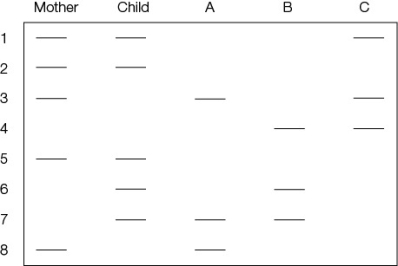 The figure shows a series of STRs (just for one locus) for a mother, a child, and three men who are all being considered as the possible biological father (A, B, and C).Suppose that, based on the data from this locus, only one of the three men could be ruled out as the father.What further testing would be performed to determine definitively who the father is?
 (Essay)
4.8/5 (93)
(93) Refer to the figure. 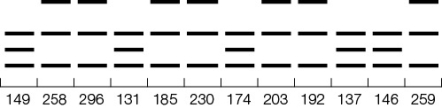 The figure shows the STR patterns at a hypothetical locus in a family in which some individuals develop high cholesterol.Immediately below the STR patterns are the cholesterol levels of each corresponding individual.What inferences can we draw from these results?
 (Essay)
4.9/5 (83)
(83) Because of the redundancy in the genetic code, many mutations in the coding regions of genes are
(Multiple Choice)
4.8/5 (81)
(81) In chronic myelogenous leukemia (CML), certain white blood cells undergo a gain-of-function mutation resulting in a totally new protein.This cancer-inducing protein has unregulated enzymatic activity that promotes cell division.Based on this information, which treatment option would be the best fit for CML?
(Multiple Choice)
4.8/5 (78)
(78) Which enzyme is used by bacteria as a defense against bacteriophage?
(Multiple Choice)
4.9/5 (86)
(86) Nitrites, a human-made preservative for meats, and aflatoxin, a natural product produced by the mold Aspergillus, are similar in that
(Multiple Choice)
4.8/5 (81)
(81) Prenatal screening is much more feasible today, in part because very few cells are needed.What technology has been most responsible for the reduction in the number of cells required?
(Multiple Choice)
4.9/5 (70)
(70) 
Filters
- Essay(0)
- Multiple Choice(0)
- Short Answer(0)
- True False(0)
- Matching(0)