



 Chat with AI
Exam 15: Gene Mutation and Molecular Medicine

Exam 1: Studying Life246 Questions
Exam 2: Small Molecules and the Chemistry of Life246 Questions
Exam 3: Proteins, Carbohydrates, and Lipids246 Questions
Exam 4: Nucleic Acids and the Origin of Life246 Questions
Exam 5: Cells: the Working Units of Life248 Questions
Exam 6: Cell Membranes246 Questions
Exam 7: Cell Communication and Multicellularity246 Questions
Exam 8: Energy, Enzymes, and Metabolism246 Questions
Exam 9: Pathways That Harvest Chemical Energy246 Questions
Exam 10: Photosynthesis: Energy From Sunlight242 Questions
Exam 11: The Cell Cycle and Cell Division260 Questions
Exam 12: Inheritance, Genes, and Chromosomes250 Questions
Exam 13: Dna and Its Role in Heredity257 Questions
Exam 14: From Dna to Protein: Gene Expression252 Questions
Exam 15: Gene Mutation and Molecular Medicine251 Questions
Exam 16: Regulation of Gene Expression245 Questions
Exam 17: Genomes249 Questions
Exam 18: Recombinant Dna and Biotechnology243 Questions
Exam 20: Mechanisms of Evolution243 Questions
Exam 21: Reconstructing and Using Phylogenies246 Questions
Exam 22: Speciation247 Questions
Exam 23: Evolution of Genes and Genomes252 Questions
Exam 24: The History of Life on Earth246 Questions
Exam 25: Bacteria, Archaea, and Viruses262 Questions
Exam 26: The Origin and Diversification of Eukaryotes252 Questions
Exam 27: Plants Without Seeds: From Water to Land251 Questions
Exam 28: The Evolution of Seed Plants259 Questions
Exam 29: The Evolution and Diversity of Fungi261 Questions
Exam 30: Animal Origins and the Evolution of Body Plans248 Questions
Exam 31: Protostome Animals244 Questions
Exam 32: Deuterostome Animals246 Questions
Exam 33: The Plant Body243 Questions
Exam 34: Transport in Plants248 Questions
Exam 35: Plant Nutrition247 Questions
Exam 36: Regulation of Plant Growth246 Questions
Exam 37: Reproduction in Flowering Plants247 Questions
Exam 38: Plant Responses to Environmental Challenges246 Questions
Exam 39: Physiology, Homeostasis, and Temperature Regulation258 Questions
Exam 40: Animal Hormones249 Questions
Exam 41: Immunology: Animal Defense Systems265 Questions
Exam 42: Animal Reproduction261 Questions
Exam 43: Animal Development261 Questions
Exam 44: Neurons, Glia, and Nervous Systems250 Questions
Exam 45: Sensory Systems249 Questions
Exam 46: The Mammalian Nervous System: Structure and Higher Functions254 Questions
Exam 47: Musculoskeletal Systems259 Questions
Exam 48: Gas Exchange247 Questions
Exam 49: Circulatory Systems252 Questions
Exam 50: Nutrition, Digestion, and Absorption259 Questions
Exam 51: Salt and Water Balance and Nitrogen Excretion251 Questions
Exam 52: Animal Behavior249 Questions
Exam 53: The Physical Environment and Biogeography of Life248 Questions
Exam 54: Populations259 Questions
Exam 55: Species Interactions254 Questions
Exam 56: Communities247 Questions
Exam 57: Ecosystems238 Questions
Exam 58: A Changing Biosphere222 Questions
Select questions type


The research area of molecular genetics is bolstered by DNA sequencing for all of the following reasons except
(Multiple Choice)
4.7/5  (87)
(87) Because DNA has a _______ charge, it moves to the _______ end of the field in gel electrophoresis.The _______ DNA molecules migrate the most quickly.
(Multiple Choice)
4.9/5 (88)
(88) Refer to the table.  Alkaptonuria is an inborn error of metabolism, caused by defects in an enzyme in the pathway that breaks down tyrosine (see Section 14.1).Humans who are homozygous for one of these mutations make nonfunctional enzyme and accumulate the enzyme's substrate, homogentisic acid, which causes their disease symptoms.In 1996, researchers in Spain cloned and sequenced the gene for the enzyme and characterized several mutant alleles.The table shows the wild-type coding strand sequence for part of the gene and the corresponding region from one of the mutant alleles.What type of mutation is this?
 (Multiple Choice)
4.8/5 (89)
(89) In gel electrophoresis, one can determine the relative abundance of a fragment (compared with other fragments of the same size) by
(Multiple Choice)
4.8/5 (66)
(66) A couple plans to have children.Since breast cancer has occurred on both sides of the family, they are concerned about their BRCA1 status and decide to have their genomes sequenced.With the guidance of a genetic counselor, they evaluate the results and are relieved to find that neither carries a BRCA1 allele associated with increased incidence of breast and ovarian cancer.However, they are upset to discover that they are both heterozygous for the gene that causes tissue-nonspecific alkaline phosphatase (TNSALP) deficiency, also known as hypophosphatasia.This disease affects osteoblasts and chondrocytes and results in impaired bone mineralization.One of the prospective parents carries a mutation associated with the severe form, which results in fatality not long after birth.Which test could ensure that the mother does not become pregnant with a fetus homozygous for hypophosphatasia?
(Multiple Choice)
4.8/5 (75)
(75) Sequencing of a child's genomic DNA reveals that the child is a heterozygote for a new mutation.This mutation appears in all of the cells tested from a variety of tissues (including skin, blood, and hair).The mutation is not found in either the mother or the father.Most likely, this is a new _______ mutation that occurred in _______.
(Multiple Choice)
4.8/5 (73)
(73) Refer to the chart of the genetic code. 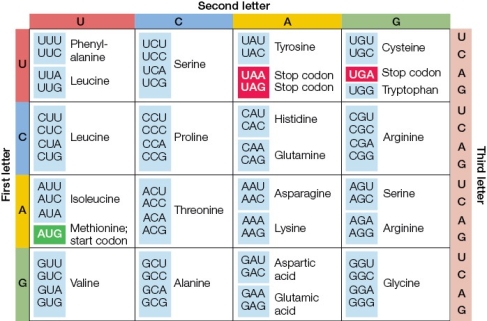 Given the codon CUU, would any mutations in the first position result in a missense mutation? Explain.If there would be any changes, name them.
 (Essay)
4.8/5 (76)
(76) Which mutation will be least likely to alter the function of a protein?
(Multiple Choice)
4.9/5 (88)
(88) Refer to the figure. 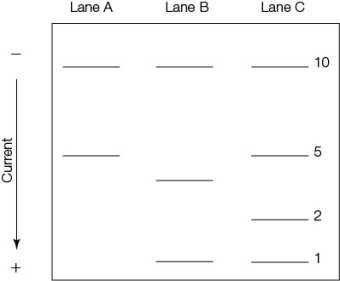 Would the above information be sufficient for determining what would happen if the DNA fragment was cut with both enzymes? Explain.
 (Essay)
4.8/5 (79)
(79) DNA is _______ charged due to the presence of _______ groups.
(Multiple Choice)
4.8/5 (75)
(75) When can variation at SNPs be detected using standard gel electrophoresis?
(Multiple Choice)
4.9/5 (85)
(85) In a DNA electrophoresis procedure, a geneticist will most likely use a longer-than-usual gel matrix and allow the procedure to proceed for a longer length of time than usual when
(Multiple Choice)
4.8/5 (80)
(80) Lofenelac, the milk-based product given to children with PKU, is
(Multiple Choice)
4.9/5 (85)
(85) Which therapy is not used to treat disease in humans, because of ethical considerations?
(Multiple Choice)
4.8/5 (64)
(64) 
Filters
- Essay(0)
- Multiple Choice(0)
- Short Answer(0)
- True False(0)
- Matching(0)