



 Chat with AI
Exam 15: Gene Mutation and Molecular Medicine

Exam 1: Studying Life246 Questions
Exam 2: Small Molecules and the Chemistry of Life246 Questions
Exam 3: Proteins, Carbohydrates, and Lipids246 Questions
Exam 4: Nucleic Acids and the Origin of Life246 Questions
Exam 5: Cells: the Working Units of Life248 Questions
Exam 6: Cell Membranes246 Questions
Exam 7: Cell Communication and Multicellularity246 Questions
Exam 8: Energy, Enzymes, and Metabolism246 Questions
Exam 9: Pathways That Harvest Chemical Energy246 Questions
Exam 10: Photosynthesis: Energy From Sunlight242 Questions
Exam 11: The Cell Cycle and Cell Division260 Questions
Exam 12: Inheritance, Genes, and Chromosomes250 Questions
Exam 13: Dna and Its Role in Heredity257 Questions
Exam 14: From Dna to Protein: Gene Expression252 Questions
Exam 15: Gene Mutation and Molecular Medicine251 Questions
Exam 16: Regulation of Gene Expression245 Questions
Exam 17: Genomes249 Questions
Exam 18: Recombinant Dna and Biotechnology243 Questions
Exam 20: Mechanisms of Evolution243 Questions
Exam 21: Reconstructing and Using Phylogenies246 Questions
Exam 22: Speciation247 Questions
Exam 23: Evolution of Genes and Genomes252 Questions
Exam 24: The History of Life on Earth246 Questions
Exam 25: Bacteria, Archaea, and Viruses262 Questions
Exam 26: The Origin and Diversification of Eukaryotes252 Questions
Exam 27: Plants Without Seeds: From Water to Land251 Questions
Exam 28: The Evolution of Seed Plants259 Questions
Exam 29: The Evolution and Diversity of Fungi261 Questions
Exam 30: Animal Origins and the Evolution of Body Plans248 Questions
Exam 31: Protostome Animals244 Questions
Exam 32: Deuterostome Animals246 Questions
Exam 33: The Plant Body243 Questions
Exam 34: Transport in Plants248 Questions
Exam 35: Plant Nutrition247 Questions
Exam 36: Regulation of Plant Growth246 Questions
Exam 37: Reproduction in Flowering Plants247 Questions
Exam 38: Plant Responses to Environmental Challenges246 Questions
Exam 39: Physiology, Homeostasis, and Temperature Regulation258 Questions
Exam 40: Animal Hormones249 Questions
Exam 41: Immunology: Animal Defense Systems265 Questions
Exam 42: Animal Reproduction261 Questions
Exam 43: Animal Development261 Questions
Exam 44: Neurons, Glia, and Nervous Systems250 Questions
Exam 45: Sensory Systems249 Questions
Exam 46: The Mammalian Nervous System: Structure and Higher Functions254 Questions
Exam 47: Musculoskeletal Systems259 Questions
Exam 48: Gas Exchange247 Questions
Exam 49: Circulatory Systems252 Questions
Exam 50: Nutrition, Digestion, and Absorption259 Questions
Exam 51: Salt and Water Balance and Nitrogen Excretion251 Questions
Exam 52: Animal Behavior249 Questions
Exam 53: The Physical Environment and Biogeography of Life248 Questions
Exam 54: Populations259 Questions
Exam 55: Species Interactions254 Questions
Exam 56: Communities247 Questions
Exam 57: Ecosystems238 Questions
Exam 58: A Changing Biosphere222 Questions
Select questions type


Suppose that a mutation appears in a small population of plants that changes the color of their seeds from yellow to green.This mutation reaches 100 percent frequency in the population.Many generations later, some individuals with yellow seeds are found.We can definitely say that these individuals have acquired a(n)
(Multiple Choice)
4.9/5  (76)
(76) A restriction enzyme cuts a 25,700 bp segment of DNA into three fragments: fragment A is 5,800 bp; fragment B is 6,600 bp; and fragment C is _______ bp.Fragment _______ will move the farthest in an electrophoresis gel.
(Multiple Choice)
4.8/5 (78)
(78) _______ disease is caused by a single base substitution that changes one amino acid in a polypeptide.Phenotypic effects in homozygous individuals include defective, misshapen red blood cells.
(Short Answer)
4.9/5 (71)
(71) Refer to the figure. 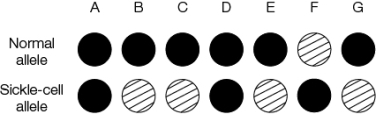 The figure presents the data from individuals who have been tested for sickle-cell anemia using allele-specific oligonucleotide hybridization.The solid circles represent hybridization; the lined circles represent lack of hybridization.Which individuals have sickle-cell anemia?
 (Short Answer)
4.9/5 (69)
(69) In wild type Drosophila melanogaster, the order of genes on a chromosome is yellow, vermillion, forked, and Bobbed.Some of the flies have a different gene order: yellow, Bobbed, forked, and vermillion.The flies with the altered gene order most likely have a
(Multiple Choice)
4.8/5 (78)
(78) Children born with two nonfunctional RB genes will develop retinoblastoma, a retinal tumor.The mutations that result in nonfunctional RB protein include the following types of mutations.Which mutation represents a SNP in the coding sequence of the gene?
(Multiple Choice)
4.8/5 (74)
(74) The phenotypic effects of Duchenne muscle dystrophy vary considerably.This variation is explained largely by
(Multiple Choice)
4.7/5 (83)
(83) A restriction enzyme cuts an 18,500 bp segment of DNA into three fragments.Fragment A is 4,400 bp and fragment B is 7,600 bp.Fragment C must be _______ bp.
(Short Answer)
4.8/5 (75)
(75) A researcher studying multi-coloration of Zea mays (maize) kernels compares the genomes of kernels that are red with those of kernels that are purple on the same corncob.The researcher examines the gene Zmf3′h1, whose functional expression results in red color instead of purple color.In the purple kernels, there is an insertion a few hundred base pairs long within this gene.When the researcher repeats this analysis of purple kernels on other corncobs, she sees the same phenomenon.However, the insertions occur at different points within the Zmf3′h1 gene.What genetic phenomenon has the researcher most likely found evidence of?
(Multiple Choice)
4.8/5 (73)
(73) One parent is heterozygous for a certain known disease and is unaffected.The other parent is homozygous normal.Under which circumstance would DNA testing be of value for their newborn son to ensure he does not suffer complications due to the disease?
(Multiple Choice)
4.8/5 (85)
(85) The isoenzyme hexosaminidase A (HEXA) is composed of subunits α and β and breaks down molecules containing terminal N-acetyl hexosamines.Tay-Sachs disease is caused by a recessively inherited loss-of-function mutation in the gene coding for the α subunit, which is the subunit that hydrolyzes the lipid GM2 ganglioside.Accumulation of this lipid in the brain leads to progressive deterioration of the nervous system and death, usually by age 4.The most common mutation in the HEXA gene is an insertion of four base pairs in exon 11 that creates a nonfunctional truncated protein.HEXA activity is 0 to 6 percent in homozygous recessives and 7 to 35 percent in heterozygous carriers, compared with noncarriers (100 percent).What evidence presented here strongly suggests that this truncated α subunit can still associate with the normal β subunit, thereby inhibiting its association with functional α subunit?
(Multiple Choice)
4.8/5 (87)
(87) An insertion of _______ nucleotides would not cause a frame-shift mutation.
(Multiple Choice)
4.9/5 (91)
(91) Which disease is caused by interactions of multiple genes and the environment?
(Multiple Choice)
4.9/5 (85)
(85) Adenosine deaminase (ADA) deficiency is a severe form of immunodeficiency that is usually fatal because of the greatly diminished ability of homozygous individuals to fight off bacterial and viral infections.The enzyme is necessary for the removal of the toxic metabolic product deoxyadenosine that is produced in T and B lymphocytes.Both T and B lymphocytes are produced by bone marrow stem cells, which can be harvested from patients.To restore T and B lymphocytes, a few children have been successfully treated for ADA with gene therapy, which would have been _______ gene therapy, given the above information.
(Multiple Choice)
4.8/5 (71)
(71) 
Filters
- Essay(0)
- Multiple Choice(0)
- Short Answer(0)
- True False(0)
- Matching(0)