



 Chat with AI
Exam 15: Gene Mutation and Molecular Medicine

Exam 1: Studying Life246 Questions
Exam 2: Small Molecules and the Chemistry of Life246 Questions
Exam 3: Proteins, Carbohydrates, and Lipids246 Questions
Exam 4: Nucleic Acids and the Origin of Life246 Questions
Exam 5: Cells: the Working Units of Life248 Questions
Exam 6: Cell Membranes246 Questions
Exam 7: Cell Communication and Multicellularity246 Questions
Exam 8: Energy, Enzymes, and Metabolism246 Questions
Exam 9: Pathways That Harvest Chemical Energy246 Questions
Exam 10: Photosynthesis: Energy From Sunlight242 Questions
Exam 11: The Cell Cycle and Cell Division260 Questions
Exam 12: Inheritance, Genes, and Chromosomes250 Questions
Exam 13: Dna and Its Role in Heredity257 Questions
Exam 14: From Dna to Protein: Gene Expression252 Questions
Exam 15: Gene Mutation and Molecular Medicine251 Questions
Exam 16: Regulation of Gene Expression245 Questions
Exam 17: Genomes249 Questions
Exam 18: Recombinant Dna and Biotechnology243 Questions
Exam 20: Mechanisms of Evolution243 Questions
Exam 21: Reconstructing and Using Phylogenies246 Questions
Exam 22: Speciation247 Questions
Exam 23: Evolution of Genes and Genomes252 Questions
Exam 24: The History of Life on Earth246 Questions
Exam 25: Bacteria, Archaea, and Viruses262 Questions
Exam 26: The Origin and Diversification of Eukaryotes252 Questions
Exam 27: Plants Without Seeds: From Water to Land251 Questions
Exam 28: The Evolution of Seed Plants259 Questions
Exam 29: The Evolution and Diversity of Fungi261 Questions
Exam 30: Animal Origins and the Evolution of Body Plans248 Questions
Exam 31: Protostome Animals244 Questions
Exam 32: Deuterostome Animals246 Questions
Exam 33: The Plant Body243 Questions
Exam 34: Transport in Plants248 Questions
Exam 35: Plant Nutrition247 Questions
Exam 36: Regulation of Plant Growth246 Questions
Exam 37: Reproduction in Flowering Plants247 Questions
Exam 38: Plant Responses to Environmental Challenges246 Questions
Exam 39: Physiology, Homeostasis, and Temperature Regulation258 Questions
Exam 40: Animal Hormones249 Questions
Exam 41: Immunology: Animal Defense Systems265 Questions
Exam 42: Animal Reproduction261 Questions
Exam 43: Animal Development261 Questions
Exam 44: Neurons, Glia, and Nervous Systems250 Questions
Exam 45: Sensory Systems249 Questions
Exam 46: The Mammalian Nervous System: Structure and Higher Functions254 Questions
Exam 47: Musculoskeletal Systems259 Questions
Exam 48: Gas Exchange247 Questions
Exam 49: Circulatory Systems252 Questions
Exam 50: Nutrition, Digestion, and Absorption259 Questions
Exam 51: Salt and Water Balance and Nitrogen Excretion251 Questions
Exam 52: Animal Behavior249 Questions
Exam 53: The Physical Environment and Biogeography of Life248 Questions
Exam 54: Populations259 Questions
Exam 55: Species Interactions254 Questions
Exam 56: Communities247 Questions
Exam 57: Ecosystems238 Questions
Exam 58: A Changing Biosphere222 Questions
Select questions type


Refer to the figure. 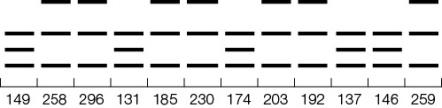 The figure shows STR patterns at a hypothetical locus in a family in which some individuals develop high cholesterol.Immediately below the STR patterns are the cholesterol levels of each corresponding individual.Do the patterns in the figure prove that the STR locus has a causal role in cholesterol levels? Explain.
 (Short Answer)
4.8/5  (74)
(74) Treating a disease by supplying a missing protein is an example of modifying the _______; somatic cell gene therapy is an example of modifying _______.
(Multiple Choice)
4.7/5 (93)
(93) Drosophila melanogaster flies that have the Shaker mutation appear normal at room temperature.If you hold a vial of flies with this mutation for a few minutes (i.e., warm the vial to body temperature, or 37oC), the flies become uncoordinated because of the warmth of your hand.If you remove your hand, the flies soon recover.Based on this information, which statement about the Shaker mutation must be true?
(Multiple Choice)
4.8/5 (89)
(89) Bacteria add _______ to their DNA to protect it from their own restriction enzymes.
(Multiple Choice)
4.8/5 (76)
(76) Refer to the figure. 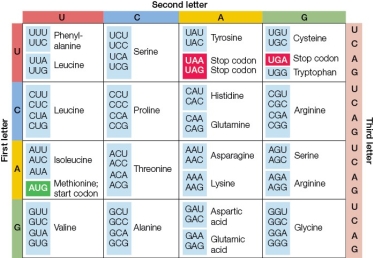 The restriction enzyme EcoR1 recognizes the palindromic sequence of GAATTC.You know the sequence of a protein but not the DNA sequence.You would like to have an idea about where in the gene there could be EcoR1 active sites.Which two consecutive amino acids could have nucleotide codons that would generate an EcoR1 active site in the DNA sequence?
 (Multiple Choice)
4.9/5 (81)
(81) In a gel electrophoresis experiment, researchers notice that one DNA band on the gel appears much darker than the others.The DNA fragment forming the band is most likely _______ than the others.
(Multiple Choice)
4.8/5 (92)
(92) Which statement regarding short tandem repeats (STRs) is false?
(Multiple Choice)
4.9/5 (70)
(70) Parkinson's disease is associated with too little production of GABA.Which therapy would be most appropriate to treat this disorder in an adult?
(Multiple Choice)
4.8/5 (89)
(89) Mutations that exhibit the altered phenotype under certain restrictive conditions are referred to as _______ mutations.
(Short Answer)
4.9/5 (85)
(85) Restricting the substrate would most likely be an effective treatment in cases when
(Multiple Choice)
4.9/5 (85)
(85) The first three nucleotides of one strand of a six-base palindromic restriction site are 5ʹ…AGC.Thus the next three nucleotides should be _______ (show orientation).
(Short Answer)
4.8/5 (87)
(87) Analysis of the abnormal white blood cells of a patient with leukemia, a type of cancer, reveals that a protein, termed LP, is always functionally active.In normal white blood cells this protein is found to be only functionally active in response to growth stimuli that induce cell division.Surprisingly, sequencing of leukemic cell DNA shows that both LP alleles in the patient's leukemic cells are normal.However, the DNA sequencing also reveals that both alleles of protein ILP, which normally inhibits LP activity in the absence of growth stimuli, have each acquired a mutation.Further research proves that these _______ mutations in both ILP alleles are the reason why LP is always active and, consequently, induces the leukemic cells to constantly undergo cell division.
(Multiple Choice)
4.9/5 (86)
(86) A baby is failing to thrive and has urine with an abnormal odor.Analysis of the baby's urine reveals that it contains amino acids not normally excreted in urine.The urinalysis results and poor health of the baby strongly suggest that the baby has a _______ disease.
(Short Answer)
4.9/5 (74)
(74) In a gel electrophoresis experiment, researchers notice that one band has migrated much farther on the gel than the others.They conclude that it is _______ than the others.
(Multiple Choice)
4.9/5 (83)
(83) A restriction enzyme cuts a 23,500 bp segment of DNA into three fragments.Fragment A is 7,800 bp, and fragment B is 10,600 bp.How long is fragment C, and which of the fragments will move the farthest in an electrophoresis gel?
(Multiple Choice)
4.8/5 (69)
(69) Which of the following treatments involves restricting the substrate?
(Multiple Choice)
4.7/5 (68)
(68) 
Filters
- Essay(0)
- Multiple Choice(0)
- Short Answer(0)
- True False(0)
- Matching(0)