



 Chat with AI
Exam 15: Gene Mutation and Molecular Medicine

Exam 1: Studying Life246 Questions
Exam 2: Small Molecules and the Chemistry of Life246 Questions
Exam 3: Proteins, Carbohydrates, and Lipids246 Questions
Exam 4: Nucleic Acids and the Origin of Life246 Questions
Exam 5: Cells: the Working Units of Life248 Questions
Exam 6: Cell Membranes246 Questions
Exam 7: Cell Communication and Multicellularity246 Questions
Exam 8: Energy, Enzymes, and Metabolism246 Questions
Exam 9: Pathways That Harvest Chemical Energy246 Questions
Exam 10: Photosynthesis: Energy From Sunlight242 Questions
Exam 11: The Cell Cycle and Cell Division260 Questions
Exam 12: Inheritance, Genes, and Chromosomes250 Questions
Exam 13: Dna and Its Role in Heredity257 Questions
Exam 14: From Dna to Protein: Gene Expression252 Questions
Exam 15: Gene Mutation and Molecular Medicine251 Questions
Exam 16: Regulation of Gene Expression245 Questions
Exam 17: Genomes249 Questions
Exam 18: Recombinant Dna and Biotechnology243 Questions
Exam 20: Mechanisms of Evolution243 Questions
Exam 21: Reconstructing and Using Phylogenies246 Questions
Exam 22: Speciation247 Questions
Exam 23: Evolution of Genes and Genomes252 Questions
Exam 24: The History of Life on Earth246 Questions
Exam 25: Bacteria, Archaea, and Viruses262 Questions
Exam 26: The Origin and Diversification of Eukaryotes252 Questions
Exam 27: Plants Without Seeds: From Water to Land251 Questions
Exam 28: The Evolution of Seed Plants259 Questions
Exam 29: The Evolution and Diversity of Fungi261 Questions
Exam 30: Animal Origins and the Evolution of Body Plans248 Questions
Exam 31: Protostome Animals244 Questions
Exam 32: Deuterostome Animals246 Questions
Exam 33: The Plant Body243 Questions
Exam 34: Transport in Plants248 Questions
Exam 35: Plant Nutrition247 Questions
Exam 36: Regulation of Plant Growth246 Questions
Exam 37: Reproduction in Flowering Plants247 Questions
Exam 38: Plant Responses to Environmental Challenges246 Questions
Exam 39: Physiology, Homeostasis, and Temperature Regulation258 Questions
Exam 40: Animal Hormones249 Questions
Exam 41: Immunology: Animal Defense Systems265 Questions
Exam 42: Animal Reproduction261 Questions
Exam 43: Animal Development261 Questions
Exam 44: Neurons, Glia, and Nervous Systems250 Questions
Exam 45: Sensory Systems249 Questions
Exam 46: The Mammalian Nervous System: Structure and Higher Functions254 Questions
Exam 47: Musculoskeletal Systems259 Questions
Exam 48: Gas Exchange247 Questions
Exam 49: Circulatory Systems252 Questions
Exam 50: Nutrition, Digestion, and Absorption259 Questions
Exam 51: Salt and Water Balance and Nitrogen Excretion251 Questions
Exam 52: Animal Behavior249 Questions
Exam 53: The Physical Environment and Biogeography of Life248 Questions
Exam 54: Populations259 Questions
Exam 55: Species Interactions254 Questions
Exam 56: Communities247 Questions
Exam 57: Ecosystems238 Questions
Exam 58: A Changing Biosphere222 Questions
Select questions type


In an experiment a culture of bacteria is plated onto six agarose plates with nutrients that support their growth.One set of three plates are exposed to visible light, and the second set of three plates are exposed to ultraviolet radiation.This experiment is appropriate for studying the effect of _______ on DNA replication.
(Multiple Choice)
4.9/5  (78)
(78) Which chromosomal mutation would allow protein X to remain functional?
(Multiple Choice)
4.7/5 (82)
(82) Which type of mutation involves two different nonhomologous chromosomes?
(Multiple Choice)
4.8/5 (76)
(76) Suppose one restriction enzyme (enzyme A, which targets a given sequence) makes one cut in a linear DNA fragment, and another restriction enzyme (enzyme B, which targets another distinct sequence) makes another cut in that same DNA.The cuts are not in the same place, and no two cut fragments are exactly the same size.The restriction digest is set up on an electrophoresis gel.How many bands should appear on the gel if both enzymes, A and B, are used in the restriction digest?
(Multiple Choice)
4.9/5 (77)
(77) DNA analysis with _______ such as SNPs and STRs can be used to answer questions related to the diversity of life.
(Short Answer)
4.9/5 (81)
(81) Suppose restriction enzyme A makes two cuts in a linear DNA fragment and restriction enzyme B makes one cut in that same DNA.The cuts are not in the same place, and no two of the cut fragments is exactly the same size.The digested samples are run in an electrophoresis gel.How many bands should the gel pick up if only enzyme A is used in the restriction digest?
(Multiple Choice)
4.8/5 (81)
(81) The wrinkled seed allele in pea plants (one of Mendel's traits) is due to a _______ mutation and is _______.
(Multiple Choice)
4.9/5 (69)
(69) DNA _______ combines PCR with restriction analysis and electrophoresis.
(Short Answer)
4.7/5 (73)
(73) Erythropoietin is a growth factor important for the generation of red blood cells (RBCs).In the bone marrow, the cells that will differentiate and proliferate to produce RBCs express a cell surface receptor that is activated by erythropoietin (EpoR).Eero Antero Mäntyranta from Finland was an Olympic skier who was accused of "blood doping" when drug testing revealed that he had abnormally high numbers of RBCs.However, this was a known condition in his family for many generations.A researcher who was studying this family trait discovered that the phenotype was the result of a deletion mutation in the EPOR gene.Mutant EpoR could not be negatively regulated, which resulted in increased production of RBCs.When it comes to competing in competitive sports, this EPOR _______ mutation has proven _______.
(Multiple Choice)
4.9/5 (85)
(85) Refer to the figure. 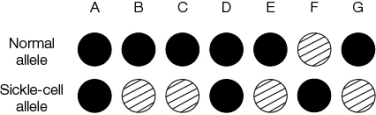 The figure presents the data from individuals who have been tested for sickle-cell anemia using allele-specific oligonucleotide hybridization.The solid circles represent hybridization; the lined circles represent lack of hybridization.Which individuals are carriers for sickle-cell anemia?
 (Short Answer)
4.7/5 (82)
(82) Which DNA sequence would most likely be recognized by a restriction enzyme? (Note: Only the coding strand is shown.)
(Multiple Choice)
4.9/5 (72)
(72) The functional activity of the KRAS protein promotes cell proliferation and is often mutated in leukemia (cancer of a type of blood cell).In a B cell leukemia, a clinical researcher identifies a G → A transition at the second base of codon 12, resulting in a glycine → aspartic acid substitution in the protein.In normal cells, KRAS protein function can be activated and suppressed by the activity of other proteins.In contrast, in the leukemic cells, KRAS protein function is resistant to suppression.This is an example of a _______ mutation generating a_______-of-function mutation.
(Multiple Choice)
4.9/5 (87)
(87) Which statement is not one of the reasons that STRs can be used for DNA fingerprinting?
(Multiple Choice)
4.8/5 (83)
(83) A retrovirus inserts DNA into a mammalian egg.This DNA is incorporated into the egg's genome and is transmitted to subsequent generations.The viral DNA is now said to be
(Multiple Choice)
4.9/5 (84)
(84) Suppose that in one cell in your skin, chromosome 14 and chromosome 18 exchange genetic materials.This change is inherited by subsequent cells.This is an example of a _______ mutation that is also a(n) _______.
(Multiple Choice)
4.9/5 (88)
(88) One son of Great Britain's Queen Victoria was born with the X-linked disease hemophilia, and two of her daughters were carriers, as some of their male children were born with hemophilia.King Albert did not have hemophilia, nor did any of Queen Victoria's relatives on her mother's side.Based on this information, the hemophilia mutation most likely originated
(Multiple Choice)
4.8/5 (74)
(74) Refer to the figure. 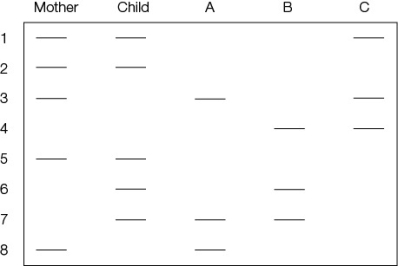 The figure shows a series of STRs (just for one locus) for a mother, a child, and three men who are all being considered as the possible biological father (A, B, and C).Which bands are shared between the mother and child?
 (Short Answer)
4.7/5 (75)
(75) A mutation in genetic material that occurs without any outside influence is known as a _______ mutation.
(Short Answer)
4.8/5 (93)
(93) 
Filters
- Essay(0)
- Multiple Choice(0)
- Short Answer(0)
- True False(0)
- Matching(0)